
How to Plan a Seattle Trip That Works in Wet, Gray Weather
Expect cool, gray, frequently wet weather; pack for damp streets, plan one neighborhood anchor per day, and keep an indoor backup.
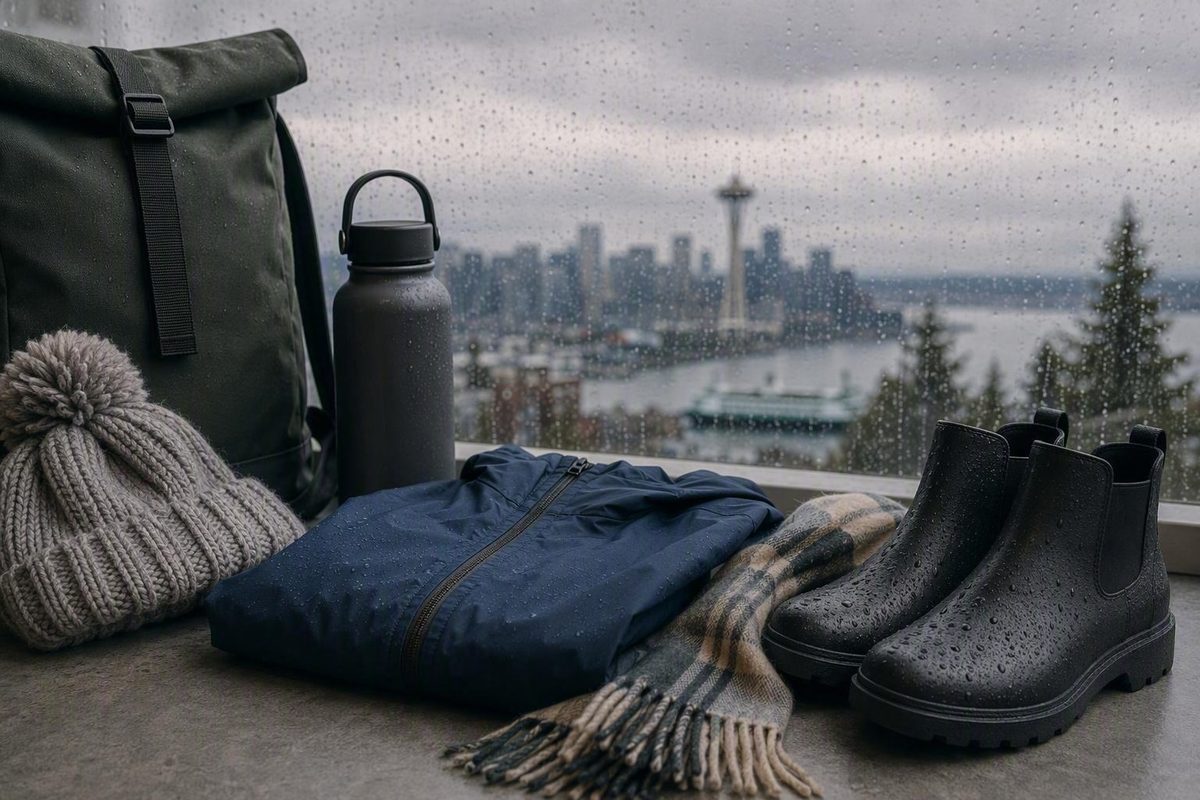
Seattle winter is easier to enjoy when you plan around the weather instead of trying to outguess it. Expect cool temperatures, frequent rain, substantial cloud cover, and shorter sightseeing windows. Build each day around one indoor or weather-tolerant anchor, keep the route compact, and identify a nearby dry alternative.
For this guide, “winter” is the practical travel-planning window from November through March. That range captures late-fall rain, the holiday season, midwinter, and the uncertain transition toward spring. Travel publishers define the season differently, and conditions can vary considerably within those five months.
The most important distinction is between Seattle and the mountains. Rain in the city can coincide with snow at higher elevations, but downtown weather does not establish road access, closures, traction rules, or avalanche conditions. Treat every mountain outing as a separate regional trip requiring current official checks.
What Seattle Winter Is Actually Like
Seattle winter is generally cool, cloudy, and wet rather than bitterly cold or continuously stormy. A typical city day may involve damp sidewalks, intermittent drizzle, low clouds, and temperatures that make an insulating layer useful without requiring expedition-level clothing.
Travel publishers do not use one consistent definition of the season. U.S. News Travel groups November through February as Seattle’s winter travel period, AAA uses roughly late November through early March, and another destination guide uses December through March. For practical trip planning, November through March is useful because unsettled weather can affect visits throughout that span.
The following figures are 1991–2020 averages for Seattle-Tacoma International Airport, as reproduced in a secondary climate summary. They should be treated as approximate planning context rather than a forecast for downtown Seattle or for particular travel dates.
| Month | Average high | Average low | Average precipitation |
|---|---|---|---|
| December | 47°F | 37°F | 5.7 inches |
| January | 48°F | 38°F | 5.2 inches |
| February | 50°F | 38°F | 3.9 inches |
The cited Seattle climate summary identifies the station and 1991–2020 period and also notes that downtown Seattle generally tends to be somewhat warmer and drier than Sea-Tac. Conditions near Pike Place Market, Seattle Center, or Capitol Hill therefore may not align exactly with airport averages.
National Climatic Data Center-derived figures published by U.S. News Travel put November at approximately 51°F for the average high, 41°F for the average low, and 5 inches of precipitation. These figures come from a different presentation of the climate record, so small differences in stations, averaging periods, and rounding should not be surprising.
Cloud cover is one of the season’s defining characteristics. Weather Spark’s winter model estimates that Seattle is overcast or mostly cloudy about 70% of the time. It also models the chance of a wet day as declining from roughly 56% near the beginning of its winter period to 49% near the end. Rain-only precipitation is overwhelmingly more likely than snow, while mixed rain and snow and snow-only precipitation are each modeled at about a 1% daily chance.
Those percentages apply to Weather Spark’s winter model, not automatically to this guide’s broader November-through-March planning window. They are modeled or historical probabilities, not predictions for a particular week.
The prevailing pattern has several practical consequences:
- Wet pavement is possible even when rain is light or intermittent.
- A view-focused stop may disappoint under low clouds but become worthwhile if visibility improves later.
- Short outdoor walks can remain manageable when paired with warm indoor stops.
- Snow should not be the foundation of a city itinerary.
- Severe cold and heavy city snowfall can occur, but neither represents an ordinary Seattle winter trip.
Climate averages help determine what belongs in your suitcase and how much flexibility to leave in your schedule. They cannot tell you whether a particular afternoon will bring steady rain, drizzle, wind, sunbreaks, or an unusual snow event.
Is Seattle Worth Visiting in Winter?
Seattle can be worth visiting in winter when the season matches your priorities. It is a tradeoff, not an unqualified bargain.
The main disadvantage is weather uncertainty. Long outdoor days are less dependable, cloud cover can obscure distant views, and wet conditions may make extended neighborhood wandering less appealing. An itinerary built primarily around viewpoints, outdoor gardens, dry trails, and long waterfront walks has a higher chance of needing revision than it would during a drier season.
The counterweight is that much of Seattle’s appeal does not depend on clear skies. Museums, food, coffee, bookstores, performances, films, hockey, indoor games, conservatories, the aquarium, and wellness experiences can all anchor a satisfying visit. Winter also encourages a more focused pace: one area at a time rather than a race between distant landmarks.
Some travel guides report fewer crowds, quieter attractions, hotel deals, or lower seasonal rates. Those benefits may appear on some dates, but they are not guaranteed. Holidays, concerts, sporting events, conventions, and limited room availability can still affect prices and crowds. Compare lodging for your actual dates rather than assuming that December, January, or February will automatically be inexpensive.
Winter may suit you particularly well if you prioritize:
- Museums, glass art, science, marine life, or architecture
- Coffee shops, restaurants, breweries, and covered food stops
- Cinema, theater, music, comedy, or dance
- Hockey, public skating, or indoor recreation
- Saunas, spas, or reservation-based Lake Union experiences
- Neighborhood stops arranged in compact clusters
- Conditional access to regional mountain snow, with separate safety planning
You may prefer another season if your main goals require consistently clear mountain views, dry urban walks, long outdoor days, dependable viewpoint conditions, or snow-free trails. Winter does not make those activities impossible; it makes them less predictable.
No fixed number of days is necessary. What matters is flexibility within the time available. On a two-day visit, that may mean leaving one afternoon open. On a longer stay, it may mean keeping one day movable so that a garden, viewpoint, ferry outing, or regional drive can shift to the most favorable weather window.
Do not treat city rain as evidence of easy or safe mountain access. Higher-elevation recreation may face winter closures or reduced access even when Seattle streets are merely wet, as AAA’s seasonal Seattle planning guide cautions. Mountain plans require separate checks of current official forecasts, road conditions, access notices, traction rules, and avalanche information.
What to Pack for Seattle’s Winter Weather
Pack for repeated transitions: outdoors to indoors, wet sidewalks to heated galleries, and cool mornings to warmer cafés or performance venues. Adaptable layers are generally more useful for an ordinary city visit than one extremely heavy coat.
A practical baseline includes:
- Waterproof walking shoes: Choose shoes you can wear comfortably for several hours on damp pavement.
- A hooded rain shell: A shell blocks rain while allowing you to adjust the layers underneath.
- Warm midlayers: A sweater, fleece, or similar layer should be easy to remove indoors.
- A comfortable base layer: Wear something suitable for heated museums and restaurants once outer layers come off.
- Weather-tolerant trousers: Choose clothing that will remain comfortable after brief exposure to drizzle or street splashes.
- Warm socks: Pack enough that one wet pair does not affect the following day.
- A protective day bag: Keep electronics, medication, travel documents, and other essentials dry.
- One dry evening layer: Reserve a clean sweater or similar garment for dinner, a performance, or another indoor evening.
Typical Sea-Tac averages—daytime highs in the upper 40s to around 50°F and lows in the upper 30s from December through February—support this layered approach. These are averages, not limits; a particular trip can be warmer, colder, windier, or wetter than the published climate normals.
Waterproof footwear deserves special attention. Repeated exposure to wet sidewalks, puddles, street crossings, and outdoor transitions can make absorbent shoes uncomfortable even without a dramatic downpour.
A hooded shell offers similar flexibility. Wear it over a lighter layer during a mild afternoon, then add insulation underneath during a colder evening. The goal is not to create a technical backcountry clothing system; it is to remain comfortable while moving between city attractions.
Keep city packing separate from mountain preparation. A rain shell, urban walking shoes, and casual layers do not establish that you are prepared for skiing, snowshoeing, winter hiking, snow play, or driving on snowy roads. Those activities may involve different clothing, equipment, transportation decisions, and safety considerations.
Check the trip-specific forecast shortly before departure and again while you are in Seattle.
Choose Activities by Weather Exposure
Not every “rainy-day activity” is fully indoors. Markets have open edges, walking tours involve street-level transitions, boats remain exposed to the weather, and gardens are still outdoor spaces. Sort activities by exposure before choosing the day’s anchor.
Fully indoor
These are the strongest choices during steady rain:
- Art, history, aviation, popular-culture, and specialty museums
- Pacific Science Center exhibits
- Seattle Central Library
- Cinemas
- Board-game cafés, escape rooms, axe throwing, and indoor mini golf
- Theater, music, comedy, and other performances
- Coffee shops and bookstore cafés
- Dance classes
- Spas and stationary sauna experiences
Distinctive winter options may include a Kraken game, an open practice, public skating, a laser show, a dance class, or indoor mini golf. Visit Seattle includes hockey, skating, hot tub experiences, cafés, games, dancing, cinema, and laser shows among its Seattle winter pastimes. Calendars change, so confirm that the specific activity is operating on your date.
Mostly covered
Pike Place Market is the clearest example. Many stalls, shops, food counters, and interior passages offer shelter, making the market useful as a rainy-day anchor. It is not completely weatherproof: arriving, moving between buildings, exploring exterior edges, and continuing toward the waterfront can involve outdoor exposure.
Treat the market as a cluster rather than a single stop. Build in time for a meal, warm drink, specialty shop, or covered food stop instead of repeatedly leaving and returning.
Mixed exposure
These attractions combine significant indoor time with outdoor movement:
- Seattle Aquarium plus the waterfront: The aquarium can provide the long indoor block, but reaching it and walking along the waterfront involve exposure.
- The Underground Tour: Much of the experience is below street level, but it remains a walking tour with outdoor transitions.
- Chihuly Garden and Glass: The attraction includes enclosed galleries and a glasshouse as well as an outdoor garden.
- Lake Union hot tub boats: The water may be warm, but the activity takes place outdoors on the lake.
- Floating saunas: Heat is available inside, but boarding, movement on the water, and optional cooling-off elements remain exposed.
Washington’s tourism guide includes hot tub boats, floating saunas, the aquarium, the Underground Tour, gardens, performances, restaurants, and museums among its winter activity suggestions. Use those as ideas rather than assurances of current operation or suitability for the day’s weather.
Outdoor
Save these options for a dry interval, light rain you are willing to tolerate, or an improving forecast:
- Kubota Garden
- Olympic Sculpture Park
- Washington Park Arboretum
- Neighborhood walks
- Extended waterfront walks
- Outdoor photography and viewpoint stops
Pair every outdoor option with a convenient indoor substitute. If conditions improve, use the outdoor window. If the rain intensifies, move the garden, park, or neighborhood walk without rebuilding the entire day.
Family-friendly rainy-day choices
Families can build a day around the Seattle Aquarium, Pacific Science Center exhibits and butterfly room, Volunteer Park Conservatory, Seattle Central Library, or food stops inside Pike Place Market. These provide visual or interactive interest without requiring an all-day outdoor commitment; a family-travel guide highlights the same attractions as rainy-day options for children and adults.
Before committing to a scheduled or ticketed activity, confirm:
- Opening days and hours
- Admission prices and discount eligibility
- Age restrictions
- Timed-entry or reservation requirements
- Outdoor segments
- Cancellation or rebooking terms
- Current exhibits, classes, performances, or skating sessions
Build Compact Winter Days by Neighborhood
The simplest winter planning method has four steps:
- Choose a practical base.
- Select one anchor activity for the day.
- Add one or two supporting stops in the same general area.
- Keep one dry fallback that does not require rebuilding the route.
Choose your base according to your main activity, preferred evening atmosphere, and how much backtracking you are willing to accept. Seattle Know’s where-to-stay guide expands on that decision without suggesting that one neighborhood is universally best.
Geographic clustering matters because every transfer adds uncertainty. A long movement across the city can consume the dry interval intended for a walk. A compact route makes it easier to shorten the outdoor portion, extend lunch, enter an attraction earlier, or replace one stop without losing the day.
This base-and-anchor method reflects Seattle Know’s stated planning philosophy: give travelers a clear route, a sensible backup, and enough context to avoid a scattered itinerary. The site explains that purpose on its About page, while its homepage presents the broader neighborhood-and-weather planning framework.
Downtown and Pike Place loop
Anchor: Pike Place Market Secondary stop: Seattle Aquarium Fallback: Coffee, a covered food stop, Seattle Central Library, or another confirmed indoor attraction
Use the market as the flexible center of the day. Explore covered stalls and shops, then move to the aquarium for the longest indoor block. If the rain is lighter than expected, add a short waterfront walk. If it becomes heavier, stay inside longer or settle into a café or meal.
This loop still includes outdoor transitions. The market, aquarium, library, and connecting streets do not form one enclosed complex, and not every option will suit every visitor’s mobility needs.
Seattle Center loop
Anchor: Chihuly Garden and Glass or Pacific Science Center Secondary stop: A film, performance, or another confirmed Seattle Center program Fallback: A laser show, café, or indoor exhibit
Choose the anchor by interest. Chihuly suits a visually focused visit, while the science center is a natural option for interactive exhibits and families. A Kraken game or another hockey activity can shape the day when schedules and locations align.
Chihuly is mixed-exposure rather than wholly indoor because it includes an outdoor garden. During heavy rain, spend more time in enclosed portions or use the science center as the primary block.
Capitol Hill and Volunteer Park loop
Anchor: Volunteer Park Conservatory Secondary stop: A café or bookstore Fallback: A cinema, dance class, spa, or other confirmed indoor reservation
The conservatory provides a warm, plant-focused centerpiece. Afterward, choose one indoor neighborhood stop rather than assembling a long checklist. This route suits visitors who prefer cafés, books, film, wellness, or a slower pace over collecting major landmarks.
Travel between Volunteer Park and other parts of Capitol Hill still involves outdoor movement. Check the current route, entrance information, and accessibility details before assuming two places will be effortless to combine.
Pioneer Square loop
Anchor: The Underground Tour Secondary stop: A café or gallery Fallback: Another confirmed indoor attraction in or near the neighborhood
The tour provides a structured historical block. Because it is not completely sheltered, arrive prepared for street-level exposure and wet pavement. Keep the rest of the schedule simple so that a delayed start or changed tour time does not create cascading problems.
These loops are planning templates, not operational guarantees. Confirm that each venue is open on your chosen day, whether reservations are required, and whether the route meets your mobility needs. “Nearby” on a general itinerary does not necessarily mean step-free, sheltered, or convenient for every visitor.
Sample One-, Two-, and Three-Day Winter Plans
A realistic winter itinerary needs fewer fixed commitments than a summer checklist. Give each day one anchor, one supporting stop, and one backup.
One day: steady rain
Anchor: Pike Place Market Secondary stop: Seattle Aquarium or an indoor museum Backup: Coffee, a covered food stop, or an extended meal
Start at the market and let its shops and food counters set the pace. Move to the aquarium or museum for the longest dry portion of the day. Finish with coffee or a covered meal instead of forcing a viewpoint or long waterfront walk in poor conditions.
Family variation: Make the aquarium the main indoor block and use market food stops as shorter breaks.
Couples variation: Add a reservation-based sauna, spa, or hot tub boat if the weather and cancellation terms are acceptable. Remember that a hot tub boat remains an outdoor activity.
Solo variation: Combine the market with a museum, library, cinema, or unhurried café visit.
Budget variation: Explore the market independently, visit Seattle Central Library, and look for currently confirmed free programs rather than assuming that a recurring free day is active.
Two days: downtown plus one interest-based neighborhood
Day one
- Anchor: Pike Place Market
- Secondary: Seattle Aquarium
- Backup: Museum, café, library, or covered meal
Day two: Seattle Center version
- Anchor: Pacific Science Center or Chihuly Garden and Glass
- Secondary: Film, laser show, performance, or another confirmed indoor attraction
- Backup: Café or indoor exhibit
Choose this version for science, glass art, family exhibits, film, or Seattle Center programming.
Day two: Capitol Hill version
- Anchor: Volunteer Park Conservatory
- Secondary: Café, bookstore, or cinema
- Backup: Dance class, spa, or another indoor reservation
Choose this version for plants, neighborhood atmosphere, wellness, books, or film.
For hockey enthusiasts, a Kraken activity can replace the second-day anchor when a game, open practice, or public-skating session fits the schedule. Confirm both location and time; hockey-related activities do not necessarily occur at the same venue.
Three days: add history, entertainment, or a weather window
Use the two-day structure above, then choose one of three approaches.
Pioneer Square day
- Anchor: Underground Tour
- Secondary: Café, gallery, or indoor architectural stop
- Backup: Museum, cinema, or indoor game
Indoor entertainment day
- Anchor: Museum, performance, hockey game, or cinema
- Secondary: Coffee or dinner in the same general area
- Backup: Indoor mini golf, board games, or another bookable activity
Improving-weather day
- Anchor: A short visit to Kubota Garden, Olympic Sculpture Park, or the Arboretum
- Secondary: A convenient indoor stop
- Backup: Replace the outdoor anchor with a conservatory, museum, aquarium, or cinema
The third day should not be overloaded simply because more time is available. Its value lies in flexibility: it provides another opportunity to use a dry interval, secure a reservation, or recover from a weather-related change.
Families may prioritize interactive science, marine life, conservatories, and manageable food stops. Couples may prefer a sauna, hot tub boat, performance, or long dinner. Solo travelers can use libraries, cinemas, cafés, and museums without coordinating several reservations. Budget-conscious visitors can investigate libraries, public gardens, self-guided market exploration, and currently scheduled free practices or programs.
Free-admission days, open practices, performances, classes, and reservation-based activities all require current verification. Do not build a budget around a program until its organizer confirms the date, eligibility, and availability.
Seasonal Events from November Through March
Separate permanent attractions from limited-time programming. The aquarium, libraries, conservatories, museums, cafés, markets, and cinemas may be useful throughout winter, subject to their regular calendars. Holiday markets, ship sailings, festivals, and special performances operate only on specific dates.
November and December
Past or recurring winter guides have included:
- Seattle International Comedy Competition
- Christmas Ship Festival
- Holiday markets
- WildLanterns
- Nutcracker performances
These are illustrative seasonal possibilities, not confirmation that every event will return on the same dates or in the same form. U.S. News Travel identifies the comedy competition and Christmas Ship Festival among Seattle’s winter events, while the state tourism guide includes WildLanterns, Christmas Ship sailings, holiday markets, and Nutcracker performances. Check current organizer calendars before making travel arrangements.
January
Build January primarily around evergreen indoor attractions rather than an assumed festival schedule. Museums, hockey, public skating, cafés, indoor games, cinema, performances, science exhibits, conservatories, and wellness activities provide a more dependable foundation.
Special events may still occur, but treat them as additions discovered through a current calendar—not as permanent January fixtures.
February
Potential February programming may include Lunar New Year or Tết celebrations, the Seattle Chamber Music Winter Festival, and Seattle Museum Month.
Seattle Museum Month requires an important qualification: the tourism guide describes it as offering half-price admission to select museums for guests who book an eligible stay at a participating downtown hotel. It is not a universal half-price offer for every visitor or every museum. Confirm the current participating hotels, museums, dates, booking rules, and redemption process through the program organizer before relying on the discount.
March
Treat March as a transition period for this guide. A March visit may still call for rain-ready clothing and the same flexible structure as a midwinter trip, but conditions and seasonal programming vary by year. Build the itinerary around evergreen attractions first, then add events once current dates are published.
For every limited-time program, verify:
- Current-year dates
- Venue and operating hours
- Ticket availability
- Age or entry rules
- Hotel-stay or residency requirements for discounts
- Cancellation or postponement notices
- Whether any portion takes place outdoors
An event’s appearance in a general winter guide does not confirm its return.
City Snow, Mountain Snow, and Backup Plans
Rain is substantially more common than snow in Seattle. Mixed precipitation and snow-only days are uncommon in the city, and heavy snowfall is not a normal feature of every winter trip.
Uncommon does not mean irrelevant. If snow or ice appears during your stay, revise the plan rather than relying on typical conditions. Exposed walks, gardens, trails, steep streets, and long regional drives may no longer suit the day. Check current local information instead of judging an entire route from the pavement outside your hotel.
A straightforward city contingency is to replace:
- Outdoor gardens with a conservatory
- A long neighborhood walk with a museum or cinema
- A regional drive with the aquarium or Pike Place Market
- A sculpture-park visit with a library or indoor game
- An exposed water activity with a spa or stationary sauna
- A viewpoint plan with a performance, class, or extended meal
Mountain snow is a separate planning problem. The Cascades and Mount Rainier area may offer winter recreation while Seattle is rainy, but higher-elevation routes may close or become unsuitable. City temperature, precipitation, and visibility do not establish whether a regional destination is accessible.
Skiing, snowshoeing, and snow play are conditional regional options—not routine activities within Seattle. Before leaving the city, consult the appropriate current official sources for:
- Weather forecasts
- Road conditions and closures
- Traction or vehicle requirements
- Park, resort, or land-manager notices
- Avalanche forecasts and warnings
- Parking and access restrictions
- Equipment, reservation, and permit rules
Do not use an old travel article to determine that a particular trail or route is open, safe, beginner-friendly, or free from avalanche danger. Consult the agency, park, resort, or land manager responsible for the destination and be prepared to cancel the outing.
Keep the geography clear as well. Tacoma, Woodinville, Leavenworth, Mount Rainier, and Cascade destinations are regional excursions rather than Seattle attractions. Each adds transportation time and another set of weather variables. On a short visit, a city backup should remain available if regional conditions are uncertain.
A Seattle winter trip works best when it stays compact and adjustable. Expect cool, gray, frequently wet weather; pack for repeated walking on damp streets; choose one neighborhood anchor per day; and keep a convenient indoor alternative.
During the week of the trip, confirm:
- The current Seattle forecast
- Venue hours and closure notices
- Timed-entry and reservation requirements
- Event dates and ticket availability
- Discount eligibility
- Outdoor exposure for tours and boat activities
- Official regional road, weather, traction, closure, and avalanche information
Does it snow in Seattle in winter?
Yes, but rain is much more common. Weather Spark’s winter model treats rain-only precipitation as overwhelmingly more likely than mixed precipitation or snow. Heavy city snowfall can occur, but it is atypical. If snow or ice is forecast, replace exposed walks and regional drives with indoor city activities.
What is the coldest month in Seattle?
December and January are generally the coldest part of this guide’s planning window, depending on the station and measurement used. Weather Spark identifies late December as the point with the lowest modeled average daily highs and lows in its Seattle winter model. The practical difference is small enough that travelers should pack for the current forecast rather than choose clothing solely by month.
Is Seattle worth visiting in December, January, or February?
Yes, if your priorities include museums, food, coffee, performances, hockey, skating, conservatories, indoor entertainment, or wellness activities. December may add holiday programming, January works well for evergreen indoor attractions, and February may include Lunar New Year programming, chamber music, or the qualified Seattle Museum Month offer.
Choose another season if the trip depends on consistently dry walking weather, clear mountain views, or long outdoor days. Winter lodging deals and lighter crowds are possible, but neither is guaranteed.
What should I wear in Seattle during winter?
Wear waterproof walking shoes, a hooded rain shell, and adjustable warm layers. Carry a day bag that protects electronics and keep one dry layer available for evenings after time outside. Ordinary city clothing should not be treated as sufficient preparation for winter hiking, snowshoeing, skiing, or snowy mountain travel.
What can families do in Seattle on a rainy winter day?
Strong family options include the Seattle Aquarium, Pacific Science Center exhibits and butterfly room, Volunteer Park Conservatory, Seattle Central Library, and food stops at Pike Place Market. Families can also consider a museum, cinema, public-skating session, laser show, or indoor game, depending on children’s ages and current schedules. Confirm hours, exhibit availability, age rules, reservations, and prices before visiting.