
How to Plan a Seattle Winter Trip That Still Works in the Rain
Expect cool, wet days—not constant snow. Pack waterproof layers, group indoor stops, and save ferries and viewpoints for clear windows.
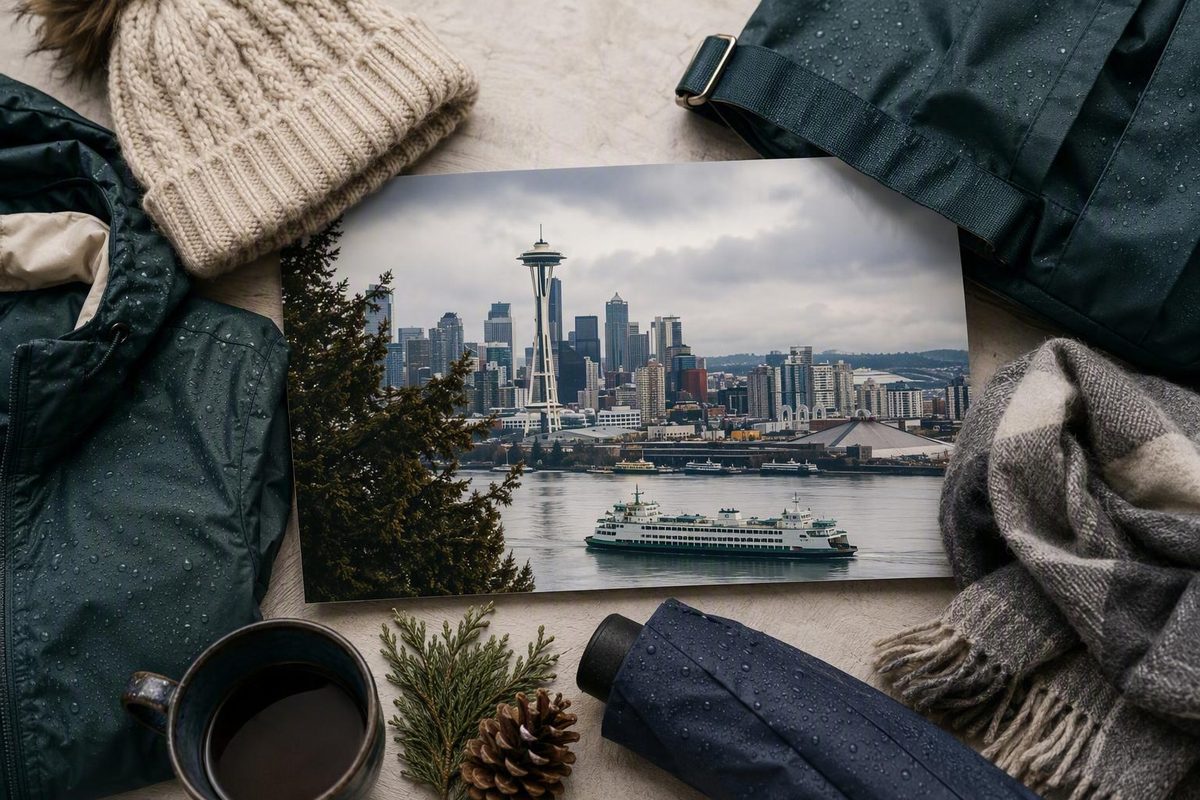
A Seattle winter trip works best when you plan for water, clouds, and short daylight—not continuous snow. This guide covers Seattle in the western Washington lowlands, primarily from December through February, with November included as useful context for late-fall and holiday travel. It does not treat Seattle’s conditions as representative of the Cascade Mountains or Washington State as a whole.
The most reliable strategy is straightforward: stay in a well-connected area, build each day around one substantial indoor attraction, and keep ferries, parks, gardens, and viewpoints movable. If you want mountain snow, plan it as a separate excursion with different transportation, equipment, and safety considerations.
Because attraction hours, event dates, transit service, and operating policies can change, confirm time-sensitive details shortly before your visit. The specific caveats below focus on decisions where weather, eligibility, or safety materially affects the plan.
What winter in Seattle is actually like
Seattle winters are generally cool, wet, cloudy, and relatively mild compared with colder parts of the United States. Expect jacket weather rather than guaranteed deep snow. Historical figures broadly place daytime temperatures in the mid-40s to low 50s Fahrenheit, with nighttime temperatures generally in the upper 30s to low 40s.
Cloud cover is a defining feature. One historical-weather dataset reports overcast or mostly cloudy conditions about 70% of the time through winter. That is a historical probability, not a prediction that 70% of your particular trip will be overcast. The same dataset shows average daily highs rising from roughly 48°F to 52°F over the season, lows near 39°F, and the lowest daily averages around December 23. Use Weather Spark’s historical Seattle winter data as a planning range rather than a trip forecast.
Rain is more characteristic of Seattle winter than sustained urban snow. That does not mean rain is constant, always light, or harmless, and it does not mean snow is impossible. Conditions can include intermittent rain, longer wet periods, dry breaks, occasional snow, or freezing surfaces. For an ordinary city visit, waterproofing is usually more useful than clothing designed for prolonged deep-snow exposure.
Seattle also should not be used as shorthand for “Washington winter.” The Cascade Mountains divide the state, and surrounding water, elevation, topography, and rain shadows create substantial regional differences. Western Washington generally has a wetter, more maritime climate. Eastern Washington is broadly drier but often colder in winter, while high elevations can retain substantial snow long after lowland conditions have moderated. The Washington State climate overview explains these broad regional contrasts.
Winter can suit travelers interested in museums, food, markets, performances, hockey, coffee, indoor family attractions, and flexible neighborhood exploration. It is less dependable for anyone prioritizing sunshine, long daylight, clear mountain panoramas, or an outdoor itinerary that cannot be rearranged.
The balanced verdict is not that winter is inherently better or worse. Seattle remains workable when the plan can bend. If you are comfortable moving a ferry ride, replacing a viewpoint with a museum, and walking in waterproof shoes, there is plenty to do. If every major activity depends on dry weather and distant views, another season may be a better match.
Seattle winter weather by month: November through February
The figures below come from a secondary-source climate table attributed by its publisher to the National Climatic Data Center. The supplied table does not identify the weather station, averaging period, or date range, so these values should not be described as precise, current climate normals. They are most useful for understanding the general scale of Seattle’s winter conditions.
| Month | Displayed average high / low | Displayed precipitation | Seasonal character | Planning implication |
|---|---|---|---|---|
| November | 51°F / 41°F | 5.0 in. | Wet late fall; some holiday programming begins | Carry full rain protection and check seasonal calendars without assuming every holiday event has opened |
| December | 47°F / 38°F | 5.43 in. | Dark and among the coolest parts of the travel window; major holiday period | Put outdoor stops in the limited daylight and reserve darker hours for meals, performances, markets, or museums |
| January | 45°F / 36°F | 5.2 in. | Coolest displayed month in this table; frequently cloudy | Build an indoor-led itinerary connected by short outdoor segments |
| February | 48°F / 37°F | 3.9 in. | Slightly higher displayed temperatures; late-winter programming | Check Museum Month, Lunar New Year, Tết, and garden-show dates while keeping outdoor plans movable |
These monthly temperature and precipitation values appear in the U.S. News Seattle climate table. Because its displayed text does not disclose the station or averaging period, use the figures as broad planning ranges: cool rather than severely cold, and distinctly wetter than Seattle’s summer.
A second historical dataset presents a slightly different pattern. It shows daily highs increasing from about 48°F to 52°F through winter, lows around 39°F, and the lowest daily averages near December 23. That daily minimum does not necessarily conflict with the monthly table identifying January as the coldest displayed month. Weather services may use different stations, periods, definitions, or calculations, and a seasonal daily series is not the same measurement as a table of monthly averages.
November: November is useful travel context, but it is late fall rather than meteorological winter. It is already part of Seattle’s wet, dark travel season, and some holiday markets, lighting displays, performances, and seasonal sailings may begin during the month. Check exact opening dates before treating an event as part of an early-November itinerary.
December: December combines cool temperatures, limited daylight, and holiday programming. Around the winter solstice, one Seattle winter guide gives an approximate planning window of an 8:00 a.m. sunrise and 4:30 p.m. sunset; this is a rough illustration, not a verified daylight table for every December date. Use the middle of the day for parks, gardens, waterfront walks, and photography, then shift meals, exhibits, and performances into the darker hours. The same guide provides the solstice estimate and general winter-planning context.
January: January has the lowest average high and low in the displayed monthly table. An indoor-led plan is sensible, but that does not require staying inside all day. Choose one substantial indoor attraction and add brief outdoor segments when conditions cooperate. Do not assume low prices or empty attractions; games, conventions, performances, holidays, and weekend events can still affect availability.
February: The displayed monthly averages edge upward, although individual cold periods remain possible. February may bring Seattle Museum Month and the Northwest Flower & Garden Show. Lunar New Year or Tết programming may occur in January or February depending on the lunar calendar and each organizer’s schedule.
Historical averages cannot tell you whether your weekend will be rainy, clear, icy, or unusually mild. Check the short-range forecast before departure and again each morning. Use climate figures to guide packing and itinerary structure, not to predict a specific day.
Rain, snow, ice, and what to pack
For city sightseeing, waterproofing is generally more useful than packing for deep snow. The aim is to remain comfortable through repeated transitions: a damp walk, a warm museum, another walk, a waterfront stop, dinner, and a cool evening return.
A practical core packing list includes:
- A waterproof outer shell with a hood
- One or two removable insulating layers
- Waterproof or reliably water-resistant footwear
- Soles with useful traction
- Comfortable socks, with a spare pair for longer days
- A warm hat and light gloves
- A water-resistant day bag or pack cover
Optional additions include a compact umbrella, quick-drying trousers, and a second pair of shoes. An umbrella can be helpful during calm rain but less convenient in crowds or exposed conditions. A hood keeps both hands free, while an umbrella can provide broader coverage when conditions suit it. Neither is a universal requirement.
Avoid relying on one heavy layer that becomes uncomfortable indoors. A base layer, sweater or fleece, and waterproof shell give you more control as you move between indoor and outdoor spaces. Waterproof footwear is particularly valuable because otherwise moderate temperatures can feel unpleasant after hours in wet socks.
Waterfronts, open observation areas, parks, and evening streets provide less shelter than market aisles or enclosed attractions. Carry an extra removable layer for those portions of the day rather than assuming the air temperature alone describes how comfortable you will feel.
Snow and ice are occasional rather than defining city conditions, but they can have an outsized effect. Seattle is hilly, and a winter travel guide notes that icy streets can be hazardous while the city has less snow-and-ice infrastructure than many colder metropolitan areas. That supports a cautious response rather than an attempt to preserve the original itinerary at all costs.
If snow or freezing conditions arrive:
- Consider whether driving is necessary, especially where the route includes steep streets.
- Check current transit and road alerts before leaving your accommodation.
- Confirm that attractions, restaurants, and scheduled activities are operating.
- Allow additional time for every transfer.
- Reduce exposed walking.
- Consolidate the day into one compact neighborhood.
- Reassess waterfront or ferry plans using current operating notices.
These are conservative planning steps, not a prediction that snow will disrupt every trip. Respond to observed conditions and current agency information rather than drawing conclusions from monthly averages.
Do not use a Seattle city packing list for a mountain outing. Skiing, snowshoeing, winter hiking, and driving over a mountain pass may require different footwear, insulation, traction equipment, emergency supplies, route knowledge, and vehicle preparation. Assess the exact destination, current conditions, and planned activity rather than adding generic “snow gear” to a city suitcase.
Build rainy-day plans around compact Seattle clusters
A rainy-day plan works best when it is geographically small. Use a one-anchor method: choose one major indoor attraction, add nearby food or coffee, and limit exposed transfers. Crossing the city repeatedly can turn manageable rain into an unnecessarily tiring day.
Downtown and waterfront: Start with Pike Place Market, then choose the Seattle Aquarium or a downtown museum as the principal indoor anchor. Pike Place is substantially covered, but it is not a sealed, weatherproof complex. Expect open edges, street crossings, slopes, wet pavement, and transitions between buildings.
The aquarium is a natural family option because it keeps the day near the waterfront. Alternatively, use a downtown museum as the long indoor block and visit the market before or afterward. If conditions improve, add a short waterfront walk rather than committing to a long exposed route in advance.
Seattle Center: Build this cluster around the Museum of Pop Culture, Pacific Science Center, or Chihuly Garden and Glass. The Space Needle fits geographically, but it need not be an automatic addition. If low clouds obscure the city and surrounding landscape, a view-focused visitor may decide that the observation experience is not worthwhile that day. Check visibility first and retain the museum as the dependable anchor.
Families can consider the Pacific Science Center and its Tropical Butterfly House, as well as selected museums and public-skating sessions. Confirm current hours, age requirements, timed-entry policies, and exhibit or session availability before departure.
Capitol Hill and nearby: Volunteer Park Conservatory can serve as the indoor anchor, followed by nearby cafes or a meal. Depending on the current calendar, a cinema, live performance, bookstore, or spa can extend the day without sending you back across the city. Check hours and transit before leaving, especially if a timed performance is central to the plan.
Other indoor categories: Seattle’s wet-weather options extend beyond the largest museums. Consider:
- The Frye Art Museum
- Independent bookstores
- Vintage and antique shops
- The underground tour
- SIFF cinema programming
- Public skating
- Indoor games
- Live theater or music
- The Pacific Science Center laser dome
- Cafes, restaurants, breweries, or a spa
The Frye Art Museum has been described as offering free admission, but current admission, exhibition access, and hours should be confirmed before you build a day around it. That description appears in Washington’s winter activity guide for Seattle, which also provides ideas for museums, tours, gardens, events, and water-based experiences.
For children, the aquarium, Pacific Science Center, Tropical Butterfly House, public skating, and selected museums offer useful weather-resistant categories. Suitability varies by child, and individual programs may have age, height, supervision, reservation, or timed-entry rules.
Neighborhood grouping does not guarantee a frictionless day. Hills, construction, crowded sidewalks, service changes, and limited opening hours still matter. The method simply reduces repeated wet walks and cross-city transfers, making it a sound itinerary principle even when the weather turns out better than expected.
Save parks, ferries, gardens, and viewpoints for the clearest window
Do not permanently assign every outdoor activity before the short-range forecast becomes useful. Treat outdoor plans as movable modules that can shift between days—or between morning and afternoon.
Use the clearest available period for:
- A waterfront walk
- A ferry ride
- The Space Needle or another viewpoint
- Discovery Park
- Golden Gardens
- Olympic Sculpture Park
- Kubota Garden
- Skyline or mountain photography
- A longer neighborhood walk
For view-dependent activities, visibility may matter more than light rain. Low clouds can limit distant scenery even during a dry period, while a cool but clear interval may be the better time for an observation deck or photography.
Before paying for a view-focused experience:
- Check current visibility and the near-term forecast.
- Review the attraction’s operating information.
- Decide whether the experience still has value without distant views.
- Keep an indoor alternative in the same general area.
Downtown makes this easy. Begin with a waterfront walk or ferry idea, but be prepared to shorten it and move into the Seattle Aquarium, Pike Place Market, or a museum. The overall shape of the day survives even if the exposed portion changes.
Never count on seeing Mount Rainier, the Olympic Mountains, or a crisp skyline. Seasonal averages cannot predict visibility on a specific day, and rain-free conditions can still be cloudy. Before making a nonrefundable purchase, decide whether you would be satisfied with the attraction if the distant view did not appear.
Kubota Garden is one possible winter garden stop. Washington’s tourism guide describes it as a 20-acre property south of downtown. Treat that as destination context rather than a guarantee of current access; verify opening information and any tour schedule for your date.
Lake Union hot-tub boats and floating saunas offer another distinctive winter category, but they require more scrutiny than a conventional indoor attraction. Confirm the operator’s current eligibility requirements, weather policies, booking terms, cancellation rules, and safety instructions. Do not use a tourism article’s claim about required boating experience as a substitute for the provider’s current rules.
The objective is not to avoid outdoor Seattle. It is to spend the best weather window on the activity that benefits most from it. A brief wet transfer is usually easier to absorb than using your clearest interval inside and leaving a prepaid viewpoint for low clouds.
Winter events and seasonal experiences by travel window
Winter programming changes annually. Use these categories to generate possibilities, then confirm dates, venues, ticket availability, reservations, age restrictions, and any eligibility conditions directly with organizers.
December
December commonly includes numerous holiday-themed possibilities:
- Holiday markets
- WildLanterns
- Christmas Ship sailings
- Nutcracker performances
- Winterfest-style programming
- Seasonal beer events
- New Year’s Eve activities
Some programs begin in November, while others operate only on selected December dates. A recurring event name does not guarantee that the same venue, format, ticket policy, or schedule will return in a future year. Avoid relying on archived calendars or historical prices.
January
January planning should rely less on an assumed annual festival calendar and more on activities that commonly publish winter schedules:
- Seattle Kraken hockey
- Public skating
- Museums and exhibitions
- Cinema
- Theater, music, and other performances
- Indoor games
- Remaining holiday pop-ups, if still operating
- Cafes, dining, or spa time
The Seattle Kraken regular season runs from October through April, subject to the current official schedule. Kraken Community Iceplex has offered public skating and hosted open practices, but session dates and access details can change. Visit Seattle’s winter activities guide also identifies skating, hockey, cinema, cafes, indoor recreation, and laser shows as winter options.
Lunar New Year and Tết programming may occur in January or February. The date moves with the lunar calendar, and individual organizations may schedule celebrations on different weekends. Check the Chinatown-International District and participating cultural organizations for the year of your visit.
February
February may include Seattle Museum Month and the Northwest Flower & Garden Show, subject to current schedules.
Museum Month has historically provided half-price admission at participating museums for guests with qualifying downtown-hotel bookings. That does not mean every hotel, museum, room rate, date, or reservation qualifies. Read the current offer conditions before choosing accommodation or calculating its value. National Geographic’s Seattle travel guide identifies Museum Month, Lunar New Year, and the garden show as winter possibilities and describes Seattle’s bus, light-rail, and streetcar options.
February may also align with Lunar New Year or Tết celebrations. These can include food, performances, cultural programming, and community events, but the venues and formats vary.
For any seasonal event, verify:
- Exact date and start time
- Current venue
- Ticket and reservation requirements
- Age or entry restrictions
- Bag and re-entry policies
- Hotel or booking eligibility for discounts
- Cancellation or weather policies
- Transit service after the event
Treat an event as the anchor for a compact day rather than one item in an overfilled, cross-city schedule.
Seattle winter is not Cascade mountain winter
Seattle occupies the western lowlands. Dependable snow recreation generally requires travel to higher elevations, where the weather, roads, access requirements, and risk profile differ materially from city sightseeing.
Skiing, snowboarding, and snowshoeing are available in the Cascades and other high-elevation parts of Washington. That does not make them automatic additions to a short Seattle visit. Travel conditions can vary with the destination, traffic, weather, road closures, pass conditions, and traction requirements, so do not assume a fixed or effortless trip from downtown.
Travel articles sometimes mention Gold Creek Pond and Commonwealth Basin as snowshoeing ideas. Treat them only as places to investigate, not unconditional recommendations or proof that a route is appropriate for beginners. The available evidence does not establish which snow destinations are safely reachable without a car, which routes suit first-time snowshoers, or which terrain requires specialized avalanche knowledge.
Lower-elevation hiking also requires caution. A trail described as open year-round can still be muddy, slick, icy, snowy, damaged, or difficult to reach. “Open” does not mean dry, hazard-free, or suitable for every visitor.
Before considering a mountain day, obtain current information from the responsible official agencies and operators about:
- The destination-specific weather forecast
- Mountain-pass conditions
- Current traction-device or chain requirements
- Road closures and return-route conditions
- Trail or resort status
- Parking and reservation requirements
- Available daylight
- Avalanche conditions and forecasts
- Required clothing and equipment
- Whether the vehicle and driver are suited to the conditions
Repeat those checks on the morning of departure. Conditions outside a Seattle hotel do not establish conditions at a pass, resort, or trailhead. Washington’s substantial variation by elevation and geography is why current destination-specific information matters.
If you lack winter-driving or backcountry experience, consider an appropriately managed activity with clearly published access and operating information, use a qualified provider where suitable, or omit the mountain day. Improvising after seeing snow in the distance is not a sound substitute for destination-specific planning.
A city alternative can still provide a winter theme. Public skating or a Kraken game offers ice and seasonal atmosphere without mountain roads, trail navigation, or avalanche terrain, while preserving more time for a short urban trip.
Do not generalize Seattle’s temperature, rainfall, or snow expectations to the Olympic Peninsula, San Juan Islands, Cascades, or Eastern Washington. Conditions can differ sharply across those regions on the same date.
A weather-flexible three-day Seattle winter itinerary
The strongest three-day itinerary is not a fixed sequence. It consists of three interchangeable modules assigned after you check the forecast, visibility, attraction schedules, and event calendar.
Module 1: Indoor culture
Begin at Pike Place Market, allowing for wet pavement and exposed transitions. Add the Seattle Aquarium or a downtown museum as the principal indoor anchor. Finish with a nearby meal, bookstore, cinema screening, or performance.
Use this module during the wettest or lowest-visibility period. It does not depend on distant views, and a brief dry interval can support a waterfront detour without making that detour essential.
A practical sequence might be:
- Morning at Pike Place Market
- Lunch nearby
- Afternoon at the aquarium or a downtown museum
- Coffee or a bookstore stop
- Dinner, cinema, or a performance
Keep the route compact rather than adding a cross-city attraction simply because it appears on a general must-see list.
Module 2: Visibility
Use the clearest available period for a ferry, waterfront walk, garden, park, or observation deck. Check current conditions before paying for a view-dependent attraction, then retain an indoor substitute nearby.
Possible pairings include:
- Waterfront walk or ferry, with the aquarium as backup
- Space Needle, with the Museum of Pop Culture or Chihuly Garden and Glass as backup
- Olympic Sculpture Park, followed by a nearby indoor stop
- Kubota Garden, followed by a meal or indoor attraction in a conveniently connected area
- Discovery Park or Golden Gardens, shortened if conditions deteriorate
Do not overload this module. A ferry, long park visit, garden, and observation deck can compete for the same limited daylight. Choose the activity that matters most.
Module 3: Neighborhood
Choose one compact district and combine one anchor attraction with coffee, food, and a short outdoor segment.
At Seattle Center, the anchor might be the Museum of Pop Culture or Pacific Science Center, with a brief campus walk and a nearby meal. On Capitol Hill, it might be Volunteer Park Conservatory followed by cafes, shopping, cinema, spa time, or a performance. Another district can work if its transit connections, hours, and indoor alternatives suit your priorities.
This module absorbs uncertain weather well because its outdoor portion can expand or contract. In a dry period, add a longer walk. In steady rain, shorten the route and spend more time at the anchor.
Two-day adaptation
For a two-day visit, combine the indoor-culture and neighborhood modules while keeping the visibility activity available for whichever forecast window looks better.
For example:
- One day centered on Pike Place Market, the waterfront, and a downtown indoor anchor
- One day at Seattle Center or Capitol Hill
- A ferry, observation deck, park, or garden moved into the clearest portion of either day
This protects the trip’s central experiences without requiring a third full day.
Car-free version
A short winter trip can be organized around light rail, buses, streetcars, and walking. A central or transit-connected base reduces backtracking and makes it easier to change plans without relocating a car.
Car-free does not mean condition-free. Downtown is hilly, and wet or icy surfaces can affect mobility. Check current transit alerts, allow extra time, and do not choose a walking route solely because two points appear close on a flat map.
Optional mountain substitution
Keep a mountain day outside the three-module structure until current information supports it. It should replace a city module only after you have checked the road, pass, weather, daylight, trail or resort status, traction requirements, and avalanche conditions. If a major element remains unresolved, keep the city plan.
Accommodation and price expectations
Winter lodging deals may be available, but winter is not guaranteed to be the cheapest period for every traveler or date. Holidays, hockey games, conventions, performances, and other events can raise prices or reduce availability. U.S. News describes winter hotel deals as possible while also showing why broad seasonal claims should not replace a comparison of your actual dates.
Final pre-trip checklist
Before departure—and again each morning—check:
- Current forecast and expected temperature range
- Visibility for view-dependent plans
- Transit alerts
- Ferry notices
- Attraction hours and timed-entry rules
- Event calendars
- Restaurant and activity reservations
- Accessibility information relevant to your group
- Any applicable mountain-pass, road, trail, traction, or avalanche conditions
The publisher’s Seattle trip-planning approach is to choose a practical base, organize the day around one anchor, and keep a sensible fallback. Its Seattle neighborhood and rainy-day planning hub presents that as a first-party planning method rather than an independently validated guarantee.
A successful winter trip depends less on predicting a rain-free weekend than on arranging flexible modules. Use compact indoor routes during wet periods, move ferries and viewpoints to the clearest window, and treat mountain snow as a separate undertaking. Pack for water and slick surfaces, verify changing schedules and alerts, and give every weather-sensitive plan a dependable indoor alternative.
The quick answers below summarize the main decisions.
Frequently asked questions
Does it snow in Seattle during winter?
Yes. Snow can occur in Seattle, but rain is generally more characteristic of winter in the city. Do not plan for continuous urban snow, and do not assume snow is impossible.
When snow or ice arrives, Seattle’s hills can make walking and driving more difficult. Check current forecasts, transportation alerts, road conditions, and attraction notices. Reduce unnecessary travel and consolidate the day into one compact area if conditions warrant it.
How cold does Seattle get in December, January, and February?
The secondary-source monthly table lists December at 47°F/38°F, January at 45°F/36°F, and February at 48°F/37°F for displayed average highs and lows. The publisher attributes the figures to the National Climatic Data Center but does not identify the station, averaging period, or date range in the supplied text. See the cited U.S. News climate table above for the figures and caveat.
Use those numbers as broad planning ranges. Individual days can be colder or warmer, and historical averages cannot predict conditions during your visit.
What should I wear in Seattle in winter?
Wear removable warm layers under a waterproof shell, with waterproof or reliably water-resistant footwear and soles that provide useful traction. Optional items include a compact umbrella, quick-drying trousers, spare socks, a warm hat, gloves, and a water-resistant bag.
Bring an extra layer for exposed outdoor portions of the day. If you are traveling to the mountains, use a destination- and activity-specific equipment list rather than relying on city clothing.
Is winter a cheaper or less crowded time to visit Seattle?
It can be, but neither lower prices nor lighter crowds are guaranteed. Some travel sources describe winter as a lower-demand period, while the stronger supported conclusion is simply that hotel deals may be available on some dates.
Prices and availability can change around holidays, sports, conventions, performances, and special events. Compare lodging for your actual dates and reserve any limited-capacity attraction that is essential to your trip.
Are Seattle’s winter conditions representative of all Washington State?
No. Seattle is in the western Washington lowlands, and conditions across the state vary substantially with elevation, topography, surrounding water, rain shadows, and the Cascade divide.
Western Washington generally has a wetter maritime climate. Eastern Washington is broadly drier but often colder in winter, and higher elevations can retain substantial snow. Do not apply Seattle’s temperatures or rain expectations to the Cascades, Olympic Peninsula, San Juan Islands, or Eastern Washington.