
Build a Seattle Trip Around Icons, Neighborhoods, Water, and Weather
Make three decisions: choose one central cluster, add one neighborhood or water experience, and identify a nearby weather-tolerant fallback.
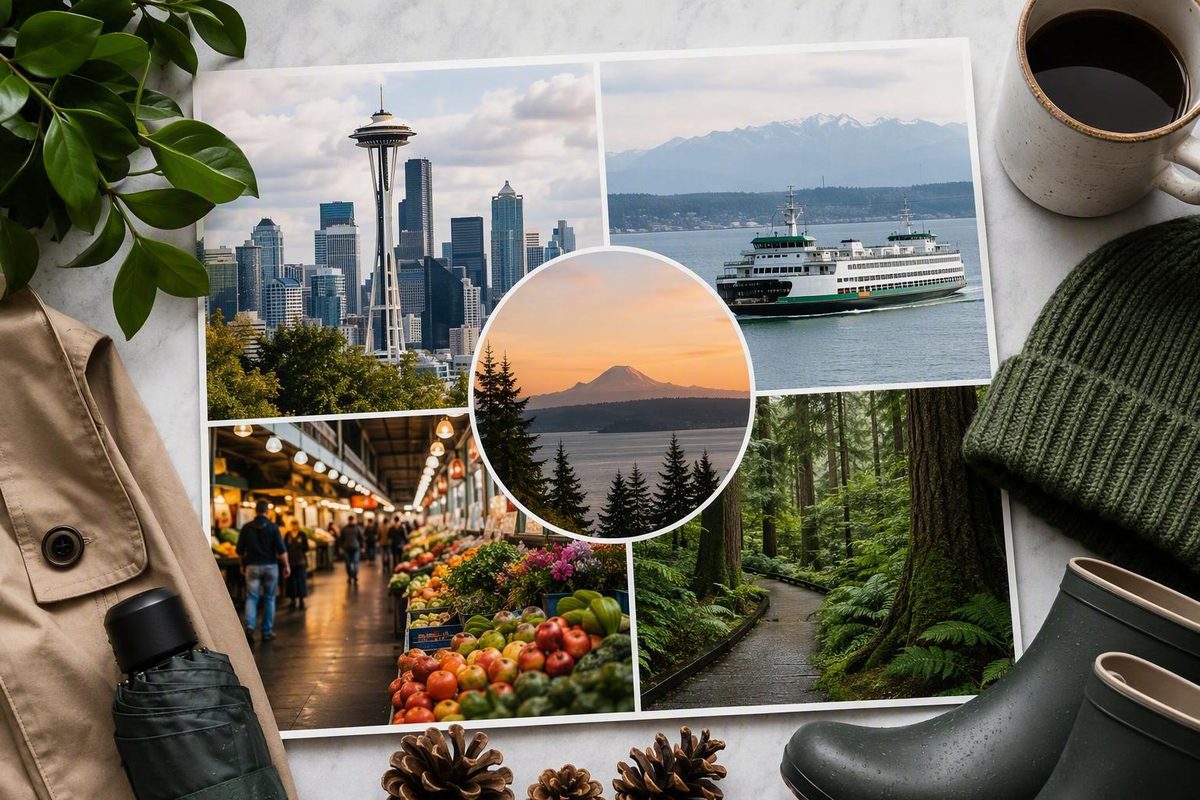
Last reviewed August 2026. Attraction access, transit service, ferry operations, and park conditions can change; confirm time-sensitive details with the relevant operator before departure.
Seattle rewards selective planning. For a first leisure trip, the goal should not be to collect every famous attraction. It should be to experience several sides of the city—market culture, the waterfront, a landmark, a neighborhood, urban nature, and perhaps a ferry—without spending the day crossing back and forth.
Use this three-part structure:
- Choose one anchor experience for each half-day.
- Add supporting stops in the same geographic area.
- Keep a weather-tolerant alternative nearby.
That leaves room for meals, hills, queues, transit, changing visibility, and the unplanned stops that make a city trip memorable.
Start Here: The Seattle Experiences to Prioritize on a First Visit
For most first-time visitors deciding what to do in Seattle, Washington, a practical shortlist is:
- Pike Place Market
- The central waterfront
- Seattle Center
- One skyline viewpoint
- One neighborhood beyond downtown
- An optional ferry or water-taxi ride
Pike Place Market, the waterfront, and Seattle Center appear repeatedly in first-visit itineraries because they combine recognizable sights with relatively efficient geography. Treat that as a useful planning pattern, not an objective ranking. A traveler focused on restaurants, music, parks, maritime scenery, or local street life could reasonably devote more time to Capitol Hill, Ballard, Discovery Park, or a ferry crossing.
Choose the day’s anchor according to your interests:
| Interest | Possible anchor | Nearby additions |
|---|---|---|
| Food and market culture | Pike Place Market | Post Alley, Overlook Walk, waterfront |
| Landmark sightseeing | Space Needle | Chihuly, MoPOP, Queen Anne |
| Art and museums | Chihuly or MoPOP | Seattle Center grounds, Olympic Sculpture Park |
| Water and scenery | Bainbridge ferry or West Seattle water taxi | Winslow or Alki shoreline |
| Dining and nightlife | Capitol Hill | Shops, cafés, neighborhood walking |
| Public art and parks | Fremont or Gas Works Park | Fremont Troll, Lake Union |
| History | Pioneer Square | Klondike museum, underground tour |
The anchor rule matters most on short visits. An observation deck, museum, aquarium visit, cruise, food tour, or Great Wheel ride can consume more time than its map location suggests. Tickets, queues, meals, and the transition to the next stop all count. Select paid attractions because they match your interests, budget, and available time—not because every guide lists them.
Visibility should influence what you book. If low clouds obscure the skyline, an observation ticket may offer less value to someone primarily interested in distant views. Use a museum first and reconsider the viewpoint later if ticket rules and the forecast allow.
Finally, distinguish activities in Seattle from regional excursions. Bainbridge Island is directly connected to downtown by ferry, but visiting it still creates a separate block of travel and exploration. Snoqualmie Falls, Mount Rainier, and Olympic National Park require progressively more transportation and advance planning. On a one- or two-day visit, every regional trip displaces something in the city.
Pike Place Market and the Waterfront: Seattle’s Most Useful Central Cluster
Pike Place Market is not one counter or one photograph. It is a working market area with produce, seafood, flowers, crafts, prepared food, restaurants, specialty businesses, and small shops on multiple levels. Visitors who remain near the main sign and fish counter see only a portion of it. Individual businesses keep different schedules, so a late visit may be quieter without providing the same vendor activity found earlier in the day. Travel coverage of the market documents its varied stalls, lower-level shops, fish throwing, and nearby Gum Wall.
The fish-throwing tradition at Pike Place Fish is one of the market’s recognizable scenes. The Gum Wall is nearby in Post Alley beneath the market. The heavily visited Starbucks in the area is often promoted as an “original” location, but do not build a visit around the assumption that it is the literal first Starbucks; the supplied visitor sources use inconsistent language about that distinction.
Visit while vendors are operating if the market itself is a priority. Restaurants may remain open after produce, craft, or specialty stalls have closed. Confirm the current schedule for any particular business rather than assuming one set of hours applies to the entire market.
Allow time to follow ramps and passages and explore below the main arcade. If food is your anchor, avoid scheduling a fixed lunch elsewhere immediately afterward. Sampling, queues, and spontaneous purchases can easily become the meal.
How to continue to the waterfront
From the market area, continue downhill toward Overlook Walk and the central waterfront. Overlook Walk connects Pike Place Market with the Seattle Aquarium area using a combination of paths, stairs, and elevators, according to current visitor transportation guidance; travelers who depend on elevators should verify operating conditions and accessible routing on the day of the visit. The same car-free planning guide describes the market-to-waterfront connection.
From the waterfront, possible additions include:
- Waterfront promenades and piers
- The Seattle Aquarium
- The Seattle Great Wheel
- Harbor-cruise departure points
- Olympic Sculpture Park
- A northbound route toward Seattle Center
Olympic Sculpture Park is useful because it combines public art with waterfront walking and can extend a northbound route toward Seattle Center without another admission charge. It can be a destination in its own right or an outdoor link between the downtown waterfront and the next cluster.
Three ways to plan the cluster
Quick highlights route
Start at the main market arcade, pause at the fish counter, descend into the lower levels, and walk through Post Alley. Continue toward Overlook Walk and choose either a short waterfront promenade or Olympic Sculpture Park before moving on.
This version suits a one-day visitor who wants to understand the market’s character without making food or shopping the main focus.
Food-and-browsing route
Give the market the entire morning or a generous part of the afternoon. Browse produce, seafood, crafts, specialty shops, and prepared-food counters across several levels. Continue to the waterfront only after eating rather than rushing to another reservation.
A food tour can provide structure and interpretation, but it is a paid anchor rather than a prerequisite for exploring the market independently.
Family or rainy-weather route
Alternate covered market browsing with one nearby indoor attraction. The aquarium is conveniently located for a market-and-waterfront day, while a longer meal can provide another break from exposed walking.
The aquarium, Great Wheel, harbor cruises, and food tours are all optional. Choosing all of them can turn an efficient geographic cluster into an expensive, tightly scheduled day.
Before visiting, confirm market-business hours, aquarium access, cruise departures, ticket requirements, and any route changes along the waterfront.
Seattle Center and Queen Anne: Choose One or Two Major Attractions
Seattle Center groups several major visitor attractions, including the Space Needle, Chihuly Garden and Glass, and the Museum of Pop Culture. Their proximity makes the area efficient for a half-day or longer block, but it does not make every venue quick to visit.
Space Needle
The Space Needle was built for the 1962 World’s Fair and functions as both a city landmark and a paid elevated-view experience. Its visitor areas include indoor and open-air observation spaces and a rotating glass platform commonly called the Loupe. A first-visit guide documents the World’s Fair origin and observation features.
Choose it if the landmark itself matters to you. On a clear day, the elevated perspective may become the focus of the visit. Under low clouds, the value may rest more on the ascent, architecture, and attraction experience than on long-distance scenery.
A free park overlook is not an exact substitute. It may provide a skyline photograph, but it does not reproduce the height, interior spaces, or downward perspective of the Space Needle.
Chihuly Garden and Glass
Beside the Space Needle, Chihuly Garden and Glass combines indoor galleries and glasshouse displays with outdoor garden installations. It suits travelers interested in glass art and can work well when intermittent rain makes a partly indoor attraction appealing.
The garden remains weather-exposed, so treat Chihuly as weather-tolerant rather than completely indoors.
Museum of Pop Culture
MoPOP covers music and broader popular-culture subjects. Depending on the current exhibition program, topics can extend into film, television, games, science fiction, fantasy, horror, and related media.
Choose MoPOP when exhibits interest you more than an observation deck or decorative glass. Because exhibitions can change, check the current lineup before assuming a particular collection or artist will be represented.
A simple selection rule
- Choose the Space Needle for the landmark experience and elevated perspective.
- Choose Chihuly for glass art and a blend of galleries, glasshouse displays, and garden installations.
- Choose MoPOP for music and popular-culture exhibitions.
- Choose two only if Seattle Center is the main focus of the half-day.
Do not book several attractions back-to-back without space for entry procedures, queues, meals, rest, and the walk between doors. Even adjacent venues require transition time.
If visibility is poor, use an indoor museum first and move the Space Needle to a clearer period if the forecast and ticket conditions permit. If clouds persist, decide whether the landmark experience alone justifies the cost.
Getting there and adding Queen Anne
The Seattle Center Monorail provides a short connection between the Westlake area and Seattle Center. Current fares, hours, payment rules, and accessibility information are time-sensitive, so verify them directly before relying on the service.
Kerry Park, on Queen Anne, is an optional free addition. It is a compact viewpoint rather than a large park or extended attraction, and reaching it involves a hill. The familiar composition places the Space Needle against the downtown skyline and Elliott Bay, subject to visibility.
A balanced Seattle Center plan might include one museum, time around the grounds, and Kerry Park. A more attraction-focused visit could pair the Space Needle with Chihuly. Trying to include the Space Needle, Chihuly, MoPOP, a long meal, Olympic Sculpture Park, and a neighborhood evening is likely to create more rushing than useful sightseeing.
Go Beyond Downtown: Pick the Neighborhood That Matches Your Interests
The right neighborhood depends on the experience missing from your central sightseeing. Choose by goal rather than treating one district as universally superior.
Pioneer Square for history and architecture
Pioneer Square pairs preserved historic character with galleries, the Klondike Gold Rush museum, and scheduled underground tours. It is a useful choice for visitors seeking context for Seattle’s early development rather than another skyline view.
The museum and underground tours overlap thematically but offer different formats: one is exhibit-based, while the other explores below-street spaces on a scheduled route. Verify current admission, tour times, accessibility, and booking requirements.
Pioneer Square fits naturally before or after the southern waterfront. It can also be paired with Capitol Hill by light rail, creating a history-to-dining day without returning to the hotel between stops.
Capitol Hill for food, shops, and nightlife
Capitol Hill offers restaurants, bars, shops, coffee, and a neighborhood atmosphere distinct from the central attraction corridor. Light-rail access makes it one of the simpler choices for a car-free evening.
This works especially well after a day of landmarks. Instead of adding another ticketed attraction, choose a dinner area and leave time to explore nearby blocks.
Fremont and Ballard for public art, parks, breweries, and boats
Fremont and Ballard can be paired geographically. A route might include the Fremont Troll, other public art, Gas Works Park, breweries, and Ballard Locks. Treat the combination as a half-day or longer rather than a brief detour.
Neither district has the same direct Link light-rail access as Capitol Hill or the University District. Buses and rideshares can bridge the gap, but traffic, transfers, and waiting time belong in the schedule.
At Ballard Locks, visitors can watch boats move between waterways, walk through the grounds, and visit the salmon fish ladder. Salmon presence is seasonal and cannot be guaranteed, so the locks should still interest you for their gardens, engineering, and boat traffic. A neighborhood-based Seattle guide similarly pairs Fremont, Gas Works Park, and the locks while warning that the northern districts are less direct by rail. See the Fremont–Ballard planning context.
University District for campus architecture and trails
The University District works for travelers interested in the University of Washington campus, campus museums, architecture, and access to the Burke-Gilman Trail. Seasonal cherry blossoms can draw visitors to the Quad, but bloom timing varies and should never be promised for a particular trip.
Because the district has Link access, it is easier to combine with Capitol Hill or downtown than with Ballard. A longer north-Seattle day can continue toward Fremont or Ballard by bus or bicycle.
West Seattle for a water-oriented neighborhood outing
West Seattle turns transportation into part of the experience. Take the water taxi, view the skyline during the crossing, and then walk near the shoreline or connect toward Alki.
Whether that plan works depends on the current water-taxi and connecting-transit schedules. Check operating days, return service, fares, and the last practical connection before departing downtown.
Beacon Hill and Columbia City for everyday neighborhood exploration
Beacon Hill and Columbia City suit travelers who prioritize neighborhood dining and ordinary street-level exploration over major landmarks. Both provide alternatives when the central corridor feels too attraction-heavy and the goal is simply to choose a meal, walk several blocks, and experience another part of the city.
On a short day, choose one farther neighborhood or one paired corridor such as Fremont–Ballard. Adding several districts usually produces more transferring than exploring.
Views, Parks, and Free Things to Do
Seattle’s viewpoints are not interchangeable. Choose according to the experience you want:
- Space Needle: a paid landmark attraction with an elevated perspective.
- Kerry Park: a compact free stop for a familiar skyline composition.
- Gas Works Park: a longer park visit with Lake Union and skyline views.
- Ferry or water taxi: moving views of the city and surrounding water.
- Olympic Sculpture Park: waterfront scenery combined with public art.
Gas Works Park occupies a former industrial setting on Lake Union. Its open space makes it more suitable for lingering than Kerry Park, while the preserved structures give the landscape a distinctive character. It also pairs naturally with Fremont.
For a larger urban-nature experience, consider Discovery Park. Its trails and waterfront access require more time than a central viewpoint, so treat it as a half-day anchor rather than an add-on. Green Lake offers an urban loop, while Alki Beach provides a shoreline outing that can connect with West Seattle.
Ballard Locks can function as a free or low-cost sightseeing stop focused on gardens, engineering, boat traffic, and the fish ladder. Check current access rules before visiting and do not build the outing around guaranteed salmon viewing.
Other potentially free cultural or garden stops include:
- Kubota Garden
- Seattle Chinese Garden
- Frye Art Museum
- Klondike Gold Rush museum
A University of Washington-hosted local activity list identifies those gardens, museums, parks, and locks among Seattle’s free or inexpensive possibilities, while noting that access policies and seasonal conditions can change. Review the broader list of outdoor and cultural options.
What to do in clear weather
When visibility improves, prioritize the activity that benefits most:
- Choose a park for sustained time outdoors.
- Choose a waterfront walk for flexible, low-commitment scenery.
- Choose a ferry for moving water and skyline views.
- Choose an elevated viewpoint if the panorama justifies the ticket.
- Choose Discovery Park or Alki if urban nature matters more than landmarks.
Clear weather does not guarantee mountain views. Local cloud banks, haze, or the direction of the light can still limit what is visible.
A budget-friendly Seattle day
Start by browsing Pike Place Market without a tour. Descend toward the waterfront, walk north through Olympic Sculpture Park, and finish at Kerry Park, Gas Works Park, or another free park. Add a free museum or garden only if its opening schedule and location fit the route.
Food and transit still cost money, but the sightseeing can remain largely free. The key is to select one farther endpoint rather than zigzagging among several.
Weather is not the only outdoor variable. Air quality, daylight, route closures, and hills can affect how much walking is practical. Check current conditions and adapt the route to the person in the group with the least mobility or endurance.
Realistic One-, Two-, and Three-Day Seattle Plans
These itineraries are templates, not promises. Lines, weather, opening hours, walking pace, accessibility needs, and meals can change what fits. Use a pacing rule of one paid or timed anchor per half-day.
One day in Seattle
Morning: Pike Place Market
Arrive while vendors are active. Browse the main arcade and lower levels, see the fish counter, visit Post Alley if interested, and eat in or around the market.
Late morning or early afternoon: waterfront
Continue through Overlook Walk to the waterfront. Choose a promenade walk, aquarium visit, Great Wheel ride, or harbor cruise—but generally not all of them.
If walking north, continue through Olympic Sculpture Park before Seattle Center. If taking direct transit to Seattle Center, omit the sculpture park rather than backtracking later.
Afternoon: Seattle Center
Choose one major attraction: the Space Needle, Chihuly, or MoPOP. If no paid venue strongly interests you, walk the grounds and continue to Queen Anne.
Evening: one finish
End with one of three choices:
- Kerry Park or a waterfront viewpoint
- Dinner in Capitol Hill or another neighborhood
- A relaxed waterfront evening
The plan is already full. Do not attach Bainbridge Island simply because the ferry terminal is nearby. One-day Seattle itineraries that attempt the market, waterfront, Seattle Center, and additional districts require significant trade-offs. A first-timer route from Pioneer Square through the central sights illustrates how quickly one day fills.
One-day rainy variation
Keep Pike Place as the first cluster but shorten exposed waterfront walking. Make the aquarium, Chihuly, MoPOP, or an underground tour the principal weather-tolerant anchor. Add coffee, covered market browsing, or a longer meal between stops.
For intermittent rain, use clearer periods for Overlook Walk, Seattle Center grounds, or a quick viewpoint. For sustained rain or low clouds, prioritize exhibits, food, and history rather than rebuilding the day around a distant district. A firsthand rainy-day account likewise shows the value of moving between Seattle Center, the market, covered attractions, and outdoor stops only when conditions improve. See the weather-adjustment example.
Two days in Seattle
Day one: central Seattle
Use the one-day framework at a slower pace: Pike Place, the waterfront, one Seattle Center attraction, and either a viewpoint or neighborhood dinner.
Day two, option A: history and nightlife
Begin in Pioneer Square with the Klondike museum or an underground tour. Continue by light rail to Capitol Hill for shops, food, and an evening out.
Day two, option B: Fremont and Ballard
Visit Gas Works Park and Fremont’s public art, then continue to Ballard Locks. Add a brewery, café, or dinner stop. Budget for bus travel or a rideshare because the corridor is less direct by rail.
Option A involves simpler rail connections. Option B provides more parks, public art, and maritime infrastructure. Choose according to interest rather than attempting both.
Three days in Seattle
Keep the first two days city-focused, then add one larger experience:
- A walk-on Bainbridge Island trip
- A West Seattle water-taxi outing with shoreline walking
- Discovery Park and another urban-nature stop
- A leisurely University District–Fremont–Ballard route
A third day does not automatically need to become a national-park excursion. Seattle’s parks, water routes, and neighborhoods can provide a substantial outdoor day without the travel burden of leaving the metropolitan area.
Substitute by interest
Food travelers: Spend longer at Pike Place and use the second half of the day for a dining neighborhood. Skip a museum rather than compressing meals.
Museum travelers: Choose two cultural institutions across separate days. Avoid scheduling two large museums plus a major viewpoint in one half-day.
Outdoor travelers: Replace a museum with Discovery Park, Alki, Green Lake, Gas Works Park, or Lake Union. Keep a nearby weather-tolerant substitute.
Families: Use one predictable indoor anchor, allow time for snacks and rest, and treat transit rides or waterfront walks as experiences rather than transitions to rush through.
Why Bainbridge strains a one-day highlights plan
The Bainbridge ferry is accessible from downtown, but the outing requires terminal arrival, boarding, travel in both directions, and time to explore Winslow. Even when service is running normally, it creates a separate half-day rhythm.
Adding Bainbridge to Pike Place, the waterfront, and Seattle Center means reducing the market to a quick pass, skipping another major attraction, or ending the day with little flexibility.
For a one-day visit, save these for later:
- Farther neighborhoods such as Ballard
- Multiple Seattle Center museums
- An island excursion
- Mount Rainier or Olympic National Park
- Any itinerary requiring several reservations in different districts
Getting Around and Adapting to Seattle Weather
Central sightseeing can generally be handled without a rental car. Walking, Link light rail, buses, the monorail, ferries, and water taxis cover many routes useful to first-time visitors.
Link light rail connects SEA Airport with downtown and neighborhoods including Capitol Hill and the University District. The Seattle Center Monorail connects the Westlake area with Seattle Center. Ferries and water taxis extend the network across the water. A car-free Seattle guide outlines these connections and neighborhood options.
Do not assume that one payment method, fare product, or pass works identically across every service. Link, buses, ferries, water taxis, and the monorail may have different fare and boarding rules. Verify current fares, schedules, payment methods, accessibility information, and service alerts with each operator.
Plan for hills, not only distance
Seattle’s topography can turn a short-looking route into a demanding walk. This matters around Pike Place Market, the waterfront, Queen Anne, and connections between different downtown elevations.
Use elevation-aware directions. When mobility, a stroller, or luggage is involved, check:
- Whether required elevators are operating
- Where accessible entrances are located
- Whether construction has changed the route
- Whether a downhill route creates a difficult return climb
- Whether a bus or monorail segment would conserve energy
“Car-free” does not mean every route is effortless on foot.
When a car becomes useful
A car becomes more useful for:
- Regional parks and mountain destinations
- Snoqualmie Falls and dispersed trailheads
- Island attractions far from ferry terminals
- Multi-stop routes poorly connected by transit
Driving may also introduce parking, traffic, ferry-line, and navigation burdens. For a trip divided between central Seattle and regional destinations, consider renting only for the regional portion.
A weather decision tree
Clear or improving conditions: Prioritize a viewpoint, park, ferry crossing, or longer waterfront walk.
Light drizzle: Keep the route but shorten exposed segments. Move between the market, cafés, museums, and covered stops.
Sustained rain: Shift toward MoPOP, Chihuly, the aquarium, market browsing, food, or a history attraction. Retain only the outdoor links required to connect them.
Low clouds: Avoid making a premium view the day’s inflexible centerpiece. Move observation plans if ticket rules allow.
Reduced air quality or visibility: Check current public information before committing to a long outdoor route, strenuous activity, or a view-dependent ticket.
The most resilient plan keeps one fallback in the same cluster. If rain starts at Seattle Center, choose MoPOP or Chihuly rather than rebuilding the day around an attraction across town.
Shortly before departure, check the official forecast, current air-quality information, attraction operations, transit alerts, and ferry notices.
Ferries and Day Trips: What Fits Without Consuming the Whole Visit
“Take a ferry” can describe four different plans:
- Ride primarily for the scenic crossing.
- Walk onto a ferry and explore a town near the terminal.
- Take a shorter water taxi to another Seattle neighborhood.
- Commit to a full regional day trip.
Clarifying the goal prevents a short water experience from becoming an unexpectedly long excursion.
Bainbridge Island: a car-free ferry-and-town experience
Bainbridge is a practical choice for travelers who want a downtown ferry departure followed by a walkable terminal district. Walk onto a Washington State Ferry in Seattle and explore Winslow near the island terminal. Shops, restaurants, galleries, and the Bainbridge Island Museum of Art are located in the terminal area, making a limited visit possible without a vehicle.
Do not assume every island attraction is nearby. Bloedel Reserve and other destinations farther from Winslow require a bicycle, car, or another onward-transportation plan. A detailed Bainbridge day-trip guide places Winslow close to the ferry while describing Bloedel Reserve as substantially farther away. Review the car-free and onward-transportation distinction.
A car-free visitor should either remain around Winslow or solve the onward connection before boarding in Seattle. Confirm ferry schedules, passenger procedures, fares, and return service before departure.
West Seattle: the shorter water alternative
For travelers who want water and skyline views without an island visit, the West Seattle water taxi may fit more easily into a city-focused day. After crossing, walk near the shoreline, eat nearby, or connect toward Alki.
This plan remains schedule-dependent. Confirm operating days, departure times, return service, fares, and connecting transportation before leaving downtown.
Snoqualmie Falls: a relatively compact drive-based excursion
Snoqualmie Falls generally requires less regional travel than Mount Rainier or Olympic National Park, although traffic, weather, and the starting point can alter the burden. Treat it as a planned excursion rather than an impulsive addition after a full city morning.
A car or organized transportation is generally more practical than attempting to combine the waterfall with an already crowded central itinerary.
Mount Rainier: a long, condition-dependent day
“Mount Rainier” is not one single stop. The travel burden depends on the chosen park area, road access, weather, traffic, daylight, parking, and the amount of walking or hiking planned.
A workable outing requires selecting a specific destination inside the park and checking current road conditions, alerts, and entry procedures.
Olympic National Park: too large for casual sampling
Olympic National Park contains widely separated environments and destinations. A rushed day trip can devote more time to transportation than to the landscape.
If Olympic is the main reason for the trip, allocate enough time for the particular area you want to visit. If Seattle is the priority, save Olympic for a longer itinerary rather than attaching it to a short city break. Regional-trip coverage likewise describes Mount Rainier and Olympic as substantial, condition-sensitive outings rather than simple extensions of a downtown day. Compare the scale of the regional options.
Use this decision rule
- Choose Bainbridge for a car-free ferry crossing and walkable terminal town.
- Choose West Seattle for a shorter water-and-skyline outing.
- Choose Snoqualmie Falls for a planned drive-based excursion with a narrower focus.
- Choose Mount Rainier or Olympic only when you accept a long day and have verified current conditions.
First-time visitors with one or two days should generally remain in Seattle unless a mountain, waterfall, or island is a central reason for the trip. Before any regional departure, check official ferry schedules, passenger or vehicle procedures, park alerts, road conditions, entry rules, and weather.
Frequently Asked Questions
Do I need a car to visit Seattle?
Usually not for a short, central visit. Pike Place Market, the waterfront, Seattle Center, Pioneer Square, Capitol Hill, and the University District can be reached using a combination of walking and transit. Ferries and water taxis add car-free outings across the water.
A car becomes more useful for mountain destinations, Snoqualmie Falls, dispersed trailheads, and island attractions far from ferry terminals. Seattle’s hills and some indirect neighborhood connections mean car-free travel still requires realistic routing.
Is the Space Needle worth visiting, or should I choose a free viewpoint?
Choose according to purpose. The Space Needle is a paid landmark experience with elevated indoor and open-air observation areas and a rotating glass platform. Kerry Park provides a free skyline composition, while Gas Works Park offers more room to linger beside Lake Union.
If the landmark itself matters and visibility supports the experience you want, the Space Needle may justify the ticket. If you mainly want a skyline photograph—or clouds obscure the view—a free park may suit you better.
What can I do in Seattle when it rains?
Build around Pike Place Market, Chihuly Garden and Glass, MoPOP, the Seattle Aquarium, an underground tour, cafés, and longer meals. Connect these with shorter outdoor walks rather than abandoning sightseeing altogether.
For intermittent rain, save waterfront walks and viewpoints for clearer periods. For sustained rain or low clouds, prioritize exhibits, food, market browsing, and history. Keep the substitute near the original plan so weather does not force a cross-city trip.
Can I visit Bainbridge Island without a car?
Yes. Walk onto the ferry in downtown Seattle and explore Winslow near the Bainbridge terminal. The nearby area includes shops, restaurants, galleries, and a museum, making a limited car-free outing practical.
A car, bicycle, or other connection becomes more useful for farther island destinations such as Bloedel Reserve. Confirm ferry schedules, fares, boarding procedures, and onward transportation before departure.
What are some free or inexpensive things to do in Seattle?
Options include browsing Pike Place Market, walking the waterfront, visiting Olympic Sculpture Park, stopping at Kerry Park or Gas Works Park, watching boats at Ballard Locks, and exploring parks such as Green Lake or Discovery Park.
Potentially free cultural and garden options include the Klondike Gold Rush museum, Frye Art Museum, Kubota Garden, and Seattle Chinese Garden. Confirm current admission policies and opening hours before building a day around any venue.
A satisfying first trip does not require completing every headline attraction. Make three decisions: choose one central cluster, add one neighborhood or water experience, and identify a nearby weather-tolerant fallback. That is enough to combine Pike Place Market, the waterfront, one Seattle Center attraction, a viewpoint, and either a neighborhood or ferry without turning the visit into a race.
Before setting out, verify current tickets, hours, accessibility information, transit service, ferry operations, weather, air quality, and park conditions through the relevant operators and public agencies.