
Which Seattle-Area Island Fits the Trip You Actually Have Time For?
Compare Bainbridge, Vashon, Whidbey, Camano and the San Juans by usable time, ferry access, car needs and realistic trip length.
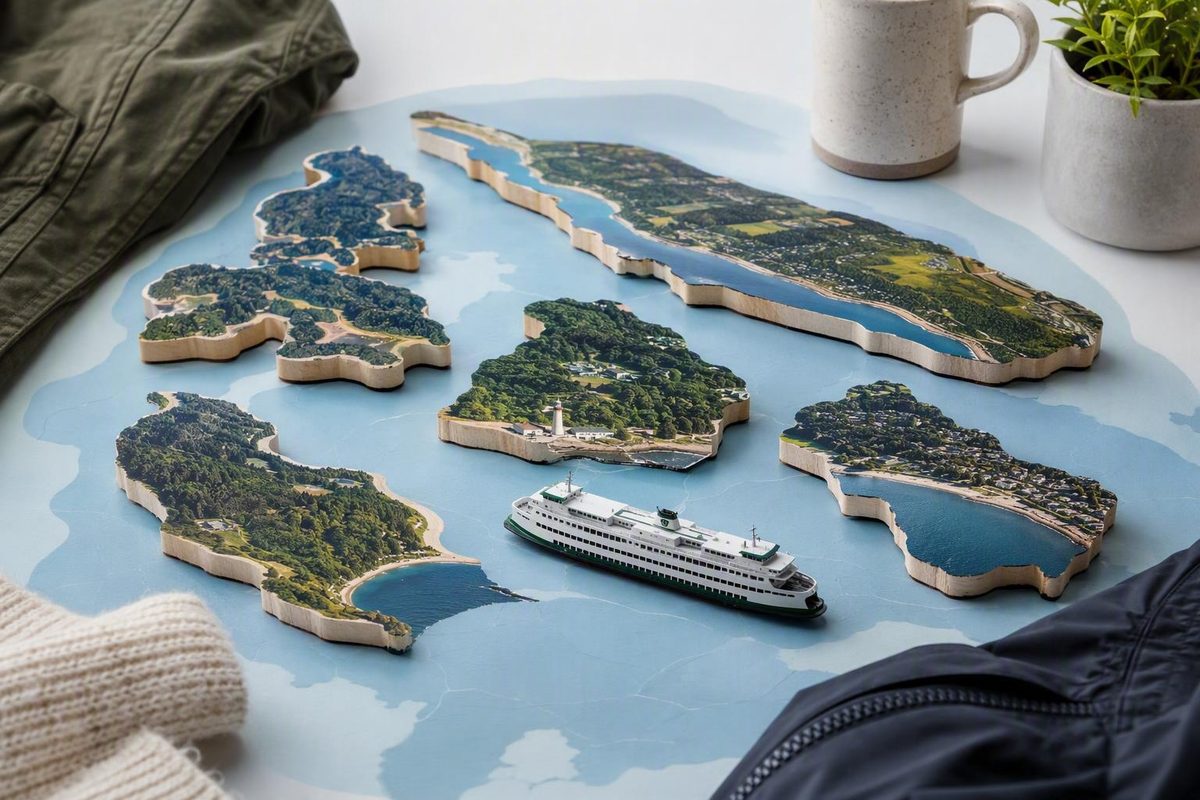
The most useful way to compare islands near Seattle is not by scenery alone. Start with the complete journey: where the boat or road begins, whether you need a car after arrival, what you can realistically reach, and how much margin the return requires.
For most first-time visitors, the choices break down like this:
- Bainbridge Island for the simplest walk-on outing from downtown Seattle.
- Vashon Island for a quieter rural day that rewards careful transit planning.
- Whidbey Island for a varied, vehicle-based road trip.
- Camano Island for a park day without ferry queues.
- San Juan, Orcas, or Lopez for an overnight or weekend rather than a quick Seattle excursion.
- Guemes, Lummi, Anderson, or Blake for specialized trips where limited access or services shape the plan.
This is a selective planning guide, not a complete inventory of Puget Sound or Salish Sea islands. It provides a high-level comparison rather than verified live operating information. Schedules, fares, parking, reservations, local transit, county-ferry procedures, and present visitor access can change and must be checked directly before travel.
Quick comparison: choose an island by time, transportation, and interests
For a first island day, choose Bainbridge and keep the outing centered on Winslow near the ferry terminal. Choose Vashon if coordinating a West Seattle departure with island transportation is acceptable. Choose Whidbey when you have a car and want to combine towns, history, beaches, and parks. Choose Camano when avoiding a ferry matters more than leaving directly from central Seattle. Give San Juan, Orcas, or Lopez at least one night whenever possible.
The table distinguishes terminal-area convenience from whole-island mobility. Its complexity, service, and vehicle assessments are planning judgments—not guarantees of current transportation, business availability, or accessibility.
| Island | Mainland departure or access | Planning complexity from Seattle | Arrival-area usefulness on foot | Vehicle need beyond arrival area | Planning assumption about services | Practical trip length | Signature interests |
|---|---|---|---|---|---|---|---|
| Bainbridge | Washington State Ferries from the Seattle waterfront | Low for a walk-on trip | Strong around Winslow | Helpful for outlying parks and gardens | Most useful near Winslow; verify individual venues | Half or full day | Museums, shops, food, waterfront walks, gardens, forest |
| Vashon | Fauntleroy in West Seattle for the usual Seattle-origin trip | Moderate to high | Ferry arrival is not a complete visitor district | Helpful; a bus-based day requires advance coordination | Dispersed and schedule-sensitive | Full day | Arts, farms, beaches, cycling, food and drinks |
| Whidbey | Mukilteo–Clinton ferry, Port Townsend–Coupeville ferry, or Deception Pass Bridge | Moderate to high | Some towns are walkable, but attractions are widely separated | Generally practical for a visitor itinerary | Concentrated in towns and dispersed elsewhere | Full day or overnight | Towns, beaches, history, parks, viewpoints |
| Camano | Road access through the Stanwood area; no ferry | Moderate driving, low marine complexity | No ferry-terminal district | Generally practical | Stops are spread across the island | Full day | State parks, beaches, marketplace, art |
| San Juan | Travel to Anacortes, then ferry to Friday Harbor | High | Friday Harbor provides a useful arrival hub | Helpful beyond town | Strongest around Friday Harbor; confirm seasonal services | Overnight or weekend | Museums, tours, Roche Harbor, parks, kayaking |
| Orcas | Anacortes ferry | High | Do not assume the ferry landing serves as a complete visitor base | Generally practical unless transfers are arranged | Concentrated around Eastsound and dispersed elsewhere | Weekend | Moran State Park, Mount Constitution, hiking, kayaking |
| Lopez | Anacortes ferry | High | Limited for a complete trip from the terminal alone | Bicycle or vehicle generally makes the island more usable | Dispersed and potentially seasonal | Overnight or weekend | Cycling, kayaking, farms, rural scenery |
| Guemes | County ferry from Anacortes | High | Limited for a broad island itinerary | Helpful for dispersed stops | Limited; verify all essentials | Full day or overnight with confirmed lodging | |
| Lummi | Local ferry access through the Bellingham area | High | Limited | Helpful | Limited and not assured by this guide | Overnight or carefully planned full day | Arts, rural atmosphere, quiet retreat |
| Anderson | Local ferry from Steilacoom | High | Limited | Generally helpful | Limited and not assured by this guide | Full day or overnight | Parks, nature reserves, low-key retreat |
| Blake | No Washington State Ferries service; present transportation must be independently established | Very high | Not applicable | Not a conventional driving destination | Very limited; this guide cannot verify a current visitor-access plan | Specialized outing only | Shoreline and trails where access is confirmed |
Direct from central Seattle: Bainbridge is the clear option in this comparison. Its ferry departs from the Seattle waterfront and arrives near Winslow.
Reached through another mainland terminal: A typical Seattle-origin Vashon trip begins at Fauntleroy. South Whidbey begins at Mukilteo, while San Juan, Orcas, and Lopez require a trip to Anacortes. Anderson is approached through Steilacoom, Guemes uses a county ferry from Anacortes, and Lummi relies on a separate local system near Bellingham.
Reached by road: Camano avoids ferries. Whidbey can also be entered from the north over Deception Pass Bridge, although that creates a substantially different driving itinerary from the Mukilteo ferry approach.
Reached by independently arranged marine transportation: Blake is not served by Washington State Ferries. A regional travel account also reports that former commercial excursion service has closed, so this guide cannot provide a verified present-day access plan. Do not treat Blake as an ordinary ticketed day trip from Seattle. The Emerald Palate describes the lack of WSF service and closure of the former excursion operation.
No ferry crossing time should be converted into a door-to-door estimate. Driving to a terminal, parking, joining a vehicle queue, ticketing, boarding, making local connections, and preserving a workable return can add considerably more time than the crossing itself.
Start with the real journey, not the ferry crossing time
There are five basic access patterns:
- Direct ferry from downtown Seattle: Bainbridge is the most useful visitor example because the crossing starts on the central waterfront and ends near a usable town center.
- King County also offers weekday-only Water Taxi service to downtown Seattle Whidbey vs Bainbridge vs Vashon: Which Island Fits?.
- Bridge access: Camano is reached by road, while north Whidbey can be reached through Deception Pass.
- County or local ferry: Guemes, Lummi, and Anderson use systems separate from Washington State Ferries.
- Independently arranged marine access: Blake requires current transportation and access confirmation; this article does not establish a viable plan.
That first positioning trip often determines whether the outing makes sense. A short crossing after a long drive, uncertain parking, and a vehicle line may require more effort than a longer walk-on crossing from downtown.
Walking on avoids the vehicle queue and the risk that your car will not fit on the desired sailing. It works best when useful attractions are near the arrival terminal or when current island transit, taxis, rentals, or prearranged transportation can complete the trip.
Driving aboard opens access to beaches, trailheads, gardens, historic sites, and rural businesses that may be impractical on foot. It also introduces vehicle capacity, possible waits, parking, and route-specific reservation or check-in rules. Those operational details are not verified here and should never be inferred from a general travel article.
For Washington State Ferries routes, use the official WSDOT system for current schedules, tickets, terminal information, rider guidance, real-time travel data, and alerts. The WSDOT first-time rider portal provides access to those official ferry resources. For Guemes, Lummi, or Anderson, use the relevant county or local operator rather than assuming WSF rules apply.
A reliable short-trip pattern is one island, one anchor activity, and a generous buffer. Do not build a fragile itinerary around several islands, a restaurant reservation immediately after docking, and the final practical return. On islands with limited evening transportation or lodging, a missed connection can alter the entire trip.
Do not rely on this or any other static guide for current fares, parking availability, reservation policies, check-in deadlines, or final sailings. Verify those details shortly before departure and again whenever a disruption would threaten the return.
Pre-departure checklist
- Confirm at least two workable outbound options.
- Identify a preferred return and a later fallback.
- Check official service alerts before leaving your Seattle base.
- Confirm the exact mainland terminal.
- Decide how you will travel after arrival: walking, driving, cycling, transit, taxi, rental, or prearranged transfer.
- Confirm that any last-mile transportation operates on your date.
- Check weather and daylight for exposed walks and rural roads.
- Verify attraction and business opening days directly.
- Carry food and water when visiting a limited-service destination.
- Decide what you will do if a sailing is full, delayed, or canceled.
- Avoid depending on the last practical connection unless you are prepared to stay overnight.
Bainbridge Island: the simplest first island day from downtown
Bainbridge is the strongest first choice for visitors who want an island experience without making transportation the main project. Published estimates place the Seattle–Bainbridge crossing at roughly 30–35 minutes: Seattle magazine describes it as about 30 minutes, while Visit Seattle gives a 35-minute estimate. Seattle magazine’s regional overview supports the lower end, and Visit Seattle supports the upper end.
Those estimates refer to the crossing, not the complete journey. You still need time to reach the terminal, wait, board, disembark, and preserve a practical return.
Bainbridge’s principal advantage is what happens after arrival. Winslow begins near the ferry terminal, allowing a visitor to reach shops, restaurants, the waterfront, and the Bainbridge Island Museum of Art without arranging a car. That makes a compact day more resilient than one in which the ferry landing and desired attractions are widely separated.
But “easy without a car” applies mainly to Winslow and nearby waterfront areas, not the whole island. Bloedel Reserve, Grand Forest, Gazzam Lake, and other outlying destinations create a last-mile problem. Depending on the date and destination, the solution may be transit, cycling, a taxi, a prearranged ride, or a vehicle—but availability must be confirmed rather than assumed.
A realistic car-free half day
- Walk onto the ferry from downtown Seattle.
- Visit the Bainbridge Island Museum of Art after arrival.
- Continue into Winslow for shops, coffee, or lunch.
- Add a short waterfront walk.
- Return to the terminal with time for a slower meal or changed sailing.
This itinerary works because the stops remain in one compact arrival zone. It also adapts well to rain: shorten the waterfront segment and spend more time in the museum, shops, or a café.
A realistic full day
Use the same Winslow core and add one outlying anchor. Bloedel Reserve works for visitors interested in gardens and designed landscapes; Grand Forest works for a woodland walk. Before committing, verify transportation in both directions, current admission or reservation requirements, opening hours, and the return margin.
Other possible stops include the Bainbridge Island Historical Museum, Kids Discovery Museum, Sakai Park, the Japanese American Exclusion Memorial, and the Waterfront Trail. Treat them as a menu rather than a checklist. Trying to combine several outlying sites with multiple museums, a long meal, and a waterfront walk can turn a simple day into a series of transfers.
Choose Bainbridge when your priorities are a direct downtown crossing, a useful town center near the terminal, and an outing that still works if you do not arrange island transportation. Bring a vehicle only when a specific outlying attraction justifies the additional logistics.
Vashon, Whidbey, and Camano: three different full-day escapes
These three islands produce very different journey shapes:
- Vashon: West Seattle ferry plus island transportation.
- Whidbey: ferry or bridge plus a regional driving itinerary.
- Camano: road-only trip with no sailing to catch.
Vashon: a coordinated rural outing
Vashon suits travelers interested in arts, farms, parks, beaches, cycling, and locally produced food or drinks. Its stops are more dispersed than Winslow’s, and the ferry arrival should not be mistaken for a compact visitor district.
A car makes it easier to combine the town center with a beach, park, farm, arts stop, or producer. A transit-based trip can work, but it must be designed around the current bus schedule. Seasonal and weekend opening patterns may also matter for galleries, tasting venues, and rural food stops.
Published sources give conflicting Vashon crossing estimates, likely reflecting different assumptions or routes. No single universal crossing duration is reliable enough to use here. Confirm the exact route and official schedule for your date.
Sample transit-planned Vashon day
- Reach the Fauntleroy terminal with a generous connection margin.
- Walk onto the appropriate sailing.
- Use confirmed island transportation to reach the town center.
- Choose lunch, shops, or an arts stop there.
- Add only one park, beach, or producer if the round-trip local connection works.
- Start back before the plan depends on a final bus-to-ferry transfer.
Vashon is a better fit than Bainbridge when rural character is the point and transportation coordination does not feel burdensome. It is a worse fit when you want to step off a downtown ferry and improvise entirely on foot.
Whidbey: a regional road trip
Whidbey offers the broadest road-trip variety among these three islands. Langley, Coupeville, Ebey’s Landing, Fort Casey, beaches, viewpoints, and Deception Pass can each anchor a day. Access is possible through the Mukilteo–Clinton ferry, the Port Townsend–Coupeville ferry, or Deception Pass Bridge.
The entry point changes the trip. Arriving at Clinton naturally favors south and central Whidbey. Driving over Deception Pass favors the north. Entering from Port Townsend may fit a wider Olympic Peninsula itinerary, but it is not the obvious route for every Seattle visitor.
Whidbey takes more than an hour to drive from north to south, so attempting the entire island in one day usually produces more driving than exploring. The Emerald Palate’s comparison supports the north-to-south traversal estimate.
Sample south or central Whidbey day
- Drive to Mukilteo and take the ferry to Clinton.
- Begin in Langley for a walk and meal.
- Choose either a central-island history-and-landscape anchor such as Ebey’s Landing or Fort Casey, or a second south-island stop.
- Return through Clinton unless a longer northbound road trip is part of the deliberate plan.
A route continuing through Deception Pass can work as a substantial one-way loop, but it should not be treated as an effortless alternative to returning by ferry. A car and a full day are practical planning assumptions; an overnight makes it easier to combine the island’s regions without rushing.
Camano: a ferry-free park day
Camano removes the sailing variable. You drive north through the Stanwood area and continue onto the island by road. This does not eliminate traffic, but it removes ferry capacity, vehicle queues, and missed-sailing concerns.
Possible anchors include Camano Island State Park, Cama Beach State Park, Camano Commons, and an art stop. These destinations do not form a walkable arrival district, so a vehicle is the practical planning choice for most visitors.
Sample Camano loop
- Choose one state park as the day’s main outdoor stop.
- Add Camano Commons for food or a marketplace visit.
- Include one gallery or art destination after confirming current hours.
- Return by road without structuring the evening around a ferry departure.
Choose Camano when you want shoreline or forest time but prefer highway traffic to ferry uncertainty. It is also a useful alternative when a ferry-dependent vehicle trip has become too fragile.
San Juan, Orcas, and Lopez: plan a destination trip, not a quick ferry outing
Three naming distinctions matter:
- San Juan Island is one island in the wider San Juan Islands archipelago.
- Friday Harbor is the principal visitor hub on San Juan Island.
- Orcas and Lopez are separate islands with different transportation and activity patterns.
Washington State Ferries serving Lopez, Orcas, San Juan, and Shaw depart from Anacortes, not downtown Seattle. Reaching Anacortes adds a substantial road journey before terminal procedures, waiting, boarding, and the ferry crossing.
One Seattle-focused guide estimates roughly three hours outbound for the combined drive-and-ferry journey. That is an illustration, not a guaranteed door-to-door time, and may not include every delay or connection. The guide also distinguishes the visitor profiles of San Juan, Orcas, and Lopez.
That total effort is why San Juan, Orcas, and Lopez are better treated as overnight or weekend destinations. A same-day visit may be technically possible on selected schedules, but technical possibility is not the same as a resilient or enjoyable itinerary.
San Juan Island: services and tours around Friday Harbor
San Juan Island offers the most immediately useful arrival hub of the three. Friday Harbor has shops, restaurants, museums, lodging, and departing tours. Beyond town, possible destinations include Roche Harbor, parks, beaches, and the San Juan Islands Sculpture Park.
A walk-on overnight can work if the first day stays centered on Friday Harbor and transportation for any outlying destination is arranged in advance. Wildlife and whale-watching tours are possibilities, not guarantees of seeing any particular species.
Realistic trip shape: Arrive in Friday Harbor, explore town and one nearby attraction, stay overnight, and use the next morning for a museum, tour, or prearranged island excursion before returning.
Orcas Island: mountainous terrain and a dispersed itinerary
Orcas is the strongest match for travelers prioritizing hiking, forests, Moran State Park, and Mount Constitution. Eastsound provides a useful concentration of food, lodging, and shops, but visitors should not assume they can step off the ferry and complete the desired itinerary on foot.
Arrange transportation to Eastsound and any park destinations before arrival, or bring a vehicle after confirming current ferry procedures.
Realistic trip shape: Spend a weekend based near Eastsound, devote a separate day to Moran State Park and Mount Constitution, and avoid combining a major hike with both legs of the Seattle journey.
Lopez Island: cycling and rural scenery
Lopez is associated with cycling, kayaking, farms, Lopez Village, and a quieter rural setting. That does not automatically make it an easy cycling trip. Ferry procedures, road conditions, distances, luggage, weather, daylight, and lodging location all affect feasibility.
Realistic trip shape: Bring a bicycle only after confirming ferry procedures and the complete route, stay overnight, and use Lopez Village or confirmed lodging as a base. Do not assume bicycle rentals or other transportation will be available after arrival.
The official tourism site maintains separate planning material for Lopez, Orcas, and San Juan Island, including transportation, lodging, recreation, and accessibility resources. Use the San Juan Islands Visitors Bureau site to compare island-specific information.
Walk-on passengers may avoid vehicle-queue and reservation complications, but they still need onward mobility. Seasonal transit, taxis, rentals, and tour transfers can vary by island and date. Vehicle reservation and check-in rules can also change, so confirm both outbound and return requirements through Washington State Ferries.
Quieter and limited-service choices: Guemes, Lummi, Anderson, and Blake
Guemes, Lummi, Anderson, and Blake are specialized choices. They are not simply quieter versions of Bainbridge: none combines a downtown Seattle departure with a useful walkable arrival hub.
The service descriptions below come from travel accounts rather than live operator information. This guide does not verify current schedules, fares, parking, vehicle procedures, food, lodging, or local transportation for these islands.
Guemes Island
Guemes is reached by a county ferry from Anacortes rather than Washington State Ferries. WSF tickets, alerts, and operating assumptions therefore do not govern the trip.
Possible outdoor anchors identified in the supplied travel reporting include Guemes Mountain, Peach Preserve, and Kelly’s Point. Limited services make it prudent to bring food and water and establish the return plan before departure.
Guemes suits a visitor who wants a focused hike or shoreline outing and accepts the additional trip to Anacortes plus a separate ferry system. It is not an efficient choice for someone with only a few free hours in downtown Seattle.
Lummi Island
Lummi is described in regional travel reporting as a small, arts-oriented island approached through the Bellingham area using a local ferry system. The same reporting describes dining and lodging as limited, but it should not be used to assume any particular business will be open.
Plan around a confirmed same-day return or a confirmed place to stay. Verify current ferry operations, parking, food, lodging, and onward transportation directly.
Anderson Island
Anderson is reached through Steilacoom using a local ferry system. A regional travel account identifies parks, nature reserves, a general store, and limited services, but it does not establish present opening hours or transportation availability.
The trip is more naturally suited to travelers already positioned south of Seattle or combining it with a South Sound itinerary. From central Seattle, reaching Steilacoom is a substantial part of the outing.
Blake Island
Blake is not served by Washington State Ferries, and the supplied travel reporting says former commercial excursion service has closed. This guide therefore cannot confirm an ordinary visitor route or recommend Blake as a casual day trip.
Mentions of private boats or kayaks in travel accounts should not be treated as an access recommendation. Unless you can independently establish current transportation, permission, conditions, and a return plan appropriate to your experience, choose a serviced island instead.
Limited-service island readiness checklist
Before choosing Guemes, Lummi, Anderson, or Blake, confirm:
- Transportation in both directions
- The responsible ferry or transportation operator
- Current access conditions
- Food and drinking water
- Restroom availability
- Communications
- Weather and daylight
- Lodging if a same-day return fails
- A fallback if the crossing or activity cannot proceed
Do not assume restaurants, lodging, bicycle rentals, taxis, fuel, medical services, or shops will be available because an older article mentions them. A regional roundup describes Guemes, Lummi, and Anderson as limited-service destinations reached through distinct local ferry approaches. See the underlying island descriptions in Postcards to Seattle.
Match the island to what you want to do
There is no single useful ranking of islands near Seattle. Start with the activity, then apply your transportation and time limits.
| What you want | Strongest fit | Why it fits | Main limitation |
|---|---|---|---|
| Walkable arrival-area day | Bainbridge | Winslow’s museums, shops, food, and waterfront are near the ferry | The recommendation does not extend to the whole island |
| Varied road trip | Whidbey | Towns, beaches, parks, history, and viewpoints can be combined by region | Large, dispersed, and easy to overplan |
| Ferry-free park day | Camano | Road access removes sailing and ferry-capacity uncertainty | A car remains useful, and traffic is still possible |
| Arts, farms, and rural atmosphere | Vashon | Dispersed arts and producer stops create a different pace | Ferry, bus, and business hours require coordination |
| Mountain-oriented hiking | Orcas | Moran State Park and Mount Constitution anchor the itinerary | Anacortes access and island transportation favor a weekend |
| Cycling and rural scenery | Lopez | Rural roads, farms, and village stops suit a cycling-focused stay | Road comfort, weather, logistics, and services require checking |
| Visitor services and tours | San Juan Island | Friday Harbor provides a practical visitor hub | Outlying destinations still require transportation |
| Greater separation from the main visitor circuit | Guemes, Lummi, Anderson, or Blake | More complicated access and fewer services can reduce casual visitation | Transportation and basic services require significantly more work |
For walking: Choose Bainbridge, but define the plan narrowly. A Winslow-centered day is walkable; “Bainbridge without a car” is too broad a promise.
For hiking: Bainbridge offers woodland walks with simpler overall access. Whidbey combines coastal and historical landscapes. Orcas is the mountain-oriented choice, but it deserves more time.
For cycling: Lopez is the clearest destination-focused choice, while Vashon and Camano may interest experienced road cyclists. The evidence available here is insufficient to rank bicycle safety, shoulder width, traffic stress, gradients, or route protection. Check current conditions and match the ride to your ability.
For arts and food: Bainbridge is simplest when you want museums, shops, and meals in a compact district. Vashon better fits a rural arts-and-producers day if hours and transportation are confirmed. San Juan Island provides more visitor infrastructure around Friday Harbor but requires substantially more travel from Seattle.
For beaches and parks: Whidbey provides broad variety for a driving itinerary. Camano is the straightforward ferry-free alternative. Vashon works best when you select one beach or park rather than attempting several scattered stops by limited transit.
For families: Bainbridge’s compact Winslow plan reduces transfers and makes it easier to alternate indoor and outdoor stops. Camano can simplify gear management because the car stays with you. For any ferry-dependent driving trip, carry food, layers, and something to do during an unexpected wait.
For visitors with limited mobility: Terminal proximity is not a complete accessibility answer. Confirm boarding procedures, elevators, ramps, local transit, restrooms, trail surfaces, attraction entrances, and distances between stops. The supplied evidence is not sufficient to rank these islands for accessibility.
Build a resilient island day: weather, seasons, and ferry disruptions
A resilient island plan has three parts:
- One island
- One anchor activity
- One flexible secondary stop
That structure leaves room for traffic, a later sailing, a longer meal, or a weather change. Island hopping may look efficient on a map, but each additional crossing introduces another timetable, terminal, boarding process, and failure point.
Ferry delays or cancellations can result from staffing or mechanical problems, while vehicle waits may increase during weekends, holidays, commute periods, and disruptions. San Juan Islands visitor guidance specifically advises travelers to monitor ferry alerts because service can be delayed or canceled. Review its ferry-planning and disruption guidance for Anacortes routes.
Check official alerts at three points:
- Before leaving your hotel or Seattle base
- Before driving a substantial distance to a mainland terminal
- Before beginning the final activity that precedes your return
Seasonal transit, tours, rentals, restaurants, tasting rooms, galleries, and attractions may operate fewer days or shorter hours outside peak periods. Some may be weekend-only. Confirm directly with the operator or venue whenever a closure would undermine the trip.
A workable bad-weather pattern
Alternate short outdoor segments with indoor anchors. On Bainbridge, that might mean a waterfront walk between a museum, shops, and lunch. On Whidbey, pair a brief beach or bluff stop with a town or historical attraction. On San Juan Island, keep the first day near Friday Harbor rather than committing immediately to a long exposed excursion.
In heavy rain or wind:
- Shorten exposed shoreline and bluff walks.
- Avoid making one weather-dependent activity the sole reason for the trip.
- Keep dry clothing accessible.
- Preserve enough time to reach the terminal without rushing.
- Follow posted closures and restrictions.
Disruption fallbacks
- Switch from driving aboard to walking on only if the destination still works without the car.
- Replace a ferry-dependent outing with Camano when a road-based park day meets the same goal.
- Keep the day in Seattle if reaching the island would leave too little usable time.
- Remove the outlying attraction and retain a terminal-area plan.
- Stay overnight only when lodging is genuinely confirmed.
The final decision should be based on usable time and last-mile mobility, not a generic ranking of beautiful islands. Keep a first walk-on trip centered on Bainbridge. Use Vashon for a coordinated transportation day. Give Whidbey or Camano a car and a regional focus. Give San Juan, Orcas, or Lopez at least an overnight whenever possible.
Before you leave
Verify current schedules, service alerts, terminal status, tickets, fares, vehicle reservation rules, check-in requirements, parking conditions, local transit, county-ferry operations, attraction hours, weather, and the final practical return. Use Washington State Ferries for WSF routes and the responsible county or local operator for Guemes, Lummi, and Anderson. This article does not represent a live operational check.
Frequently asked questions
What is the easiest island to visit from downtown Seattle?
Bainbridge Island is the easiest under clear criteria: it has a direct ferry from the Seattle waterfront, Winslow begins near the arrival terminal, and a useful cluster of museums, shops, restaurants, and waterfront sights can be reached without arranging a car.
The recommendation applies primarily to a Winslow-centered visit. Bloedel Reserve, Grand Forest, and other outlying attractions may require confirmed transit, cycling, taxi service, a prearranged ride, or a vehicle.
Can I visit an island near Seattle without a car?
Yes. Bainbridge is the most straightforward option because useful attractions are near the Winslow terminal. A car-free half day can combine the Bainbridge Island Museum of Art, shops or lunch in Winslow, and a waterfront walk.
Vashon can work without a car if the mainland connection, ferry, island bus, and return are coordinated. In the San Juans, walking onto the ferry may simplify boarding, but it does not solve transportation after arrival.
“Can I board without a car?” and “Can I explore the island without a car?” are different questions. Always verify the last-mile connection.
Are the San Juan Islands a realistic day trip from Seattle?
A same-day trip may be technically possible on selected schedules, but it is not an easy or resilient plan. The ferries begin in Anacortes, so the journey includes a substantial drive, terminal procedures, a ferry crossing, and onward transportation.
San Juan Island, Orcas, and Lopez are better treated as overnight or weekend destinations. For a first visit, consider a Friday Harbor-centered overnight, an Orcas weekend built around Moran State Park, or a Lopez stay designed around cycling and rural scenery.
Should I walk onto the ferry or take a car?
Walk on when useful attractions are near the terminal or when onward transportation is confirmed. This avoids the vehicle queue and works particularly well for a Winslow-centered Bainbridge day.
Take a car when the plan depends on dispersed parks, trailheads, beaches, rural businesses, or lodging. A vehicle generally makes Whidbey and Camano more practical and may be useful on Orcas or Lopez, subject to current ferry procedures.
A car expands access but adds waiting, parking, capacity constraints, and possible reservation requirements. Verify current rules for both directions.
Which island near Seattle does not require a ferry?
Camano Island is the clearest ferry-free choice in this guide. It is reached by road through the Stanwood area and suits a vehicle-based day involving Camano Island State Park, Cama Beach State Park, Camano Commons, or an art stop.
Whidbey can also be reached without a ferry by driving to its north end and crossing Deception Pass Bridge, but that produces a longer road-trip pattern from Seattle. For a simpler ferry-free island day, choose Camano and confirm traffic, park conditions, attraction hours, weather, and the return route before departure.