
How to See Seattle’s Central Sights Without Crisscrossing the City
Link Pike Place Market and the waterfront as one central cluster, then decide whether one Seattle Center attraction fits your day.
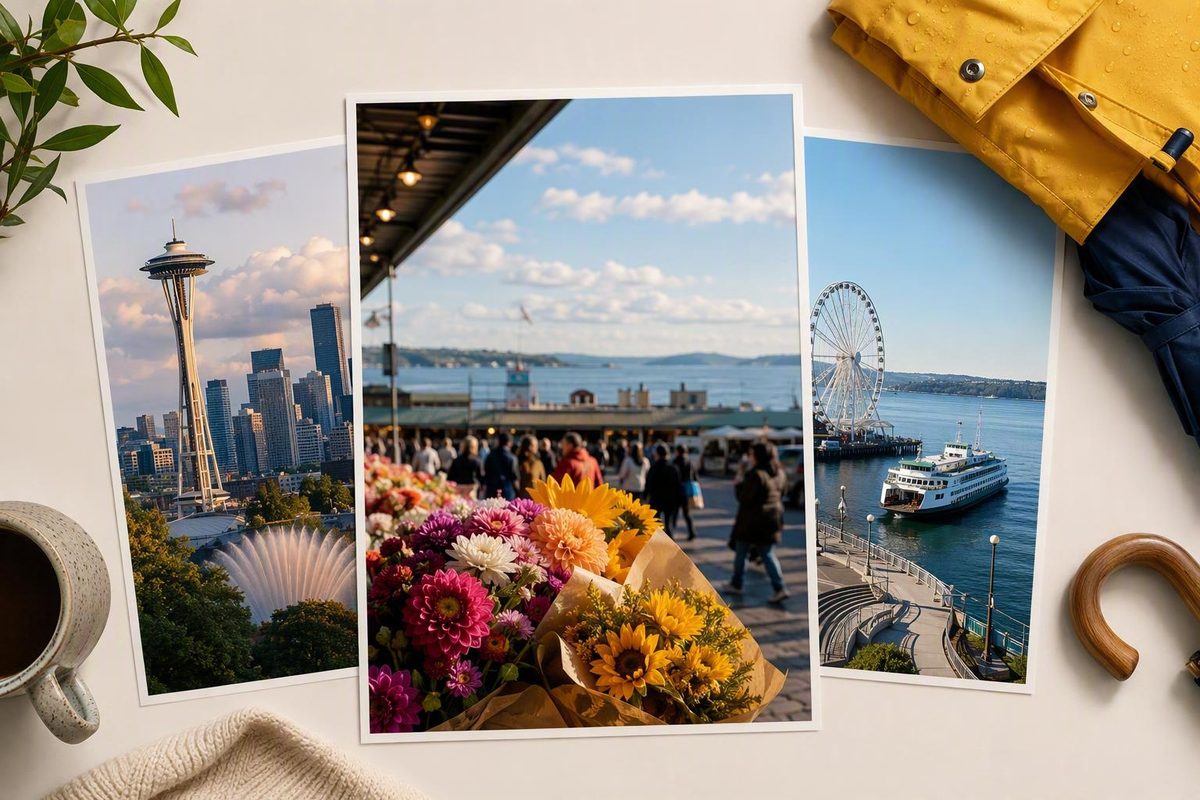
Seattle’s famous attractions do not occupy one compact “downtown.” Pike Place Market, Seattle Art Museum, Seattle Central Library, and the central waterfront form a practical core. Pioneer Square extends the route south into a neighboring historic district. Olympic Sculpture Park lies north along the waterfront, while the Space Needle and several major museums occupy Seattle Center farther beyond it. Kerry Park is farther north in Queen Anne.
That geography should shape a first or short visit. Use Pike Place Market as the central anchor, connect it with the waterfront and one or two nearby cultural or historic stops, and treat Seattle Center, a ferry crossing, a cruise, Olympic Sculpture Park, and Kerry Park as optional modules. This keeps the route manageable without a car and leaves time to experience places rather than merely photograph their entrances.
The central planning rule is simple: choose one anchor activity, add supporting stops in the same direction, and keep a dry alternative ready. Before leaving, verify current hours, admission, timed-entry rules, performance schedules, attraction access, and transit service with the relevant operators.
Start with the map: what counts as downtown Seattle?
For this guide, the practical downtown core is the compact central area containing Pike Place Market, Seattle Art Museum, Seattle Central Library, and the central waterfront. These sights can be connected on foot without turning the day into a citywide transit exercise.
The surrounding districts require a little more precision:
- Pioneer Square is a historic district immediately south of the core. It is distinct from downtown but fits naturally into a central Seattle walking day.
- Belltown lies generally north of the Pike Place area and often serves as the transition toward Olympic Sculpture Park and Seattle Center.
- Olympic Sculpture Park is north of the central core on the waterfront. It is often combined with Belltown or Seattle Center routes.
- Seattle Center is north of downtown. Its campus contains the Space Needle, Chihuly Garden and Glass, the Museum of Pop Culture, Pacific Science Center, International Fountain, Climate Pledge Arena, KEXP Gathering Space, and other cultural and event venues.
- Kerry Park is in Queen Anne, not downtown. It requires a deliberate extension beyond Seattle Center or a separate outing.
Visitor itineraries sometimes blur these labels because the attractions appear close on a city map. Yet proximity on a map does not make them one stop. A hotel-produced central Seattle itinerary, for example, places the library, Pike Place Market, Seattle Art Museum, Olympic Sculpture Park, and Seattle Center across a broader sequence rather than treating them as one compact cluster in its suggested itineraries.
A useful way to picture the route is as a south-to-north corridor:
Pioneer Square → Central Library and downtown arts → Pike Place Market → Overlook Walk and central waterfront → Belltown and Olympic Sculpture Park → Seattle Center → Queen Anne and Kerry Park
You can walk substantial portions of that corridor, but covering the distance is not the same as visiting every attraction. A museum, scheduled tour, observation deck, cruise, ferry crossing, performance, or substantial meal introduces opening hours, queues, ticketing, or a fixed departure.
District labels therefore serve a practical purpose: they prevent overplanning. Calling Seattle Center and Kerry Park “downtown” can make a schedule look compact even when it involves several transitions. Adding a ferry and multiple museums makes that schedule still more vulnerable to weather, sold-out entries, service changes, and missed departures.
For most first-time visitors, three clusters are enough:
- Pioneer Square for history.
- Pike Place Market and the central waterfront for food, street life, and water views.
- Either downtown culture or one Seattle Center attraction for a substantial indoor or ticketed experience.
This framework works particularly well for cruise passengers, conference attendees, and travelers with only part of a day. It also lets you remove one cluster without rebuilding the entire route.
The essential downtown sights at a glance
The table below compares the principal central options. Cost categories are intentionally broad because admission and visitor rules can change. “Public-space visit” means that the district or exterior can be explored without treating it as a ticketed attraction; food, shopping, tours, exhibitions, and special programming remain separate decisions.
| Sight | District | Setting | Cost category | Likely role in the itinerary | Best suited to |
|---|---|---|---|---|---|
| Pike Place Market | Downtown core / Pike Place historic district | Mixed indoor and outdoor | General browsing does not function as a single ticketed attraction; purchases, tours, meals, and classes cost extra | Primary food, shopping, craft, and street-life anchor | First-time visitors, food-focused travelers, photographers, shoppers |
| Seattle Central Library | Downtown core | Primarily indoor | Confirm current public visitor access | Short architecture stop or wet-weather pause | Architecture and design interests |
| Seattle Art Museum | Downtown core | Indoor, with exterior public art nearby | Check current gallery admission and visitor rules | Major cultural anchor or shorter exterior stop | Art-focused visitors and rainy-day planners |
| Central waterfront | Waterfront edge of downtown | Primarily outdoor, with indoor attractions | Public-space walk or paid attraction, depending on the plan | Scenic connector between the Market and piers | Walkers, families, photographers |
| Pioneer Square | Historic district south of downtown | Mixed indoor and outdoor | Public district exploration; individual attractions vary | Architecture and city-history cluster | History and architecture interests |
| Klondike Gold Rush museum | Pioneer Square | Indoor | Described by the supplied evidence as free | Self-guided historical alternative or complement to a tour | Budget-conscious visitors and history interests |
| Seattle Underground | Pioneer Square | Below modern street level | Bookable guided-tour experience | Structured interpretation of the historic district | Visitors who prefer guided storytelling |
Pike Place Market deserves more than a photograph beneath its sign. It can organize the day around food, crafts, shopping, street activity, or a scheduled experience.
Seattle Central Library is primarily an architecture-oriented stop rather than a conventional sightseeing attraction. A central itinerary describes its distinctive structure as an 11-story design in its downtown route. If you are not planning an extended visit, the building can still serve as a visual starting point before you continue toward Seattle Art Museum and Pike Place Market.
The scheduling choice is whether the museum becomes the day’s anchor or a supporting stop. Entering the galleries requires more room than seeing the building and nearby exterior public art.
Pioneer Square is the guide’s recommended central history cluster. Underground passages remain beneath parts of the district at the former street level, while the National Park Service-operated Klondike Gold Rush museum offers a self-directed alternative described as free in the supplied evidence for a Pioneer Square itinerary. A guided underground tour adds interpretation and access to tour-specific areas, but it also introduces a ticket and fixed start time.
Not every downtown venue needs to occupy the daytime route. Benaroya Hall, The 5th Avenue Theatre, and The Triple Door are better considered as performance or evening options. Their relevance depends on what is scheduled during your visit, not simply on seeing the buildings from outside.
Likewise, Ye Olde Curiosity Shop can add character to a waterfront walk, but it is an optional detour rather than a universal priority. The route works best when every added stop reflects an actual interest—food, art, history, architecture, shopping, performance, or views.
How to explore Pike Place Market without treating it as one stop
Pike Place Market is not one sight. It is a layered district containing food businesses, shops, craftspeople, farmers, permitted buskers, produce, seafood, flowers, restaurants, and prepared food.
The Market was established in 1907 and covers a nine-acre historic district across 10 levels. It operates seven days a week except Thanksgiving and Christmas Day, but schedules vary among merchants, restaurants, farm tables, craftspeople, and food businesses according to the Market’s visitor information.
That variety supports several different kinds of visit:
- Meal anchor: Build the Market portion around breakfast, lunch, dinner, or progressive snacking.
- Shopping anchor: Concentrate on crafts, specialty foods, flowers, books, gifts, and locally made products.
- Tour anchor: Let a prebooked food or history tour determine the surrounding schedule.
- Class anchor: Reserve a cooking class and keep the rest of the Market visit selective.
- Photography anchor: Explore signs, produce displays, overlooks, street activity, Post Alley, and the lower levels.
- Browsing anchor: Wander without a checklist, but set a stopping or spending limit if another attraction matters later.
Choose one of those modes instead of trying to complete all of them. A food tour, full restaurant meal, cooking class, detailed shopping session, and photography walk are separate experiences competing for the same day.
Do not skip the lower levels
Many first-time visitors remain near the most visible stalls and the Pike Place sign. That is the busiest and most recognizable layer, but not the whole district. The lower levels and surrounding passages contain additional small businesses and give the Market more depth than its street-facing photographs suggest.
Let your priorities determine the sequence. If food is the focus, begin with the vendors or meal you most care about. If shopping is the focus, save attention and carrying capacity for the less visible levels rather than buying everything near the first entrance.
Post Alley and the Gum Wall are nearby visual detours. They can be included without becoming the purpose of the visit. Stop if they interest you, then return to the vendors, craftspeople, restaurants, and layered interiors that give the Market its substance.
The same caution applies to the Starbucks at 1912 Pike Place. It is often called the original store, but the more accurate shorthand is the longest-operating location after the business moved there as described in a first-timer itinerary. Whether its line is worth joining is a personal tradeoff. If the storefront itself matters, make it one of your chosen Market experiences. If your goal is simply coffee, waiting can displace browsing, a meal, or the waterfront.
Early versus later: there is no perfect arrival time
An early arrival can mean lighter foot traffic and clearer sightlines. It can also mean that many shops and craftspeople have not begun operating. Later in the morning, more of the Market may be active, but busier pathways and queues can slow your progress.
Choose your timing according to the experience you want:
- Go earlier for breakfast, produce, seafood activity, photography, or a quieter first look.
- Go later in the morning or during the afternoon if shopping, craftspeople, buskers, and a broader range of open businesses matter more.
- Go in the evening for a restaurant or atmospheric walk, while recognizing that the daytime vendor experience may be winding down.
The Market’s site provides a live business directory, interactive map, and visitor guide. It also states that vehicle access on Pike Place is restricted during selected daytime hours beginning at 10 a.m. under a pilot arrangement that may change in its current planning guidance.
The useful scheduling question is not “How long does Pike Place take?” It is “What am I doing there?” A quick visual circuit, seated meal, tour, cooking class, and shopping session are different commitments. Decide which one anchors the day, then attach the waterfront, a museum, or Pioneer Square around it.
Walk the waterfront from Overlook Walk to Olympic Sculpture Park
It opened in 2024 and connects the Market area with the Seattle Aquarium and waterfront. The same central attractions overview identifies the aquarium at Pier 59, the Seattle Great Wheel at Pier 57, Pier 62, downtown ferry and water-taxi connections, and Olympic Sculpture Park as parts of the broader waterfront landscape in its Seattle sightseeing guide.
From the Market, use this sequence:
- Reach Overlook Walk.
- Pause for water and city perspectives.
- Descend toward the aquarium and piers.
- Choose one short southern or northern waterfront segment.
- Continue north only if Olympic Sculpture Park belongs in the plan.
Possible waterfront stops include:
- Seattle Aquarium
- Seattle Great Wheel
- Pier 62
- Waterfront promenades and public spaces
- Restaurants and shops
- Harbor-cruise departure points
- Ferry and water-taxi terminals farther south
These are options, not a checklist. The waterfront can be a scenic connector or become the day’s paid anchor through an aquarium visit, wheel ride, or cruise. Trying to treat every pier attraction as a quick stop usually produces repeated queues and ticket decisions rather than a coherent walk.
Set realistic expectations for the views. Puget Sound, the piers, and the city are part of the immediate setting. Distant mountains may appear when weather and visibility cooperate, but no route can guarantee them. Plan around the waterfront and urban landscape you can reliably experience.
For an unusual detour, Ye Olde Curiosity Shop displays curiosities and kitsch. The supplied guide describes exhibits that include mummies, shrunken heads, and a Fiji Mermaid in its collection of unusual Seattle attractions. It suits travelers who enjoy odd collections, but it need not replace a more meaningful food, art, or history stop.
Continuing north to Olympic Sculpture Park
If weather and energy remain favorable, continue north along the waterfront toward Olympic Sculpture Park. The park is a free, nine-acre waterfront extension of Seattle Art Museum featuring large-scale outdoor installations according to the central attractions overview.
It fits particularly well when:
- You want outdoor art without committing to another indoor museum.
- The weather favors walking.
- You are already moving toward Belltown or Seattle Center.
- You want a flexible stop without a fixed entry time.
- You are limiting ticketed attractions.
It is less useful as a rushed checkbox after an already full museum-and-Market day. Outdoor art benefits from some wandering, and the northward route moves you away from Pioneer Square, the downtown ferry terminal, and other southern stops. If your next major plan lies south of Pike Place, save the park for a northbound itinerary.
Treat water travel as its own module
A harbor cruise, ferry crossing, or water-taxi ride is not merely another pier stop. Each has a departure time, boarding process, fare, return plan, and exposure to service changes. Treat it as an anchor activity.
Washington State Ferries depart downtown for Bainbridge Island and Bremerton, while water taxis connect downtown with West Seattle and Vashon Island. Choose among these experiences by purpose:
- A harbor cruise emphasizes narrated sightseeing.
- A ferry crossing makes both the journey and destination part of the day.
- A water-taxi trip supports a focused outing to a connected destination.
- A waterfront walk provides water views without committing to a sailing schedule.
Check the relevant operator shortly before departure for current sailings, fares, boarding rules, cancellations, and service notices. If the crossing matters, prioritize it rather than squeezing it between a museum and another timed attraction.
Add Pioneer Square for Seattle history
Pioneer Square lies south of the practical downtown core and works as either the beginning or end of a central sightseeing route. Its historic setting, underground story, and Klondike-era interpretation make it a logical history cluster.
The defining feature is that passages remain beneath parts of modern Pioneer Square at the former street level. Visitors can approach that story in two main ways: a scheduled underground walking tour or a self-guided museum visit.
Underground tour versus Klondike museum
Choose an underground tour if you prefer:
- A guide connecting physical spaces with city history
- A structured narrative rather than self-directed exhibits
- Access to areas included in the operator’s tour
- A fixed activity around which to build the route
The tradeoffs are ticket cost, a scheduled start, and the possibility that advance booking will be useful. Routes, admission, age guidance, physical conditions, and access policies can change, so consult the operator before purchasing.
Choose the Klondike Gold Rush museum if you prefer:
- A lower-cost history stop
- More control over arrival and pace
- An indoor alternative during wet weather
- Freedom from a guided-tour schedule
The supplied evidence identifies the museum as operated by the National Park Service and describes admission as free. It is not identical to an underground tour: the museum supplies broader historical context through exhibits, while a tour focuses attention on the physical layers beneath the district.
Doing both may suit a history-focused day. For a general first visit, however, two substantial history activities can crowd out Pike Place Market or the waterfront.
How to fit Pioneer Square into the route
For a south-to-north day, begin in Pioneer Square and complete the chosen history experience before moving toward downtown and Pike Place Market. This gives a scheduled tour a clear place in the morning and allows the later route to become more flexible.
For a north-to-south day, begin at Pike Place Market, descend through Overlook Walk, follow the waterfront south, and finish in Pioneer Square. This progression can work well if dinner or an evening event is nearby, but confirm that the selected museum or tour still operates when you expect to arrive.
When combining Pioneer Square, Pike Place Market, and the waterfront, choose one substantial history experience. The district itself, an underground tour, a museum, a full Market meal, and a cruise cannot all remain “quick stops” simply because their map markers look close.
Do not infer current accessibility, route surfaces, physical conditions, age guidance, or booking rules from a general itinerary. Those details require direct confirmation from the museum or tour operator.
Decide whether Seattle Center belongs in your downtown day
Seattle Center is north of downtown, not inside the strict downtown core. It is close enough to combine with central sightseeing, but large enough to function as a separate cluster.
The 74-acre campus was created for the 1962 World’s Fair. Its principal attractions and venues include the Space Needle, Chihuly Garden and Glass, Museum of Pop Culture, Pacific Science Center, International Fountain, Climate Pledge Arena, KEXP Gathering Space, and additional cultural and event spaces. The 605-foot Space Needle was also built for the 1962 World’s Fair as summarized in the Seattle Center attractions guide.
The Seattle Center Monorail links downtown and the campus, providing an alternative to walking. That connection makes Seattle Center practical without a car, but it does not remove the time required to reach the station, enter an attraction, explore it, and continue or return.
Choosing among the major attractions
The Space Needle is an observation attraction, not simply a tower to view from street level. Whether the experience fits your day depends on current admission, weather, budget, interest in the structure, and desire for an elevated viewpoint.
Chihuly Garden and Glass is a glass-art attraction beside the Space Needle. It suits visitors seeking a visually focused art experience and those already committed to spending time on the campus.
MoPOP, or the Museum of Pop Culture, focuses on music, science fiction, and popular culture. Its relevance depends heavily on your interests and the exhibitions available during your visit. For someone interested in music or genre culture, it can reasonably become the day’s principal museum rather than an add-on.
Pacific Science Center is another substantial indoor option. Families should check current exhibits, admission, age guidance, and visitor conditions rather than assuming every program will suit every child.
International Fountain, the campus grounds, KEXP Gathering Space, and event venues can support a Seattle Center visit without requiring a stack of attraction tickets.
A one-day rule for Seattle Center
If you are also exploring Pike Place Market, the waterfront, and Pioneer Square, choose one major Seattle Center attraction. That might be the Space Needle, Chihuly Garden and Glass, MoPOP, or Pacific Science Center—not all four.
A workable icons-oriented progression is:
Pike Place Market → Overlook Walk → short waterfront segment → downtown monorail station → one Seattle Center attraction
Olympic Sculpture Park can serve as a walking bridge toward Seattle Center, but its location does not make the entire route downtown. Walking through the park also changes the plan from a compact central loop into a longer northbound progression.
Kerry Park should be considered only as an additional Queen Anne extension. It is neither at Seattle Center nor downtown. Its skyline composition may appeal to photographers, but Mount Rainier visibility depends on weather. If Kerry Park matters, give it a distinct place in the schedule rather than assuming it will fit automatically after museums and observation attractions.
Choose a realistic half-day or full-day route
The following routes are deliberately modular. Each has one anchor and a limited number of supporting stops. Walking is the default within the central clusters; the monorail is the dedicated connection considered here for Seattle Center.
Half-day downtown core route
Route: Central Library → Seattle Art Museum or its exterior → Pike Place Market → Overlook Walk → short waterfront segment
Start at Seattle Central Library for architecture, then continue toward Seattle Art Museum. If art is the anchor, enter the museum and keep the Market and waterfront portions shorter. If Pike Place Market is the anchor, treat the museum as an exterior stop and move on.
At the Market, select one primary activity: a meal, focused browsing, shopping, or photography. Use Overlook Walk to reach the waterfront and finish with one pier or promenade segment rather than attempting every attraction.
This route works because all the stops support one compact central cluster. It also adapts to rain through the library, museum, Market interiors, and optional indoor waterfront attractions.
Full-day history route
Route: Pioneer Square → one history attraction → downtown transition → Pike Place Market → Overlook Walk → waterfront
Begin in Pioneer Square. Choose either an underground tour or the Klondike Gold Rush museum as the principal history experience, then spend some time seeing the district itself before moving north.
Use Pike Place Market as the day’s food and street-life anchor. Afterward, descend through Overlook Walk and finish along the waterfront. Depending on energy and the fixed commitments already in the schedule, the final segment might be a public-space walk, an aquarium visit, or a prebooked cruise—not necessarily all three.
This route progresses in one direction and gives a scheduled history tour a stable place while preserving flexibility later.
Full-day icons route
Route: Pike Place Market → Overlook Walk → waterfront → monorail → one Seattle Center attraction
Use the Market as the first anchor. Continue through Overlook Walk and choose a concise waterfront segment. Then return to the downtown monorail connection and travel to Seattle Center.
Choose one major ticketed experience at Seattle Center. Add campus public spaces only if time and energy remain. If the attraction uses timed entry, build the earlier part of the day backward from that appointment.
Olympic Sculpture Park is an optional substitution, not an automatic addition. You can continue north through the park toward Seattle Center instead of returning for the monorail, but that creates a longer outdoor route.
Lower-cost route
Route: Pioneer Square → Klondike Gold Rush museum → Pike Place Market browsing → Overlook Walk and waterfront public spaces → optional Olympic Sculpture Park
This route limits admission spending while preserving variety. The Klondike museum supplies an indoor history component. Pike Place Market offers atmosphere and browsing without requiring a tour or full meal. Overlook Walk, waterfront public spaces, and Olympic Sculpture Park add outdoor scenery and public art.
Food, shopping, and transportation still affect the budget. “Lower cost” does not mean cost-free; it means avoiding several major admissions in the same day.
The tradeoffs that protect the itinerary
Major museums, guided tours, observation attractions, cruises, ferries, and performances all compete for substantial portions of the day. So do long meals and serious shopping. Kerry Park introduces another geographic extension rather than functioning as a nearby downtown overlook.
A plan containing Pioneer Square, Pike Place Market, the waterfront, several museums, Seattle Center, Kerry Park, and a ferry may be physically imaginable. It is unlikely to feel comfortable, and it leaves little room for meals, queues, weather, navigation, or an unexpected place worth lingering over.
Seattle Know recommends organizing a visit around neighborhood clusters, one anchor activity, and a dry fallback on its trip-planning homepage. Its stated editorial purpose is to provide a clear route, practical backup, and enough context to reduce scattered travel on the Seattle Know About page.
Applied to downtown Seattle, that means:
- Choose the anchor: Market, history, art, waterfront activity, or Seattle Center attraction.
- Add only a few supporting stops in the same direction.
- Identify one item that can be dropped without damaging the day.
- Check live schedules for ferries, water taxis, tours, and performances.
- Stop adding attractions when the route requires repeated north-south travel.
A short visit succeeds through selection, not completion.
Adapt the route for rain, budget, families, and evening plans
Seattle’s central sights support a flexible indoor-outdoor pattern. Weather does not have to cancel the route, but it should determine which pieces receive priority.
For rain
Alternate short outdoor connections with indoor stops such as:
- Seattle Central Library
- Seattle Art Museum
- Covered and indoor portions of Pike Place Market
- Klondike Gold Rush museum
- A booked underground tour, subject to current conditions
- Seattle Aquarium
- An indoor Seattle Center attraction
Do not assume Pike Place Market is entirely indoors. Moving among buildings, alleys, overlooks, and the waterfront still involves outdoor exposure. In persistent rain, shorten public-space portions and give one museum or meal more room.
A practical wet-weather sequence is Central Library, Seattle Art Museum, Pike Place Market, and one additional indoor attraction. Overlook Walk can remain a short connection rather than requiring an extended waterfront walk.
For a clear day
Prioritize experiences that benefit most from visibility:
- Pike Place overlooks
- Overlook Walk
- Waterfront promenades
- Olympic Sculpture Park
- A cruise or ferry crossing
- A paid observation experience, if it fits the budget
- Kerry Park as a separate Queen Anne extension
Clear conditions improve the possibility of distant views but do not guarantee a particular mountain, sunset, or horizon. Treat the immediate waterfront, skyline, public art, and cityscape as the baseline experience.
For a lower-cost day
Emphasize:
- Pioneer Square streets and architecture
- The Klondike Gold Rush museum
- Pike Place Market browsing
- Post Alley
- Overlook Walk
- Public waterfront spaces
- Olympic Sculpture Park
- Exterior architecture and public art
- Seattle Center grounds, subject to current access
Avoid letting a nominally low-cost route become an unplanned series of food and souvenir purchases. Decide whether the discretionary budget is for a Market meal, shopping, transportation, or one ticketed attraction.
For families
Visit Seattle identifies the Museum of Illusions and Original Selfie Museum among downtown attractions, alongside Market and performing-arts activities in its downtown overview.
Suitability depends on children’s ages, interests, tolerance for crowds, and preferred pace. Verify current age guidance, admission, timed-entry requirements, exhibit availability, and accessibility directly.
For many families, one ticketed attraction plus the Market and waterfront will be more manageable than several museums. Leave room for food, transitions, and an earlier finish.
For art and culture
A coherent central art route is:
Seattle Art Museum → waterfront public spaces → Olympic Sculpture Park
If time and budget permit, continue to Chihuly Garden and Glass at Seattle Center. That is a district change, not simply the next downtown museum.
For performing arts, consult current schedules at:
- Benaroya Hall
- The 5th Avenue Theatre
- The Triple Door
- Climate Pledge Arena
- Other downtown and Seattle Center venues
An evening performance can be the day’s anchor just as easily as a museum. If curtain time is fixed, keep the afternoon geographically close and avoid adding a ferry or distant viewpoint.
For a later start
A late start favors Pike Place Market, a waterfront walk, and an evening performance or dinner. It is less compatible with businesses that close earlier, daylight-dependent views, or a museum requiring a substantial visit.
Check same-day hours before beginning. Market restaurants, craftspeople, food vendors, and shops do not all follow the same schedule.
For shopping
Pike Place Market and the downtown retail core include locally made products, food gifts, art, crafts, and Native-designed goods.
If artist identity or current business ownership affects a purchase, verify it through the retailer or maker rather than relying on an older tourism listing.
Shopping can also become an anchor. A serious craft or specialty-food session may replace a museum rather than fitting invisibly between other activities.
Verify before departure
Hours, admission, timed-entry rules, tour availability, performance schedules, attraction access, closures, and transit service can change. Check current information shortly before leaving, particularly for:
- Pike Place Market businesses
- Museums and observation attractions
- Underground tours
- Harbor cruises
- Ferries and water taxis
- The monorail
- Evening performances and arena events
This guide does not assume particular restroom availability, luggage storage, hill grades, parking conditions, stroller access, or wheelchair access. Those details vary by route, attraction, and operator and require current first-party confirmation.
Frequently asked questions
What are the must-consider downtown Seattle sights for a first visit?
Begin with Pike Place Market, the central waterfront, Seattle Art Museum, and Seattle Central Library. Add Pioneer Square if history is a priority. Together, these form the most compact central route discussed in this guide.
Olympic Sculpture Park is a useful northern extension, while Seattle Center should be treated as a separate cluster. The right combination depends on whether the anchor is food, art, architecture, history, waterfront scenery, or a ticketed attraction.
Is the Space Needle in downtown Seattle?
No. The Space Needle is at Seattle Center, north of the strict downtown core. It is practical to combine with downtown by walking or using the monorail, but it belongs to a separate sightseeing cluster.
Allow time for the connection to Seattle Center, current ticketing or entry procedures, the observation experience, and the return or onward route.
Can you see Pike Place Market, the waterfront, and Seattle Center in one day?
Yes, if Pike Place Market and the waterfront form one central cluster and you choose only one major Seattle Center attraction.
The plan becomes less comfortable if you also add Pioneer Square, multiple museums, Kerry Park, a cruise, or a ferry. Choose one anchor and treat the other sights as supporting stops.
Which downtown Seattle sights are free?
The supplied evidence describes the Klondike Gold Rush museum as free, and Olympic Sculpture Park as a free waterfront extension of Seattle Art Museum. General browsing at Pike Place Market, exterior architecture, Pioneer Square’s public areas, and public waterfront spaces can also be approached without buying an attraction ticket, although food, shopping, transportation, tours, and special programming may cost extra.
Always confirm current admission and access before visiting.
What time should you visit Pike Place Market?
Go early if you want lighter crowds, breakfast, produce, seafood activity, or photography. Go later in the morning or during the afternoon if craftspeople, shopping, buskers, and a broader selection of operating businesses matter more.
There is no single opening time for every merchant. Use the Market’s live directory and interactive map on the day of your visit.
Build the day around one anchor
Reduce the plan to one practical choice: make Pike Place Market, Pioneer Square history, the waterfront, or one Seattle Center attraction the day’s anchor. Add only nearby stops, keep one dry alternative, and verify live hours, tickets, transit, and access before departure.
Central Seattle works best as a sequence of geographic clusters—not as a race among every famous sight on the map.