
Plan an Easy Bainbridge Island Day, With or Without a Car
About four hours allows for the art museum, a Winslow meal, limited browsing and a short waterfront walk. Longer routes account for transport and ferry buffers.
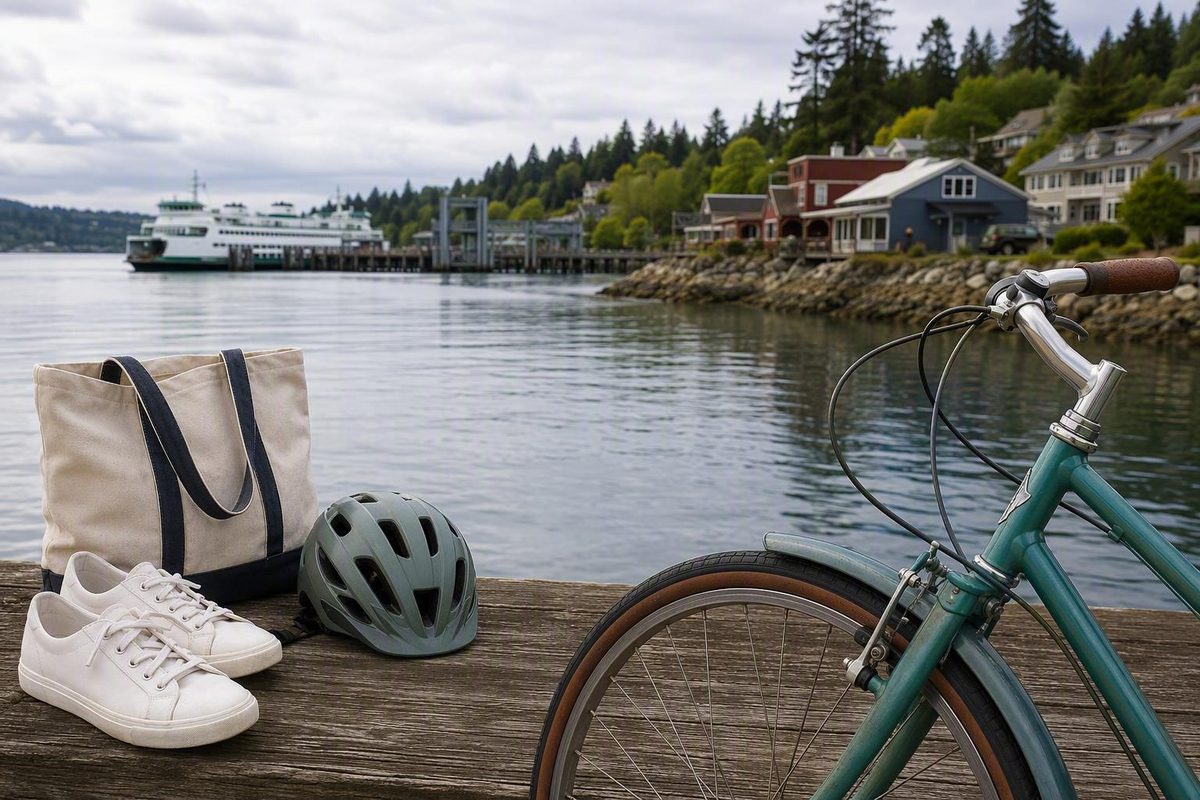
Bainbridge Island is easiest to enjoy in one of two ways: as a compact outing through Winslow and Eagle Harbor, or as a broader island trip organized around one garden, forest, shoreline, or historical destination.
That distinction matters. Many lists of things to do on Bainbridge Island place walkable museums beside parks several miles away without accounting for the transportation between them. A walk-on visitor can have a full day near the ferry. A visitor with a car—or a confirmed bicycle, bus, taxi, or rideshare plan—can travel farther, but should still resist turning the island into a checklist.
The simplest planning method is:
- Choose one anchor activity.
- Add secondary stops in the same area.
- Protect your return-ferry buffer.
- Keep one indoor alternative ready.
Choose the Right Shape for Your Bainbridge Island Day
First decide how much time you genuinely have on the island. Keep that separate from the time required to reach Colman Dock, wait to board, cross Puget Sound, unload, and make the return trip.
This guide uses the following convention throughout: itinerary lengths refer to island activity time unless a ferry segment is specifically listed.
| Time and transportation | Sensible focus | What to leave out |
|---|---|---|
| About four hours on the island, walk-on | Art museum, Winslow, lunch, short waterfront segment | Outlying gardens, forests, beaches, and the memorial |
| Six to eight hours on the island, walk-on | Winslow museums, shops, food, waterfront, and possibly Pia | Multiple remote attractions |
| Full day with a car or confirmed onward transportation | One major outlying anchor, one compatible secondary stop, then Winslow | An island-wide circuit of parks, wineries, and museums |
Winslow is the practical base for walk-on passengers. Museums, independent shops, galleries, a bookstore, cafés, restaurants, tasting rooms, and waterfront areas are clustered beyond the ferry terminal. The district is compact, although the walk from the ferry is generally uphill and the surrounding routes are not entirely level.
For a first visit, use this decision rule:
- Choose Winslow if convenience, food, museums, shopping, or a relaxed car-free day matters most.
- Choose Bloedel Reserve if you want the day to revolve around gardens, woods, water features, buildings, and walking paths.
- Choose one forest or shoreline park if nature matters more than downtown browsing.
- Choose the Japanese American Exclusion Memorial for a history-focused day, with transportation arranged before leaving Seattle.
A car is not necessary for a satisfying visit. It does make Bloedel Reserve, Fay Bainbridge Park, Fort Ward Park, Grand Forest, Gazzam Lake Nature Preserve, and other outlying places easier to reach. Even with a car, limit a standard day to one major remote attraction. Driving, parking, navigating, and completing a substantial visit can consume much of the available time.
Bainbridge Island is the homeland of the Suquamish People. Geographic accuracy matters when discussing that history: the Suquamish Museum and Chief Si’ahl’s grave are across Agate Pass on the Kitsap Peninsula, not on Bainbridge Island. They can be part of a separate regional outing, but they are not walkable attractions from the Bainbridge ferry.
This one-anchor structure follows Seattle Know’s approach to planning a ferry day from downtown Seattle: treat the crossing as part of the itinerary, cluster the day around one destination, and retain a buffer and weather fallback.
Ferry and Island Transportation: Walk On, Bike, or Drive?
The Seattle–Bainbridge ferry connects Colman Dock at Pier 52 in downtown Seattle with Eagle Harbor on Bainbridge Island. The normal crossing is approximately 30 to 35 minutes dock to dock, but terminal access, ticketing, boarding, unloading, and delays all add to the total journey. The route does not offer passenger or vehicle reservations; boarding is first-come, first-served, according to the local Bainbridge ferry guide.
Winslow is commonly estimated to be a 10-to-15-minute uphill walk from the island terminal, depending on pace and the particular shop, museum, or restaurant. Treat that as an estimate rather than a guaranteed transfer time, especially when traveling with children, carrying bags, or moving at a slower pace. A detailed Bainbridge day-trip guide likewise places Winslow about half a mile from the dock and describes the walk as roughly 10 to 15 minutes (Wheatless Wanderlust).
Which way should you travel?
| Mode | Main advantage | Main trade-off | Best fit |
|---|---|---|---|
| Walk on | Direct access to Winslow and no vehicle-capacity queue | Remote attractions require another transportation plan | Short or full car-free Winslow day |
| Bicycle | Expands your range without joining the car queue | Hills, traffic, weather, and road riding require confidence | Experienced riders with a mapped route |
| Drive | Makes remote gardens, forests, parks, and the memorial easier to combine | Vehicle queues can create uncertainty in both directions | Full-day trip centered beyond Winslow |
| Transit | May connect the terminal with other parts of the island | Route, day, and return service must be checked | Travelers who confirm the complete round trip |
| Taxi or rideshare | Can bridge the distance to one remote destination | Availability and return pickup are not assured | A prearranged or confirmed point-to-point trip |
Walking on is usually the simplest option when Winslow is the priority. It avoids vehicle-capacity lines and lets you begin exploring shortly after disembarking. Driving is more useful when Bloedel Reserve or a remote park is the anchor, but summer periods, weekends, holidays, commuter hours, and major Seattle events can increase vehicle waits.
Bicycling offers a middle ground, but a place being bikeable does not mean every traveler will find the ride comfortable. Consider island hills, road traffic, weather, daylight, distance, and bicycle parking. Map the route before departure rather than improvising a long ride because the island looks compact.
Transit, taxi, and rideshare can work only when the complete journey works. For transit, confirm the route, operating day, stop, outbound trip, and return connection.
Immediately before departure, use Washington State Ferries for the current schedule, fares, alerts, terminal conditions, and vehicle-loading information. Do not rely on a timetable copied into a travel article. If you plan to use Kitsap Transit, check the agency’s current route information separately.
Anyone with timed admission, dinner reservations, a flight, a show, or another fixed Seattle commitment should preserve at least one sailing of contingency time. If the intended sailing is delayed—or full for vehicles—the appropriate response is to drop a secondary island stop rather than jeopardize the final workable connection.
The crossing may offer skyline and mountain views when visibility cooperates. Sunset color and wildlife sightings depend on timing, weather, and chance. Exterior passenger areas can also be cold and windy even without active rain, so carry a warm or weather-resistant layer (A Happy Passport).
The Best Car-Free Loop Through Winslow and Eagle Harbor
Here, “best” means a practical, low-complexity route for many first-time walk-on visitors—not an objective ranking. The suggested sequence begins near the ferry, moves into Winslow, and leaves the waterfront or Sakai Park as a flexible extension. Depending on which waterfront segment you choose, Pia may work better as an alternative extension than as an additional stop.
1. Begin at Bainbridge Island Museum of Art
Bainbridge Island Museum of Art is close to the ferry and focuses on artists and collections from the Puget Sound region. Third-party guides repeatedly describe admission as free, but confirm the current policy, opening hours, and exhibition availability directly with the museum before traveling.
For itinerary drafting, allow approximately 45 to 75 minutes. That is an editorial planning allowance rather than a statement about how long the museum requires. A local account describes the museum’s regional focus, its location near the ferry, and free admission at the time of publication (Gig Harbor Now).
Starting here gives the day an immediate indoor anchor. If an exhibition holds your attention, stay longer and shorten shopping or the waterfront portion rather than rushing through the galleries.
2. Walk into Winslow
Continue toward Winslow’s commercial streets for independent shops, galleries, cafés, restaurants, tasting rooms, and Eagle Harbor Books. The area is compact enough for casual browsing, but restaurant waits and shopping time can expand quickly.
A useful planning block is 60 to 90 minutes for a meal and modest browsing. This is not a restaurant-service guarantee. If food is one of the day’s priorities, allow more time and make an outdoor extension optional.
3. Visit Bainbridge History Museum
Bainbridge History Museum incorporates a former schoolhouse and interprets subjects including immigration and incarceration, lumber, maritime transportation, agriculture, and island communities. It complements the art museum rather than duplicating it.
Allow approximately 45 to 60 minutes as a flexible planning block if you want more than a quick look. The museum can be especially useful before a history-focused afternoon because its interpretation helps place the memorial and Eagle Harbor within a broader island story.
4. Add Eagle Harbor Waterfront Park or a waterfront segment
Treat the waterfront as a flexible outdoor block rather than a mandatory complete loop. A 30-to-60-minute segment can provide a change of pace while keeping you reasonably close to Winslow.
Bainbridge guides describe western and eastern portions of the Waterfront Trail, but a complete route is longer than a casual waterfront pause and access details can change. Consult a current map before setting out. If rain, wind, mobility, or ferry timing becomes a concern, make this a short out-and-back walk instead. The reported loop lengths and surrounding attractions are summarized by Small Town Washington.
5. Extend to Pia the Peacekeeper only if time allows
Pia the Peacekeeper stands in Sakai Park, commonly described as less than a mile on foot from the ferry terminal. Artist Thomas Dambo created the recycled-material sculpture with local volunteers. Published guides disagree about the total number of installations in the wider regional project, so the relevant planning fact is Pia’s location rather than a disputed count (Ordinary Adventures).
Allow 45 to 75 minutes for the extension, including the walk, time at the artwork, and the return toward Winslow or the terminal. Pace, crossings, and the route you choose will determine whether it fits comfortably.
A practical car-free sequence
A workable order is:
Ferry terminal → art museum → Winslow shops and lunch → history museum → waterfront segment or Pia → ferry terminal
Choose the waterfront or Pia first; add both only if the day is running comfortably. This avoids treating every nearby attraction as mandatory.
Low-cost day: Walk onto the ferry, prioritize museums whose free admission you have confirmed for your date, see public art, use public parks and waterfront paths, and bring or buy a simple lunch. Staying in one walkable cluster also avoids the cost of local transfers.
Art, Island History, and the Japanese American Exclusion Memorial
Bainbridge Island’s two central museums serve different purposes. The Bainbridge Island Museum of Art centers regional artists and collections. Bainbridge History Museum interprets the island through subjects including immigration, Japanese American incarceration, lumber, maritime transportation, agriculture, and community life.
The history museum’s former schoolhouse is part of that experience. Its exhibits can also help visitors choose a focused route: someone interested in maritime transportation might continue toward Eagle Harbor, while someone seeking a deeper understanding of wartime incarceration may devote the afternoon to the Japanese American Exclusion Memorial.
The memorial is a place of remembrance and interpretation, not a quick photo stop. It recounts the forced removal and incarceration of Japanese American residents beginning in March 1942. Published sources give conflicting totals for the number removed, so this guide does not repeat an unresolved figure.
The National Park Service operates the memorial, and a self-guided audio experience featuring survivor oral histories has been available through the NPS app. Confirm current app content and ranger availability before visiting. A local account describes the memorial’s history, National Park Service role, and audio interpretation (Gig Harbor Now).
The memorial is outside the central Winslow loop. Do not casually add it to a short car-free itinerary. It requires additional time and a confirmed car, taxi, rideshare, bicycle, or current transit connection—including a workable return.
A respectful history-focused sequence is:
- Bainbridge History Museum: establish island context.
- Lunch or a quiet pause in Winslow: leave space between interpretive sites.
- Japanese American Exclusion Memorial: allow unhurried time for the memorial wall, grounds, and available interpretation.
- Return with a ferry buffer: do not compress the visit around an optimistic connection.
This can be an emotionally substantial route. A meal, waterfront pause, or quiet return crossing may fit more naturally than pairing the memorial with hurried tastings or unrelated entertainment.
Indigenous history requires the same care with context and geography. Bainbridge Island is Suquamish homeland, while the Suquamish Museum and Chief Si’ahl’s grave are across Agate Pass on the Kitsap Peninsula. They should not be described as Bainbridge attractions or walkable ferry-area stops.
Gardens, Forests, Beaches, and Parks Beyond Winslow
Leave Winslow when one outdoor experience is important enough to anchor the day. Choose according to the experience you want, the time it deserves, and the transportation you can confirm.
| Destination | Primary experience | General planning approach | Transportation reality |
|---|---|---|---|
| Bloedel Reserve | Designed gardens, woods, water features, buildings, and paths | Substantial half-day block | Car or confirmed round-trip alternative |
| Grand Forest | Maintained woodland trails | Route-dependent | Easier with a car or confirmed connection |
| Fay Bainbridge Park | Rocky shoreline, driftwood, and picnic time | Flexible weather-dependent visit | Easier with a car |
| Fort Ward Park | Trails, rocky shore, military remnants, and boat traffic | Flexible route-based visit | Easier with a car |
| Gazzam Lake Nature Preserve | Forest-trail outing | Route-dependent | Car or carefully planned alternative |
Bloedel Reserve
Bloedel Reserve combines landscaped garden areas, woods, ponds or streams, a Japanese garden, buildings, and walking paths. It is substantial enough to be the main attraction rather than one item in a long circuit.
Use two to three hours as a general editorial planning allowance, excluding transportation. Reported visits range from roughly 1.5 to four hours because walking pace and level of interest vary. Visitors interested in gardens, photography, architecture, or slow woodland walks should lean toward the longer end. A Bainbridge destination guide similarly suggests a two-to-three-hour visit and describes the Reserve’s gardens, streams, ponds, and trails (Explorer Sue).
Check admission, hours, timed-entry rules, and transportation directly with Bloedel Reserve before committing to the trip. Do not place it in a supposedly car-free itinerary until both the outbound and return connections have been confirmed.
Grand Forest
Grand Forest suits visitors seeking a maintained woodland walk rather than a designed garden. Select a route in advance and leave enough daylight and transportation time for the return.
Descriptions such as “relatively flat” or “beginner-friendly” do not establish wheelchair or stroller accessibility. If mobility is a concern, consult current maps and surface, closure, and facility information from the responsible park authority.
Fay Bainbridge Park
Fay Bainbridge Park offers a rocky, driftwood-covered shoreline and space for a picnic. Views toward Seattle or surrounding mountains may be part of the experience in clear conditions, but they are not guaranteed.
This is an exposed, weather-dependent choice. Wind, cold, or low visibility may make the visit shorter than anticipated. Check current facilities and park rules before departure.
Fort Ward Park
Fort Ward Park combines trails, rocky shoreline, remnants of military structures, and views of boat traffic through Rich Passage. It can suit visitors interested in both historical traces and shoreline scenery.
Choose a route appropriate for your group and confirm current conditions. Do not infer swimming, paddling, pet, or accessibility rules from a general destination guide.
Gazzam Lake Nature Preserve
Gazzam Lake Nature Preserve is another option for a forest-trail day. It belongs in the “choose one” category rather than serving as an automatic addition after Grand Forest. Route difficulty, conditions, and suitability vary, so use a current map and responsible park information.
The characteristics of Grand Forest, Fay Bainbridge Park, Fort Ward Park, and Gazzam Lake are summarized in this island guide covering car-free and driving options.
How much can you combine?
With a full day and efficient transportation, Bloedel Reserve plus one shoreline or forest stop may work. Winslow can then provide a meal if the return-ferry buffer remains secure.
What usually does not work is combining Bloedel Reserve, multiple forests, a beach, wineries, both museums, and downtown shopping. The issue is not merely distance on a map. Every additional stop introduces navigation, parking, waiting, walking, and another set of operating hours.
Choose depth over coverage. A substantial garden visit followed by one meal will generally produce a more coherent day than a rapid circuit of distant pins.
Food, Drink, Shopping, and Family-Friendly Stops
Treat food and browsing as part of a geographic cluster rather than as an island-wide restaurant tour. Winslow offers the greatest flexibility for walk-on visitors because you can choose according to current hours, appetite, and ferry timing without arranging another ride.
Frequently mentioned examples include Pegasus Coffee House and Blackbird Bakery for coffee or breakfast, Proper Fish or waterfront-area restaurants for lunch, and Mora Iced Creamery or another currently open dessert stop. These are examples, not rankings. Business hours, opening days, reservation policies, age restrictions, and dietary accommodations can change and should be checked directly.
Eagle Harbor Books is an independent bookstore that fits naturally into the Winslow loop. It also provides a useful indoor pause between a museum, meal, and brief waterfront walk.
Downtown winery or brewery tasting rooms can be optional adult stops. Producers elsewhere on the island require more transportation. Confirm current opening times and age policies, and do not structure the return trip around an unverified tasting-room schedule.
With younger children
Kids Discovery Museum is the clearest child-focused indoor attraction near the ferry. A manageable family sequence is:
- ferry crossing;
- Kids Discovery Museum;
- casual lunch;
- Pia the Peacekeeper;
- short waterfront walk or dessert;
- return ferry.
Keep the final outdoor portion short enough that tired children do not have to hurry back to the terminal.
With school-age children
Let interests determine the museum. Some children may prefer regional art, while others may connect more readily with island, transportation, or community history. Combine one museum with the ferry ride, Pia, and a manageable waterfront or park segment.
One indoor activity, one outdoor activity, and a meal usually create a more adaptable family day than several timed attractions.
With teenagers
Emphasize the art museum, Eagle Harbor Books, public art, the waterfront, food, and an optional outdoor activity. Kids Discovery Museum is more clearly oriented toward younger children, so it should not be assumed to suit teenagers. The bookstore and children’s museum are both described in a family-oriented Bainbridge day-trip guide.
Water activities
Kayaking and other on-water activities require current confirmation of the operator, weather, equipment, launch arrangements, age requirements, and safety procedures. Casual shoreline access does not establish that an activity is suitable for every visitor or every day.
Four Practical Itineraries for Different Kinds of Visit
The following routes use activity blocks rather than fixed clock times. The four-hour and six-to-eight-hour labels refer to time available on Bainbridge Island. Add Seattle-terminal access, boarding, both crossings, unloading, and a return buffer when calculating the full excursion.
1. Four-hour car-free route
This is the appropriate shape for a short island visit:
- Arrival and walk toward Winslow: a short transition block.
- Bainbridge Island Museum of Art: about one hour.
- Winslow lunch and browsing: about 60 to 90 minutes.
- Waterfront: a short 30-to-45-minute segment.
- Return walk and ferry buffer: protect the final portion of the visit.
Do not add Bloedel Reserve, a distant park, or the Japanese American Exclusion Memorial. The value of this route is its simplicity.
Fallback rule: If arrival is delayed, shorten the waterfront walk or browsing. Do not turn the museum or meal into a sprint.
2. Six-to-eight-hour car-free route
This route fills a longer island day without requiring a car:
- Art museum: approximately one hour.
- Winslow coffee, shops, or bookstore: 45 to 60 minutes.
- Lunch: 60 to 90 minutes.
- History museum: approximately one hour.
- Waterfront segment: 30 to 60 minutes.
- Pia or additional shopping and food: approximately one hour.
- Return-ferry buffer: preserve a comfortable connection.
Pia is optional. Skip it when weather deteriorates, walking takes longer than expected, or the museums hold your interest.
Fallback rule: If the ferry is delayed, remove Pia or shorten shopping. Preserve the central museum-and-Winslow structure.
3. Full-day car-assisted nature route
Use this route when the purpose is to see more of the island rather than spend most of the day downtown:
- Vehicle arrival and unloading: allow for capacity-related uncertainty.
- Bloedel Reserve: approximately two to three hours, plus local travel and entry time.
- One outdoor stop: choose Fay Bainbridge Park, Grand Forest, Fort Ward Park, or another single destination.
- Winslow meal: approximately 60 to 90 minutes.
- Optional browsing: only if the ferry buffer is secure.
- Return crossing: avoid placing a fixed Seattle commitment immediately afterward.
Choose the secondary outdoor stop according to geography, weather, and energy. There is no need to pair one forest with another simply because both fit on the map.
Fallback rule: If ferry or admission timing shifts, remove the secondary park. Do not reduce the Reserve to a rushed walkthrough to preserve an extra stop.
4. History-focused route
This route requires confirmed transportation beyond central Winslow:
- Bainbridge History Museum: approximately one hour.
- Winslow lunch, pause, or contextual walk: 60 to 90 minutes.
- Transfer to the Japanese American Exclusion Memorial: use a car, prearranged taxi, confirmed rideshare, mapped bicycle route, or current transit connection.
- Memorial: leave an unhurried interpretive block rather than assigning a rushed minimum.
- Return transfer and ferry buffer: confirm both before leaving Winslow.
Avoid treating the memorial as a brief stop between unrelated entertainment. The route works better when the history museum establishes context and the rest of the afternoon remains spacious.
Fallback rule: If transportation to and from the memorial becomes uncertain, remain in Winslow and spend more time with the history museum and nearby waterfront.
Rainy-day substitutions
For steady rain or wind, prioritize:
- Bainbridge Island Museum of Art;
- Bainbridge History Museum;
- Kids Discovery Museum for younger children;
- Eagle Harbor Books;
- cafés, shops, and a relaxed lunch;
- cinema or performing arts with verified showtimes;
- a currently operating tasting room for appropriate adult groups.
Use outdoor time in short segments between indoor stops. An exposed beach or long forest walk does not need to remain in the itinerary simply because it appeared in the original plan.
Low-cost variation
Walk onto the ferry, choose a museum whose free admission is confirmed for your date, see public art, use Waterfront Park, and pack a meal or choose a simple lunch. If time permits, add the history museum or Pia instead of paying for transportation to a remote attraction.
The saving mechanism is not racing through more free places. It is remaining in one walkable cluster and avoiding unnecessary transfers.
What to Verify Before You Leave Seattle
Editorial review date: August 22, 2026. This date covers the article’s route structure and the supplied published evidence; it is not a substitute for a same-day operational check. Live ferry conditions, transit service, admission rules, venue hours, and business openings must still be confirmed with the responsible operator.
Pre-departure checklist
- [ ] Ferry schedule: Check the intended outbound and return sailings.
- [ ] Service alerts: Look for delays, cancellations, vessel changes, or terminal disruptions.
- [ ] Fares: Confirm current passenger, bicycle, and vehicle charges.
- [ ] Vehicle queues: Review loading and terminal conditions if driving.
- [ ] Venue hours: Confirm that each anchor attraction is open on your date.
- [ ] Admission: Check current prices and any free-admission policy.
- [ ] Timed entry: Verify whether Bloedel Reserve or another venue requires advance booking.
- [ ] Exhibitions and programs: Confirm that the gallery, performance, or event you want is available.
- [ ] Transit: Check the exact route, operating day, stop, outbound departure, and return connection.
- [ ] Taxi or rideshare: Consider arranging the return pickup from a remote destination.
- [ ] Businesses: Verify restaurant, bakery, bookstore, shop, and tasting-room hours.
- [ ] Seasonal events: Check whether an event will affect traffic, parking, or operating hours.
- [ ] Weather: Review rain, wind, temperature, and visibility.
- [ ] Return commitments: Preserve at least one sailing of contingency time.
Use Washington State Ferries for current sailing information, alerts, fares, and vehicle conditions. Use the responsible venue, transit agency, park authority, or activity operator for attraction-specific information.
If relying on Kitsap Transit, do not assume service is frequent or organized around sightseeing. A bus that reaches an attraction in the morning is not useful without a workable return trip.
Check Bloedel Reserve’s admission and timed-entry rules before arranging transportation. Published descriptions reflect different dates and do not agree on every operational detail.
Rain can shorten a waterfront walk, wind can make shorelines and exterior ferry decks uncomfortable, and poor visibility can remove anticipated views. Ferry delays and full vehicle sailings can alter the day even when every attraction remains open.
When something changes, use this hierarchy:
- Preserve the return-ferry buffer.
- Preserve the anchor activity.
- Shorten shopping or the waterfront segment.
- Replace an exposed stop with a museum, bookstore, or café.
- Do not compensate by adding a different distant attraction.
Can you enjoy Bainbridge Island without a car?
Yes. A car-free day works well when it remains centered on Winslow and Eagle Harbor. From the ferry, visitors can walk to the art museum, history museum, shops, cafés, restaurants, bookstore, and waterfront areas. With additional time, Pia at Sakai Park can also fit.
A car becomes more useful for Bloedel Reserve, Fay Bainbridge Park, Fort Ward Park, Grand Forest, and other outlying destinations. Without one, confirm both the outbound and return transportation before leaving Seattle.
Do you need a reservation for the Seattle–Bainbridge ferry?
No. The route does not offer passenger or vehicle reservations and operates first-come, first-served. Walk-on passengers avoid vehicle-capacity queues, while drivers may have to wait during busy periods. The crossing itself is normally about 30 to 35 minutes, excluding boarding, unloading, and delays (Bainbridge Island ferry guide).
Check Washington State Ferries immediately before departure for current schedules, alerts, fares, and loading conditions.
How much time should you spend on Bainbridge Island?
Allow about four hours on the island for the art museum, a Winslow meal, limited browsing, and a short waterfront walk. Six to eight hours supports a fuller car-free day with both museums and either Pia or additional food and shopping.
For Bloedel Reserve, one outdoor stop, and a Winslow meal, use a full day. Bainbridge planning guides commonly recommend six to eight hours for island highlights and two to three hours for Bloedel Reserve alone (Explorer Sue).
These estimates exclude travel to the Seattle terminal, waiting, both ferry crossings, and unloading.
What can you do on Bainbridge Island when it rains?
Build the day around the Bainbridge Island Museum of Art, Bainbridge History Museum, Kids Discovery Museum for younger children, Eagle Harbor Books, cafés, shops, cinema, performing arts, or a verified tasting room.
Rain does not automatically require canceling the trip, but wind and poor visibility can reduce the appeal of exterior ferry decks, beaches, gardens, and viewpoints. Keep one indoor anchor and treat the waterfront as optional.
Can you reach Bloedel Reserve without bringing a car?
Potentially, but only with a confirmed round-trip plan. Depending on the date and time, transportation might involve current transit service, a taxi, rideshare, bicycle, or another arranged option. Availability and return connections may be limited.
Do not put Bloedel Reserve into a car-free itinerary until you have verified the exact outbound connection, admission requirements, and return to the ferry terminal. If any part of that chain is uncertain, choose the walkable Winslow route instead.
The central choice is straightforward: walk onto the ferry and keep the day compact around Winslow, or select one outlying island anchor and arrange transportation before leaving Seattle. For a first visit, protect the ferry ride, one meaningful attraction, a relaxed meal or walk, and a weather-ready fallback. On the morning of travel, check ferry alerts, venue rules, and return transportation one final time.