
How Century 21 Built Seattle's Vision of the Future
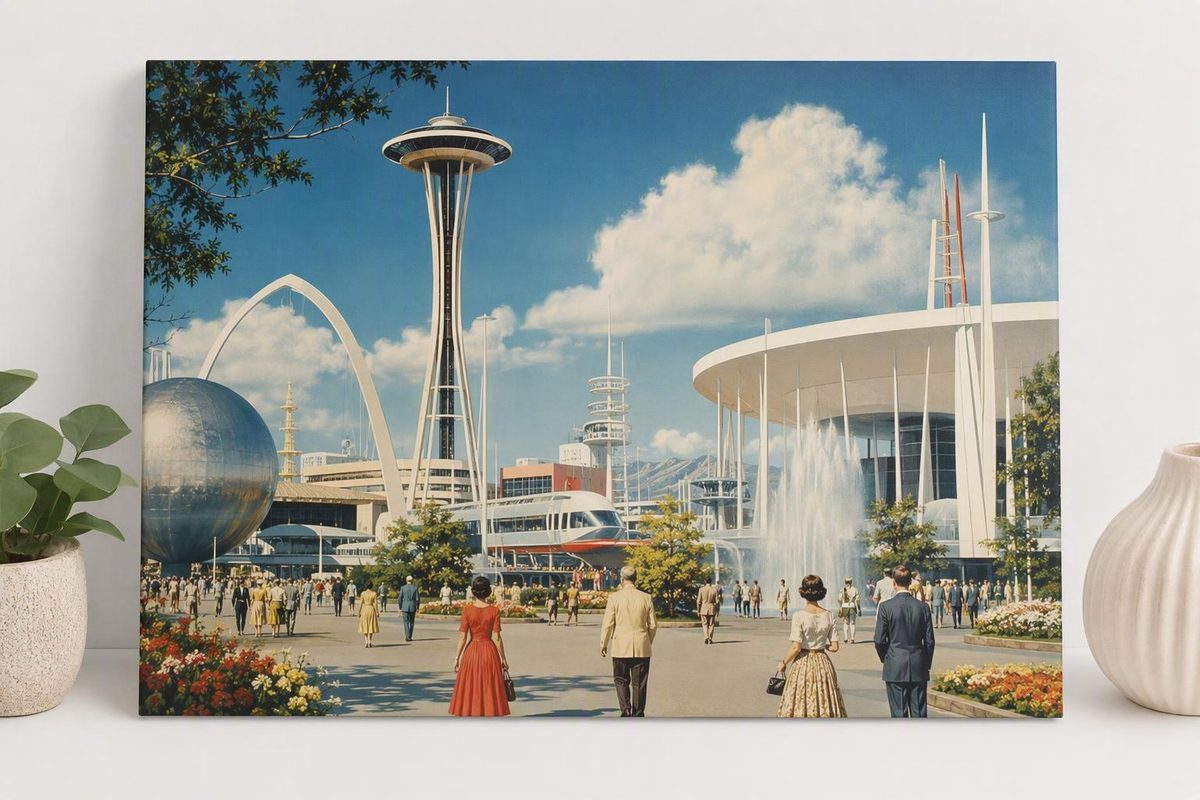
Seattle’s Century 21 Exposition promised visitors a journey into the next century. Futuristic architecture, scientific exhibits, corporate demonstrations, amusement rides, fashion displays, and international storefronts presented technology as a route to prosperity and a better everyday life.
Yet the Seattle World’s Fair was more than a six-month spectacle. Civic leaders deliberately used it to finance and build a permanent public campus. The Space Needle became the symbol, but the fair’s deeper legacy lies in Seattle Center, the Pacific Science Center, the Monorail, the International Fountain, and the arena that now occupies the former Washington State Pavilion.
That achievement came with costs. Public money underwrote much of the project. Site preparation removed part of an older working-class neighborhood, while anticipated tourist demand threatened tenants in residential hotels. Cold War exclusions, corporate promotion, and restrictive assumptions about gender also complicated the fair’s claim to represent a universal future.
Century 21 is therefore best understood as both an optimistic Space Age production and a long-term redevelopment project—one whose ambitions, landmarks, and unresolved tensions remain visible today.
Seattle World’s Fair at a glance
The fair’s official name was the Century 21 Exposition, although it is commonly called the Seattle World’s Fair. It operated from April 21 through October 21, 1962, in the Lower Queen Anne area north of downtown. Its official attendance was 9,609,969 admissions, commonly rounded to nearly 10 million. These dates, the official total, and the discrepancy in municipal accounts are documented in the Seattle Municipal Archives’ Century 21 collection.
Century 21 invited visitors to imagine life in the coming century. Its dominant subjects were science, technology, electronics, space exploration, transportation, consumer products, and new forms of domestic life. The presentation was overwhelmingly optimistic: innovation appeared capable of making cities more efficient, homes more convenient, and space increasingly accessible.
The site’s reported size requires context. Planners initially selected a 28-acre, city-owned civic site near Queen Anne Hill because it was close to downtown and could become a permanent civic center. The completed exposition and present-day Seattle Center are commonly described using a broader 74-acre footprint. The figures refer to different boundaries and stages of development rather than contradictory measurements of the same parcel; the larger figure remains in use for the contemporary Seattle Center campus.
A compact timeline places the project in order:
- 1955: City Councilmember Al Rochester begins campaigning for a second Seattle exposition.
- 1956–1957: Civic-center financing moves through authorization, voter approval, state matching support, and implementation. Historical accounts attach different years to different stages.
- 1960: The Bureau of International Expositions certifies Century 21 as an official world’s fair.
- 1961–1962: Major construction proceeds on pavilions, utilities, public spaces, the Space Needle, and the Monorail.
- April 21, 1962: The fair opens.
- October 21, 1962: The fair closes after six months.
The official dates, certification, attendance, and principal construction projects appear in the documented Century 21 chronology.
The exposition’s motto, “Living in the Space Age,” captured its public identity. Its physical setting, however, reveals a second purpose. Seattle was not merely assembling exhibits for temporary visitors; it was creating a civic district close enough to downtown to remain useful after the gates closed.
Why Seattle pursued an international exposition
The idea began with City Councilmember Al Rochester. In 1955, Rochester promoted a new exposition inspired by Seattle’s 1909 Alaska-Yukon-Pacific Exposition. The initial hope was to commemorate the earlier fair’s 50th anniversary in 1959, but the project grew in scale and eventually opened three years later.
Rochester’s proposal appealed to several ambitions at once. A major exposition could attract national and international attention, bring visitors to the region, make Seattle more visible to investors, encourage downtown development, and associate the city with science and aerospace. Just as importantly, it could leave public buildings and open space behind.
That last goal strongly influenced the site choice. Planners considered larger alternatives, but the civic-auditorium area near Queen Anne Hill offered three practical advantages: it was close to downtown, it already contained public facilities such as the armory and Civic Auditorium, and permanent improvements there could become a civic center after the exposition. Post-fair reuse was therefore part of the planning logic, not an improvised response after closing day.
Financing was layered rather than contained in one simple fair budget. Seattle voters authorized a $7.5 million civic-center bond, which Washington matched. Federal participation added more than $9 million, often rounded in retrospective accounts to approximately $10 million, chiefly for the U.S. Science Exhibit. Corporations paid for sponsored displays, while private investors financed the Space Needle. The city also undertook utility, transportation, parking, lighting, beautification, and public-space work associated with the exposition. The municipal account of the city’s participation distinguishes those public projects from other federal, corporate, and private investments.
Sources variously associate the civic bond with 1956 or 1957. A project of this scale moved through political authorization, voter approval, state matching legislation, planning, and spending.
Federal involvement also required political work. Washington senators Warren Magnuson and Henry Jackson supported national participation, while federal legislation established a framework for representation, funding, and invitations to other governments. The resulting U.S. Science Exhibit gave the fair one of its largest intellectual and architectural anchors.
International certification mattered for similar reasons. Recognition by the Bureau of International Expositions strengthened Century 21’s legitimacy and helped organizers approach foreign governments, businesses, and prospective exhibitors as participants in a recognized world’s fair rather than a regional trade show.
The coalition behind Century 21 also explains why the exposition cannot be assigned to one founder or funder. Rochester supplied early civic momentum, but elected officials, administrators, architects, federal representatives, businesses, private investors, and a nonprofit operating organization all moved the project forward. HistoryLink’s account of the fair’s origins and planning traces that progression from Rochester’s proposal through financing, accreditation, design, and construction.
Some retrospective accounts say the fair earned a profit. That conclusion may be supportable, but the available evidence does not include audited revenues, expenses, accounting methods, or an explanation of how permanent public construction was treated. It is safer to say that Century 21 attracted nearly 10 million admissions and left substantial civic facilities than to declare it unquestionably profitable.
How Sputnik and the Cold War shaped Century 21
Century 21 did not begin with a fully formed Space Age identity. Early proposals leaned toward a western or regional celebration. World events then gave science, engineering, and space exploration a new political urgency.
The Soviet Union’s launch of Sputnik in October 1957 intensified American concern about scientific education, missile technology, and international prestige. It also gave Seattle’s planners a compelling theme. A fair about the West could celebrate regional history; a fair about science and space could position Seattle within a global contest over the future.
That theme matched the regional economy. Boeing’s aircraft, missile, and aerospace work had already linked the Seattle area with advanced engineering and national defense. Boeing helped make a technology-centered fair plausible, but it did not create Century 21 by itself. The concept emerged from civic planning, federal Cold War priorities, business sponsorship, architectural experimentation, and the need for a distinctive international message.
Century 21 presented itself as a preview of life in 2000 and beyond. Exhibits imagined voice recognition, computers, electronics, automated highways, faster vehicles, modular houses, and other technologies expected to reshape daily life. Boeing’s Spacearium simulated travel beyond Earth, Ford offered An Adventure in Outer Space, Washington presented a World of Tomorrow, and John Glenn’s Friendship 7 Mercury capsule appeared at the fair in August 1962. The University of Washington’s history of Century 21’s Cold War setting connects these displays with Sputnik, Seattle’s aerospace economy, and the fair’s predictions for the coming century.
These exhibits were not neutral forecasts. Government presentations promoted American scientific capability at a moment of geopolitical competition. Corporate displays associated private enterprise with invention, abundance, convenience, and personal freedom. Together, they suggested that American capitalism could deliver both technological superiority and a comfortable consumer future.
Several attractions made that message tangible:
- The U.S. Science Exhibit translated scientific research into monumental architecture and public displays.
- Boeing’s Spacearium turned aerospace into an immersive entertainment experience.
- Ford’s An Adventure in Outer Space placed an automobile company inside the fair’s vision of exploration.
- The Friendship 7 capsule brought a celebrated artifact of crewed spaceflight to the grounds.
- Washington’s World of Tomorrow explored what ordinary life might look like in the next century.
The Space Needle condensed the fair’s identity into one recognizable structure. Hotel executive and fair organizer Edward Carlson developed the early tower concept after encountering a Stuttgart tower topped by a restaurant. Architects and designers then refined the idea into a privately financed observation tower and dining attraction. The completed Space Needle stands 605 feet tall, rather than the frequently rounded 600 feet, according to a history of surviving world’s-fair landmarks.
Its observation deck and restaurant made Seattle itself part of the futuristic display. Visitors could rise above the exposition and see the city, water, and surrounding landscape from a structure designed to evoke spaceflight. The tower was simultaneously architecture, attraction, restaurant, orientation point, and advertisement.
Century 21’s internationalism nevertheless had firm political boundaries. The Soviet Union declined to participate. The People’s Republic of China, North Vietnam, and North Korea were excluded from invitations. The fair’s “world” was therefore filtered through American diplomatic recognition and Cold War policy.
Displays and publicity frequently associated men with science, engineering, and exploration, while fashion, household goods, consumption, and domestic life were framed as women’s concerns. The exposition could imagine computers and automated roads more readily than transformed gender roles.
Century 21 offered a sincere and often exhilarating confidence in discovery. At the same time, it sold a particular version of progress—American, corporate, consumption-oriented, and shaped by Cold War anxieties.
What visitors encountered at the 1962 fair
There was no single typical day at Century 21. Visitors arrived with different budgets, interests, schedules, and expectations. Rather than invent an hour-by-hour itinerary, it is more useful to consider the main categories of experience: transportation, architecture, science, international commerce, entertainment, and souvenirs.
Arrival was part of the spectacle. The Monorail connected downtown with the fairgrounds, turning an ordinary transfer into a demonstration of futuristic urban transportation. Its elevated track and streamlined trains gave riders an immediate sense that they were entering a staged vision of tomorrow.
The Space Needle supplied the vertical landmark. Visitors could look down over the fairgrounds and Seattle from a tower designed to evoke the Space Age. Even those who did not ascend it experienced the Needle as a constant orientation marker.
The U.S. Science Exhibit provided an institutional center. Its dramatic arches and exhibition spaces framed science as a public undertaking worthy of monumental architecture. In contrast to amusement rides and retail areas, it asked visitors to consider research, discovery, and national scientific capacity.
The Washington State Pavilion represented the host state. Designed by Paul Thiry, it was one of the principal permanent buildings on the grounds. Its large interior supported displays during the fair and gave Seattle a reusable arena afterward.
The International Fountain created a shared outdoor focus. It offered a gathering place rather than a conventional enclosed pavilion. Its setting helped connect monumental architecture with the exposition’s plazas and pedestrian routes.
The Gayway concentrated amusement. The carnival area balanced the instructional tone of science exhibits with rides and midway entertainment. The Bubblelator offered a playful vision of modern movement, the Skyride carried passengers above parts of the grounds, and Show Street supplied adult-oriented entertainment.
International pavilions expanded the fair’s visual and cultural range. Documented participants included pavilions associated with Japan, India, the Philippines, African nations, Taiwan under the Republic of China, and the United Nations. These did not constitute a complete or politically neutral representation of the world, but they offered encounters with national displays, architecture, goods, food, and performance beyond the United States.
The Boulevards of the World linked sections of the grounds through shopping and dining. Restaurants, shops, and kiosks displayed goods from about a dozen nations. A surviving photograph of Boulevard West shows the German businesses Gabriel and Hewitt, the Samran Thai Company, and Paris’ Bagatelle Cuisine. Those examples document one portion of the commercial landscape rather than the full range of participation, as the Museum of History & Industry’s Boulevard West record makes clear.
Admission was another part of the experience. An advance adult ticket cost $1.80 in early 1962, according to the municipal archive. Without comparing that price with contemporary wages, transportation expenses, and household costs, however, it would be misleading to label the fair either cheap or expensive.
The ticket also mattered after admission. Tickets, season passes, programs, Monorail and Skyride tickets, posters, clothing, jewelry, photographs, and souvenirs preserved the exposition’s visual identity. Space Needle earrings, commemorative accessories, fashion items, and printed programs allowed visitors to carry a portable version of Century 21 home.
Ceremony and celebrity added publicity without defining the whole event. The opening program combined civic ritual with bells, balloons, and military aircraft. Cultural performances and dedication concerts reinforced the claim that Century 21 was an arts event as well as a technology show. Elvis Presley visited Seattle to film It Happened at the World’s Fair, giving the exposition a durable place in popular culture.
For visitors, Century 21 alternated between instruction and entertainment. Someone could move from federal science to corporate promotion, from an international storefront to a carnival ride, and from monumental architecture to a small souvenir. That variety was deliberate: forecasts of the future became more appealing when surrounded by food, shopping, performance, and play.
The people and institutions behind the fair
Century 21 does not have a single founder in any useful sense. Different people deserve credit because they performed different jobs at different moments.
Al Rochester belongs at the beginning of the civic story. As a Seattle city councilmember, he promoted the proposal for a second exposition and helped turn an idea into a government-backed planning effort. Calling him the originator of the early civic campaign is more precise than saying he single-handedly created the fair.
Edward “Eddie” Carlson became a major organizer and was central to the Space Needle concept. Inspired by a tower with a restaurant in Stuttgart, he imagined a tall dining and observation structure for Seattle. That starting idea still required architects, investors, engineers, contractors, approvals, and land before it could become the finished tower.
Joe Gandy served as fair president. Ewen Dingwall managed daily operations, while Jay Rockey directed public relations. Their roles illustrate the distinction between proposing the event, governing its organization, running it, and presenting it to the public.
Political support came from several levels. Seattle officials managed bonds, infrastructure, permits, utilities, transportation work, and public facilities. Washington state supplied financial and political backing. Senators Warren Magnuson and Henry Jackson assisted efforts to secure federal participation.
Architecture likewise involved several commissions:
- Paul Thiry served as chief architect and designed the Washington State Pavilion.
- Minoru Yamasaki designed the U.S. Science Pavilion, now the Pacific Science Center.
- John Graham Jr. helped develop the Space Needle and advanced the revolving-restaurant concept.
- Victor Steinbrueck helped refine the tower’s form.
- Other architects adapted existing civic buildings and designed supporting structures across the grounds.
These divided responsibilities—along with the roles of Rochester, Carlson, Gandy, Dingwall, Rockey, Thiry, Yamasaki, Graham, and Steinbrueck—are documented in HistoryLink’s account of Century 21’s organizers and designers.
A private nonprofit primarily administered the exposition, but that does not make Century 21 simply a private event. The city financed permanent facilities, regulated development, incorporated the grounds into utility systems, improved transportation, oversaw major projects, and prepared the surrounding public realm. Federal and state governments supported other portions. Corporations created sponsored exhibits, while private interests developed the Space Needle.
This division of labor reconciles apparently competing claims about who “made” the fair. Rochester could originate the civic campaign while Carlson advanced its organization and most famous attraction. Gandy could lead the fair corporation while Dingwall managed operations. Thiry could shape the site’s architectural framework without designing every building. Public agencies could build the civic foundation while private sponsors supplied attractions.
Century 21 was not the product of one visionary. It was a coalition project in which public goals, private investment, political influence, architectural authorship, and promotional skill overlapped.
The costs behind the optimistic vision
The architecture of Century 21 encouraged visitors to look up and ahead. An honest history must also examine what happened on the ground.
Preparing the site meant demolishing much of a working-class, turn-of-the-century neighborhood around the civic complex. Buildings and established patterns of residence were removed to create a unified exposition landscape. The surviving evidence does not establish a precise number of residents or businesses displaced, so a responsible account should not invent one.
Housing pressure also spread beyond the demolition zone. Some residential-hotel landlords anticipated a surge of visitors and converted monthly rooms to daily tourist accommodation or raised prices. Existing tenants faced displacement or the threat of losing housing in favor of more lucrative short stays.
Seattle attempted to intervene through an Emergency Hotel Licensing Board. The ordinance establishing it was adopted on April 17, 1962. On May 25, 1962, Judge W. R. Cole ruled the ordinance invalid and unconstitutional. The exact number of tenants displaced remains unknown, according to the municipal archive’s documented account of the housing controversy.
The irony is that the predicted accommodation shortage did not materialize. Temporary use of vacant apartments and docked ships added capacity, and some visitors stayed for less time than planners expected. Residents had nevertheless faced rent increases, insecurity, or removal in anticipation of demand that proved smaller or shorter-lived than forecast.
The episode exposes a recurring tension in urban mega-events. Cities promote benefits expected to be broad and long-lasting, while immediate burdens often fall unevenly. Property owners, contractors, businesses, and public institutions may gain from redevelopment, while renters and residents with less financial or political power absorb uncertainty and displacement.
The fair’s politics deserve similarly measured criticism. Century 21 celebrated scientific learning and gave the public access to architecture, exhibits, and ideas that could be genuinely inspiring. Its national displays also functioned as Cold War messaging, while corporate pavilions promoted branded versions of the future. Communist governments were absent by refusal or exclusion, and global language could not overcome the diplomatic boundaries placed on participation.
Its gender assumptions further narrowed the future on display. Men were commonly associated with science and technology; women were more often directed toward fashion, consumption, or domestic improvement. A society could apparently automate highways and develop voice recognition while leaving older divisions of authority largely intact.
None of these issues erases the fair’s civic achievements. Nor should surviving landmarks be treated as proof that every decision was justified. Century 21 must be evaluated from more than one position: from the observation deck, from a scientific pavilion, from city hall, and from the room of a tenant told that tourist demand had made their home more valuable to someone else.
From temporary fairgrounds to Seattle Center
Permanent reuse was one of Century 21’s central planning goals. Seattle chose the Lower Queen Anne civic site partly because buildings, utilities, and open space created for the exposition could remain useful after the fair closed.
That strategy produced Seattle Center: a civic, cultural, museum, entertainment, and sports campus rather than an abandoned fairground. Not every attraction survived, and the remaining buildings have been renovated or repurposed, but the concentration of public space and institutions remains legible.
The clearest then-and-now transitions are:
- U.S. Science Exhibit → Pacific Science Center
- Washington State Pavilion → Washington State Coliseum → KeyArena → Climate Pledge Arena
- Century 21 fairgrounds → Seattle Center
Several surviving features make the history visible on foot:
- Space Needle: A privately financed observation tower and restaurant built as a fair attraction; it remains the campus’s dominant vertical marker.
- Monorail: Constructed to connect downtown with the exposition; it continues to provide the same basic geographic connection.
- International Fountain: A fair-era public-space centerpiece that remains part of the campus landscape, although it has been transformed.
- Seattle Center Armory: An older building incorporated into the exposition as Center House and retained as a gathering and food-service space.
- Pacific Science Center: The direct institutional successor to the U.S. Science Exhibit.
- Climate Pledge Arena: The latest use of the facility lineage that began with the Washington State Pavilion.
Seattle Center’s current guide identifies the Space Needle, International Fountain, Armory, and arena among the attractions visitors can encounter across the campus today. Their survival does not mean they remain unchanged. Renovations, new uses, and surrounding development have added later architectural layers.
Those later layers should not be mistaken for fair originals. The Museum of Pop Culture and Chihuly Garden and Glass are prominent Seattle Center attractions, but neither was built for Century 21. They demonstrate how the campus continued to evolve rather than what visitors saw during the exposition.
The distinction between public and private investment also remains important. The Space Needle was privately financed. By contrast, the civic campus, utility work, public spaces, transportation facilities, science institution, and arena lineage depended heavily on public initiative and investment. Century 21’s legacy is not one financing story but a mixture of private attraction development and public capital planning.
The exposition also accompanied less glamorous infrastructure work. Utilities were extended or placed underground, transportation links were improved, parking was developed, lighting was installed, and streets and public spaces were prepared for heavy use. These projects lacked the visual drama of the Space Needle, but they helped the site function during the fair and after it.
Many historical accounts argue that Century 21 changed Seattle’s image or “put it on the map.” That interpretation is plausible: the fair gave Seattle a widely reproduced skyline symbol, attracted millions of admissions, and associated the city with science and aerospace. It cannot prove that the exposition single-handedly caused Seattle’s later economic growth, cultural prominence, or downtown development. Those outcomes also depended on aerospace, trade, migration, public investment, technology industries, and broader regional and national changes.
The strongest claim is narrower. Century 21 supplied Seattle with a durable visual identity and a permanent concentration of civic facilities. It gave later generations an adaptable campus on which new cultural and entertainment uses could accumulate.
A simple way to explore the fair’s legacy today
You do not need a tightly timed itinerary to understand the former fairgrounds. A compact route organized around what each place was during Century 21—and what it became—works better than racing between unrelated attractions.
Before setting out, verify current operating hours, admission prices, closures, transit details, and accessibility directly with the relevant venue. The route below is a historical framework, not a promise that every interior will be open.
If you are still deciding on a base, choose accommodation around how you expect to move through the city rather than treating every neighborhood as equally convenient. This guide to choosing where to stay in Seattle offers a practical starting point.
1. Begin downtown with the Monorail
Starting downtown makes the journey itself the first artifact. The Monorail was built to carry fairgoers between the city center and Century 21, and its approximately one-mile route still links downtown with Seattle Center. The current campus and Monorail connection are summarized in Visit Seattle’s overview of the 74-acre Seattle Center.
Riding it lets you approach the grounds through an original fair project rather than merely arriving at a modern attraction. The train compressed the perceived distance between downtown and the exposition while presenting public transportation as part of the future.
2. Orient yourself at the Space Needle
Once at Seattle Center, use the Space Needle as your visual anchor. During the fair it was a privately funded observation tower, restaurant, attraction, and marketing symbol. Today it remains a visitor attraction and the most immediately recognizable remnant of Century 21.
You do not need to buy an observation-deck ticket to understand its role. From ground level, notice how the tower acts as a marker visible from multiple parts of the campus. It gave a sprawling exposition one dominant image and continues to make the former fairgrounds identifiable from across Seattle.
3. Walk to the Pacific Science Center exterior and grounds
The Pacific Science Center began as the U.S. Science Exhibit. Its arches and courtyards embodied the idea that science should occupy one of the exposition’s most monumental architectural settings.
Even without entering, the exterior helps distinguish Century 21’s institutional ambitions from its commercial rides and amusements. The fair sought to entertain, but it also intended to leave a permanent place for public engagement with science.
4. Continue toward the International Fountain
The International Fountain illustrates the endurance of open space. During the fair it functioned as a central landscape feature and gathering point. It remains a focus of the campus, though its physical treatment and operation have changed.
This is a useful place to pause because it shifts attention away from individual buildings. Seattle Center’s legacy includes plazas, lawns, pedestrian routes, and relationships among structures—not only attractions that require admission.
5. Identify the Armory and its fair-era role
The present Seattle Center Armory predates Century 21 but was incorporated into the exposition as Center House. It demonstrates how planners combined existing civic buildings with new construction rather than creating the entire site from nothing.
Today it remains a public gathering and food-service location. Historically, it shows that the exposition involved adaptation as well as invention: an older public building was reassigned to support a future-themed event and then adapted again for the post-fair campus.
6. Finish at the former Washington State Pavilion
The Washington State Pavilion became the Washington State Coliseum, later KeyArena, and ultimately Climate Pledge Arena. This sequence is one of the clearest examples of planned reuse followed by repeated modernization.
From outside, consider the difference between preserving a building untouched and preserving a civic function through transformation. The arena has changed substantially, but its lineage reaches back to the host state’s principal fair pavilion.
Along the way, you will encounter buildings from later phases. The Museum of Pop Culture and Chihuly Garden and Glass are not Century 21 structures. Treat them as evidence that Seattle Center remained an active cultural campus capable of absorbing new architecture rather than as remnants of the fair itself.
Travelers who want more architectural interpretation can check for a guided Seattle Center tour. The Seattle Architecture Foundation has offered a route covering the Space Needle, Monorail, Pacific Science Center, and newer buildings such as MoPOP. Schedules, prices, routes, and meeting points can change, and the organization warns that portions may involve stairs without nearby elevator access, so confirm current conditions on the Seattle Center architecture tour page.
For wet weather, retain the same historical sequence but alternate brief outdoor observations with indoor stops where access is available. The Armory can provide a useful pause, while museums may serve as longer indoor anchors. Avoid building the entire day around a fixed exterior route if rain, mobility needs, private events, or closures make that uncomfortable.
Century 21’s central paradox becomes clearest while walking the campus. The fair promised a temporary journey into the future, but its most consequential achievement was a permanent civic landscape. The Space Needle supplied the symbol; Seattle Center, the Pacific Science Center, the Monorail, the International Fountain, the Armory, and the surviving arena demonstrate how planning outlasted spectacle.
Those places are best explored as layers rather than as a frozen set from the fair. They preserve architectural ambition and public investment, but they also point toward neighborhood demolition, housing displacement, political exclusion, commercial messaging, and social assumptions that complicate nostalgia. The former fairgrounds matter precisely because they make both sides of that history visible.
Frequently asked questions
What was the official name of the Seattle World’s Fair?
Its official name was the Century 21 Exposition. “Seattle World’s Fair” is the common descriptive name. The title emphasized the exposition’s promise to show visitors life in the 21st century.
How many people attended the 1962 Seattle World’s Fair?
The official attendance was 9,609,969 admissions, commonly rounded to nearly 10 million. A Seattle municipal summary says more than 10 million people entered the grounds, but it does not explain the discrepancy. The official figure is therefore the more precise answer. The total should be described as attendance or admissions rather than assumed to represent the same number of unique individuals.
Which Seattle World’s Fair buildings and attractions still exist?
The principal visible legacies include the Space Needle, Monorail, International Fountain, Seattle Center Armory or former Center House, Pacific Science Center, and the fair-era pavilion facility now occupied by Climate Pledge Arena.
Some structures have been heavily altered, and not every attraction at Seattle Center dates to the fair. In particular, the Museum of Pop Culture and Chihuly Garden and Glass are later additions.
Why was the Seattle World’s Fair focused on space and the future?
Organizers initially considered a western-regional celebration, but Sputnik’s launch helped redirect the fair toward science, technology, and space. The theme fit Seattle’s aerospace economy and Boeing’s regional influence while supporting a federal Cold War message about American scientific power, capitalism, and technological progress.
Did the Seattle World’s Fair make a profit?
Some historical summaries say that it did, but a firm conclusion would require audited revenue and expense records, along with an explanation of how public construction and permanent capital improvements were treated. Based on the available evidence, it is safer not to declare the exposition unquestionably profitable.