
Meet the Colorful, Deep-Water Crab Hiding in Washington’s Inland Sea
Washington allows retention only of Dungeness, red rock and Tanner crab. Puget Sound king crab is closed to harvest.
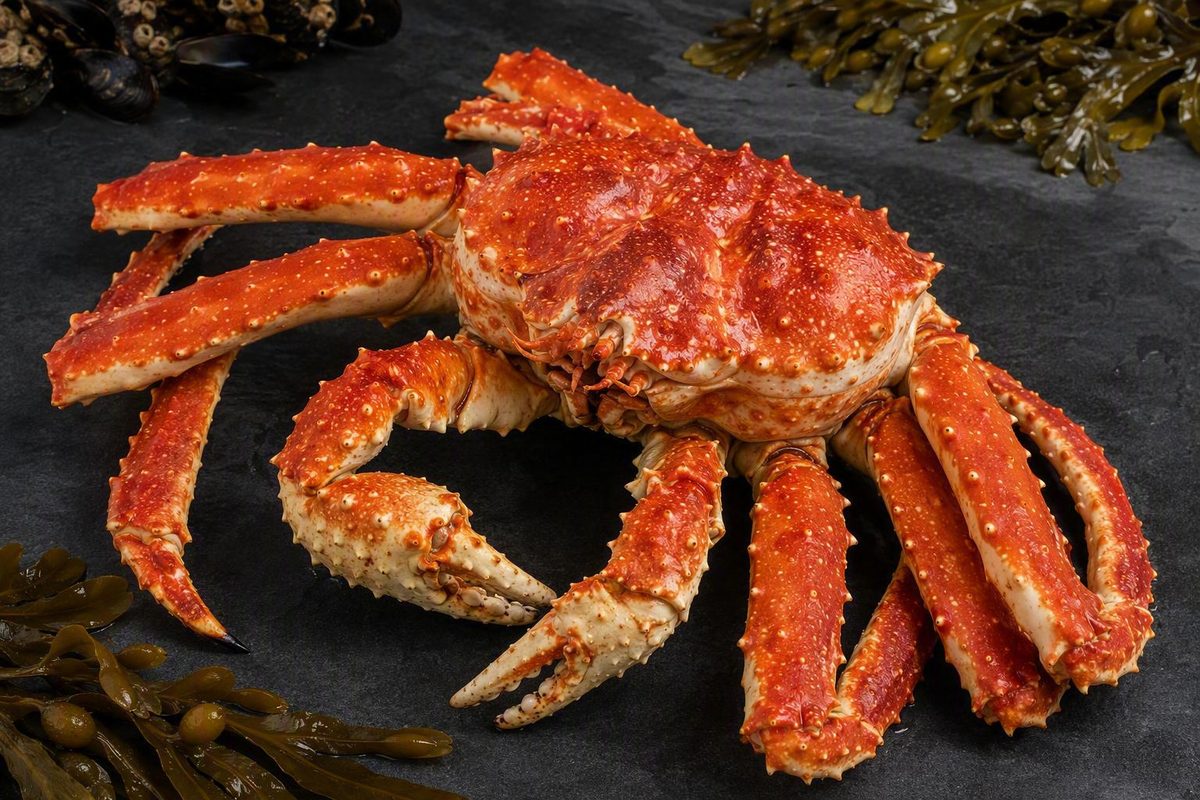
Puget Sound king crab at a glance
The Puget Sound king crab is a large, vividly colored member of the king crab family found along the Pacific coast of North America, including Washington’s Puget Sound. Unlike the familiar Dungeness crab, it is primarily associated with cold, rocky subtidal habitat and is only occasionally observed locally.
Its currently accepted scientific name is Echidnocerus cibarius. Many established aquarium, government, and diving resources still use Lopholithodes mandtii, however. A reported 2022 taxonomic treatment made that older name a junior synonym, so both names remain useful when searching for records and photographs (Puget Sound king crab taxonomic summary).
The most useful field marks are:
- A broad, heavy, roughly box-shaped body
- Blunt, rounded, wart-like bumps on the shell
- Claws and legs that fold close against the body
- A reduced rear pair of walking legs concealed beneath the carapace
- Large, prominent claws
- Bright coloration that changes with age
Juveniles are predominantly orange, sometimes with smaller areas of red, yellow, or purple. Adults can display combinations of red, orange, yellow, brown, purple, blue, and white.
The Washington Department of Fish and Wildlife describes the Puget Sound king crab as a deepwater species seen only occasionally in Puget Sound. Divers are more likely to encounter one than people checking crab pots. WDFW also notes that the crab can fold its limbs against its body until it resembles a rough box and distinguishes it from Alaska’s commercially harvested king crabs (WDFW crab identification guide).
Washington legal note: A Puget Sound king crab may not be retained recreationally. Washington allows retention only of Dungeness, red rock, and Tanner crab; other crab species are closed to harvest. An open Dungeness season does not make a Puget Sound king crab legal to keep. Check the current marine-area rules before every trip (WDFW crab seasons and regulations).
This is therefore a wildlife-identification guide, not advice for catching or eating the commercial king crabs associated with Alaska. If you encounter this species, the practical goal is to recognize it, observe or photograph it without disturbing its habitat, and leave it in the water.
How to identify a Puget Sound king crab
A Puget Sound king crab can look almost architectural. Its body is broad and heavily built, and it can draw its claws and walking legs inward to form a compact package. Viewed from above or at an angle, that posture creates a rough, box-like outline rather than the flatter, more open silhouette many people associate with crabs.
The folded posture is an important field mark. A partly concealed animal on a rocky wall or ledge may initially resemble a knobby block rather than a crab. The claws and legs become more obvious when the animal begins to move or relaxes its posture.
Look for rounded bumps, not merely a “spiny shell”
The carapace carries bumps, tubercles, and some spines, but the most distinctive texture is blunt, rounded, and wart-like. Describing the crab only as “spiny” can obscure one of the better ways to distinguish it from crabs dominated by sharper projections.
Adult coloration can include:
- Red
- Orange
- Yellow
- Brown
- Purple
- Blue
- White
Not every adult displays every reported color. Some are dominated by reds and oranges, while others show darker brown, purple, blue, or pale markings. Color should therefore support an identification rather than determine it by itself.
Shell shape and texture remain important even when the animal’s colors are difficult to assess. Look for the combination of a heavy central shell, rounded tubercles, folded limbs, and unusually varied coloration.
Why does it appear to have only six walking legs?
A Puget Sound king crab may appear to have only three pairs of walking legs. The apparently missing pair has not been lost: the fourth pair is reduced and concealed beneath the rear of the carapace. In addition to the visible walking legs, the animal has two prominent claws.
This hidden pair changes the crab’s silhouette and explains why a quick leg count can be misleading. The feature is part of the crab’s normal anatomy, not evidence of injury.
The legs are less heavily armored than the central carapace and may end in pointed or spiked tips. That contrast becomes easier to see when the crab unfolds: a thick, knobby shell sits above comparatively less armored limbs.
A compact sighting checklist
A likely Puget Sound king crab should display several of these traits together:
- Boxy profile: A broad, heavy body rather than a flat oval
- Rounded tubercles: Blunt, wart-like bumps across the carapace
- Folded posture: Claws and legs held close to the shell
- Hidden rear legs: Only three walking pairs readily visible
- Large claws: Prominent, robust claws relative to the legs
- Life-stage color: Mainly bright orange in juveniles or a more complex adult palette
Do not identify the species from color alone. A bright-orange crab is not automatically a juvenile Puget Sound king crab, and an adult does not need to display every color reported for the species. Body shape, shell texture, limb arrangement, and habitat provide a stronger identification when used together.
If the animal can be observed without touching or moving it, useful notes include the approximate shell width, depth, color pattern, posture, substrate, and whether it was exposed or sheltering. A clear image from more than one angle can help show both the carapace texture and folded-limb structure.
Juvenile versus adult appearance
Juvenile Puget Sound king crabs can look surprisingly different from the multicolored adults featured in many underwater photographs. Young animals are predominantly bright orange, sometimes with smaller areas of red, yellow, or purple. Their comparatively simple color pattern can initially suggest a different species.
Adults develop a darker and more complicated palette. Red and orange remain common, but the shell may also carry yellow, brown, purple, blue, white, or pale markings. Individual appearance varies, so this should be understood as a general life-stage difference rather than a fixed sequence in which every crab develops the same pattern.
A specialist diving account places the beginning of the transition toward adult coloration at a carapace width of about two inches. That figure is best treated as a secondary-source observation, not a universal developmental threshold for every individual or population (Advanced Diver’s Puget Sound king crab profile).
Habitat can provide supporting context
Juveniles may shelter beneath rocks in comparatively shallow areas, including places affected by low-tide conditions. Adults are more strongly associated with deeper subtidal habitat.
That distinction is useful but not absolute. Location alone does not determine age, and adults may enter shallower water during seasonal movement. Likewise, finding an orange crab beneath a rock is not enough for identification without checking its boxy body, rounded shell bumps, and concealed rear legs.
Tidepool observers should not overturn or relocate rocks merely to search for a juvenile. If a crab is naturally visible, observe it where it is rather than rearranging the surrounding habitat for a better view or photograph.
The reason for the species’ bright colors is less firmly established than the colors themselves. It may be tempting to describe juvenile orange or adult mottling as proven camouflage or a specific defense against predators, but the supplied evidence does not establish those explanations. The defensible conclusion is that coloration changes with life stage and is most useful when considered alongside anatomy and habitat.
Size, anatomy, and the scientific-name change
Published size figures for the Puget Sound king crab do not align perfectly. WDFW reports a width of up to about 10 inches, while Mote Marine Laboratory and Aquarium says the shell can exceed 12 inches (Mote’s Puget Sound king crab profile).
Those figures should not be compressed into a single definitive maximum. Sources variously refer to shell width, carapace width, or general body width, and they may not use identical measurement methods. None of those measurements should be confused with the crab’s full tip-to-tip span when its legs are extended.
A community-edited species summary describes a general size range of 6 to 10 inches and separately notes that carapace width may exceed 12 inches. Because that range is not presented as the result of a systematic population survey, it is better treated as an attributed description than as a firmly established average for the species (Puget Sound king crab species summary).
For field notes, estimate or photograph the hard central carapace separately from the legs whenever possible. “Across the shell” is more informative than an overall estimate that includes extended limbs.
The anatomy behind the unusual outline
The species’ central armor is heavier and bumpier than its legs. Its limbs can draw close to the carapace, creating the compact, box-like posture reflected in many descriptions.
The reduced fourth pair of walking legs sits beneath the rear of the carapace. Only three walking pairs are therefore readily visible. When the two claws are added to that outline, a quick glance can create the false impression that the animal lacks a normal pair of limbs.
The large claws can grasp, cut, crush, and manipulate food. Some secondary sources assign crushing and finer handling to particular sides, but the accounts directly contradict one another about which claw performs which task. It is therefore safer not to label either the left or right claw as the definitive crusher.
Why two scientific names appear
The currently accepted scientific name is Echidnocerus cibarius. Under the newer taxonomic treatment, Lopholithodes mandtii is considered a junior synonym. The two names refer to the same species, but the accepted name gives priority to Echidnocerus cibarius.
That change has not propagated through every established resource. WDFW’s identification page, aquarium profiles, and older diving articles may still use Lopholithodes mandtii. That does not necessarily mean those pages describe a different animal; it generally reflects when the resource was written or last updated.
For research, use all three search terms:
- “Puget Sound king crab”
- “Echidnocerus cibarius”
- “Lopholithodes mandtii”
The species belongs to the king crab family Lithodidae and the infraorder Anomura. That classification is useful context for its unusual body plan, but it is not necessary to identify an individual in the field.
Puget Sound king crab, box crab, or Alaskan king crab?
Similar names create two different kinds of confusion. The Puget Sound king crab can be mistaken visually for the Puget Sound box crab, while the phrase “king crab” can lead people to associate it with the commercial species harvested in Alaska. Neither inference is reliable.
| Feature | Puget Sound king crab | Puget Sound box crab | Commercial king crabs associated with Alaska |
|---|---|---|---|
| Overall impression | Large, heavy, colorful, and box-like when folded | Also capable of a compact, box-like posture | A market and fishery grouping involving other species |
| Shell texture | Blunt, rounded, wart-like tubercles with some spines | More sharply spined appearance | Varies by species |
| Color | Juveniles mainly orange; adults can be richly multicolored | Not defined by the same varied adult palette | Varies among species |
| Legs | Reduced rear walking pair concealed beneath the carapace | Different folded-limb structure | Anatomy varies by species |
| Key local distinction | Lacks the circular opening visible in a folded box crab | Notches in the claws and first walking legs form a round opening | Not the same Puget Sound species |
| Typical context | Cold, rocky subtidal habitat, often in deeper water | Identified through shell and folded-limb features | Commercial fisheries, particularly those associated with Alaska |
The key comparison with the Puget Sound box crab
When a Puget Sound box crab folds its claws and first walking legs, notches in those limbs form a rounded opening. The Puget Sound king crab lacks that opening. WDFW identifies this as a central way to separate the two animals.
Shell texture supplies another clue. The king crab’s bumps tend to be blunt and rounded, while the box crab has a more sharply spined appearance. Whenever the viewing angle permits, assess both features: look for the folded-limb opening and compare the shape of the shell projections rather than relying on general boxiness alone (WDFW crab identification guide).
Why “king crab” does not mean “Alaskan seafood”
The Puget Sound king crab is not the commercial king crab harvested in Alaska. A shared common-name phrase does not make two animals the same species or part of the same fishery. It also does not establish equivalent harvest rules, commercial importance, or menu availability.
That distinction matters for visitors familiar with commercially sold king crab legs. Seeing “king crab” in the name of a Washington animal does not imply that Puget Sound supports a recreational fishery for it.
The conservative field rule is simple: if identification is uncertain, leave the crab in the water. Generic information about an open crab season should never substitute for identifying the animal first.
Range, habitat, depth, and seasonal movement
Despite its common name, the Puget Sound king crab is not confined to Puget Sound. Its reported Pacific range extends from Alaska south to central California. Washington’s inland marine waters form only one part of that broader coastal distribution.
The crab’s principal habitat is cold subtidal water over rocky terrain, particularly in areas with substantial current. Educational species profiles report it at depths of approximately 137 to 140 meters, or about 450 feet, with adults generally associated with deeper water (Puget Sound king crab habitat profile).
Divers have reported seeing the crabs on:
- Rocky walls
- Narrow ledges
- Boulders
- Current-swept reef structure
- Crevices and protected spaces near hard substrate
These are regional observations rather than a systematic map of population density. Suitable-looking habitat does not guarantee a sighting, and no individual wall, park, island, or dive site can be presented as reliable from the evidence available here.
Juvenile habitat
Juveniles may occur beneath rocks in shallower areas, including places exposed to changing low-tide conditions. Those sheltered spaces are associated in the supplied species accounts with avoiding heat stress.
Even so, the Puget Sound king crab should not be presented as a routine tidepool find. Its principal association remains subtidal, and deliberately searching beneath rocks conflicts with the goal of observing the animal without disturbing its surroundings.
A naturally exposed bright-orange juvenile is likely to look less ornate than an adult. In that situation, the rounded tubercles, compact body, prominent claws, and concealed rear legs become especially important for identification.
Seasonal movement into shallower water
Adult Puget Sound king crabs may enter shallower water for molting, mating, or breeding and later return to depth. Secondary accounts place parts of that movement from early winter through early spring. A specialist dive account, for example, describes movement from water deeper than 100 feet into depths of roughly 30 to 50 feet during part of the regional cycle (Advanced Diver’s seasonal account).
Those reports do not establish a single universal “king crab season.” Different sources may be describing different stages of the cycle, different locations, or observations made in different years.
Specialized divers can also search deeper, rockier habitat than shoreline walkers, ferry passengers, or people checking ordinary crab pots. That helps explain how knowledgeable divers may report encounters while WDFW still characterizes the species as only occasionally seen in Puget Sound.
For Seattle visitors, realistic expectations are important. A ferry crossing offers views across Puget Sound, not a dependable underwater wildlife sighting. A waterfront walk or ordinary tidepool stop is similarly unlikely to reveal an adult deepwater crab. The supplied evidence does not support numerical sighting odds or a guaranteed location.
Diet, feeding, and life cycle: what is known and uncertain
The Puget Sound king crab appears to have a broad diet centered on echinoderms and other marine invertebrates. Reported food items include:
- Sea urchins
- Sea stars
- Brittle stars
- Sea cucumbers
- Barnacles
- Sea anemones
- Other small invertebrates
Some profiles also list algae and detritus. That may reflect broader opportunistic feeding, differences among habitats or life stages, or simply differences in the detail provided by each summary. The available evidence does not establish one indispensable prey species.
The crab’s large claws can grasp, crush, cut, and manipulate food. Those general functions are more defensible than assigning a fixed role to each side. Secondary accounts disagree about whether the left or right claw is the principal crusher.
Claims that a particular sea star is the species’ preferred food are also too strong without comparative feeding evidence. A diver may observe a crab eating one kind of prey at a specific place and time, but that observation does not establish a range-wide preference.
A cautious outline of the life cycle
Secondary accounts describe the following general sequence:
- Adults move from deeper habitat into shallower water during a seasonal reproductive period.
- Molting occurs in connection with mating.
- Females carry eggs and return to deeper water.
- Larvae hatch over a period of days.
- The larvae pass through an initial planktonic phase.
- Young crabs eventually settle to the bottom.
- Juveniles grow and gradually develop the more complicated adult color pattern.
This sequence is more reliable as a broad outline than as a precisely timed schedule. The supplied evidence consists mainly of educational profiles and specialist summaries rather than recent primary studies of every stage.
What remains uncertain
Basic descriptions of the crab’s rocky habitat, seasonal movement, and invertebrate diet are better supported here than its precise reproductive schedule. One educational profile reports as many as approximately 186,000 eggs, about a year of brooding, a 12-to-14-day hatching period, roughly two months in the plankton, and around seven years to maturity. These should be treated as reported secondary-source estimates, not universal values for every population or individual (educational life-cycle profile).
The same restraint applies to the crab’s ecological role. Its consumption of sea urchins and other invertebrates could affect a local community, but the supplied evidence does not quantify an effect on kelp forests, establish a preferred prey throughout the range, or determine feeding frequency.
Population size and long-term trends in Puget Sound also remain unclear. “Occasionally seen” describes human encounters, not a measured population estimate. A primarily deepwater animal may be difficult for most people to observe, while repeated sightings by experienced divers can be concentrated in favorable habitat.
Washington harvest rules and responsible encounters
No recreational retention of Puget Sound king crab is allowed under the current Washington rules reviewed for this guide.
The legal basis is the permitted-species list. Washington allows recreational fishers to retain Dungeness, red rock, and Tanner crab, subject to applicable seasons and other restrictions. Puget Sound king crab is not on that exclusive list, so it may not be retained. The conclusion does not depend on the rule naming Echidnocerus cibarius individually (current WDFW crab regulations).
In practical terms:
- An open Dungeness season does not authorize retention of Puget Sound king crab.
- Dungeness size, sex, or bag limits cannot be applied to make this species legal.
- A license or crab endorsement does not expand the list of retainable species.
- A Puget Sound king crab encountered in a pot or taken by hand must not be kept.
- No detailed species-specific handling protocol is established by the supplied sources, so do not improvise one from advice written for another crab.
Regulations must be checked before each trip
Crab seasons differ by marine area. Open days, quotas, closures, gear restrictions, and emergency rules can change, so older dates or saved season tables should not be treated as evergreen guidance.
Before crabbing, consult WDFW’s current rules for the exact marine area. General requirements may include an appropriate fishing license, a Puget Sound crab endorsement, a Dungeness catch record card, harvest reporting, and compliance with gear rules. The requirements depend on the location and activity, and meeting them does not make Puget Sound king crab retention legal.
Keep three separate questions in mind:
- Is recreational crabbing open in this marine area?
- Is this particular species legal to retain?
- Does the individual satisfy every applicable size, sex, shell-condition, gear, and reporting rule?
A “yes” to the first question does not answer the second.
What to do when you see one
A responsible encounter is observational:
- Leave the crab where it is.
- Photograph it without collecting or staging it.
- Do not move rocks or alter nearby habitat for a clearer image.
- If it appears in fishing gear, do not retain it.
- Note the date, approximate depth, habitat, shell size, and coloration if that can be done safely.
The practical identification to remember is a large, boxy, vividly colored crab with rounded shell bumps, folded limbs, and a concealed rear pair of walking legs.
Frequently asked questions
What is the accepted scientific name of the Puget Sound king crab?
The currently accepted name is Echidnocerus cibarius. Lopholithodes mandtii is an older name now treated as a junior synonym, but it remains common on government, aquarium, educational, and diving pages. Search both names when comparing records or photographs.
Is the Puget Sound king crab the same as the king crab caught commercially in Alaska?
No. The Puget Sound king crab is distinct from the commercial king crabs associated with Alaska. The shared phrase “king crab” does not imply the same species, fishery, harvest rules, or seafood market.
How large can a Puget Sound king crab grow?
Published profiles report maximum shell or carapace widths from about 10 inches to around 12 inches or slightly more. Because the sources use different measurement language, there is no single exact maximum that should be treated as definitive. Those figures describe the central shell rather than the animal’s full span with its legs extended (Mote’s species profile).
Is the Puget Sound king crab rare?
It is safer to say that the species is only occasionally seen in Puget Sound, especially by people who are not diving in suitable deep, rocky habitat. That wording does not establish a precise population size, a range-wide rarity classification, or a declining trend.
Can you legally keep a Puget Sound king crab caught in Washington?
No. Washington recreational rules permit retention only of Dungeness, red rock, and Tanner crab. Because the Puget Sound king crab is not one of those listed species, it may not be retained. Current seasons, closures, and marine-area restrictions must also be checked before fishing (Washington crab rules).
The practical takeaway
A Puget Sound king crab is best recognized by a combination of features: a large, heavy, box-like body; blunt, wart-like shell bumps; large claws; folded limbs; a concealed rear pair of walking legs; and bright coloration that changes from predominantly orange in juveniles to a more complicated adult palette.
Its name can be misleading in two ways. It is not confined to Puget Sound—the reported range extends from Alaska to central California—and it is not the commercial king crab associated with Alaskan seafood. It is primarily an animal of cold, rocky subtidal water, with adults generally favoring greater depths and only occasionally entering the view of most Puget Sound observers.
Important details about local abundance and the precise reproductive schedule remain uncertain. A sighting is therefore worth appreciating without turning it into a collection opportunity. Observe or photograph the crab where it is, avoid disturbing the surrounding habitat, and leave it in the water.
For Washington crabbers, the final rule is unambiguous: do not retain a Puget Sound king crab, and verify current marine-area regulations before every trip (Washington crab rules).