
Choose the Right Bremerton Ferry for Your Departure Time
Choose the right Seattle–Bremerton boat by departure time, crossing length, fare, vehicle rules, seasonal service, and the September 2026 gap.
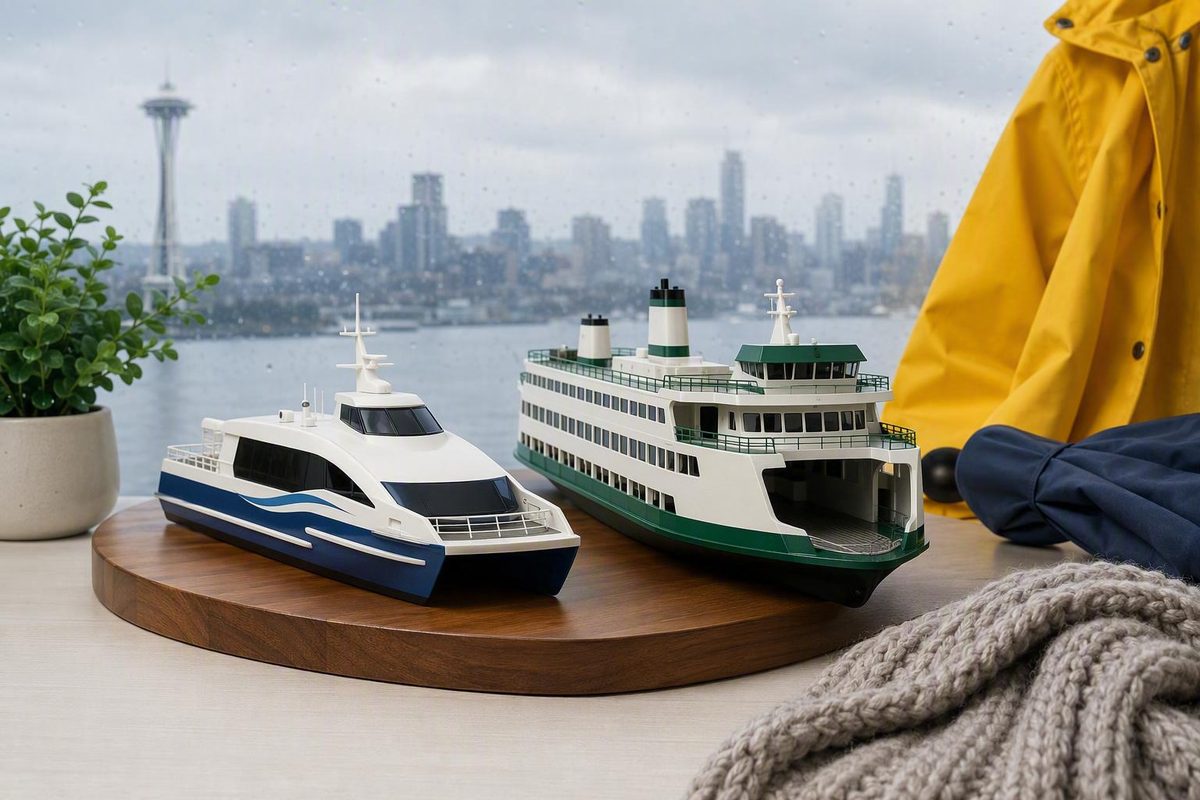
For a walk-on day trip, take Kitsap Transit’s 30-minute Bremerton Fast Ferry when both the outbound and return sailings fit. Beginning September 1, 2026, take the approximately 60-minute Washington State Ferry if you need to leave Seattle during the Fast Ferry’s 8:40 a.m.–2:25 p.m. weekday gap, after its 7:40 p.m. cutoff, on Sunday, or on a Saturday from October through April. Anyone taking a car, motorcycle, or truck must use Washington State Ferries.
Set your departure time, day, and service period; the picker identifies the usable boat, terminal, crossing time, and known fare.
Seattle–Bremerton Departure Picker
Choose when you want to leave Seattle. Exact complete timetables were not provided in the source material, so unknown next departures are shown as — rather than estimated.
At 10:00 a.m. on a weekday beginning September 1, the Fast Ferry is inside its 8:40 a.m.–2:25 p.m. gap. Walk to Colman Dock at Pier 52. The exact next WSF departure is —; check the live timetable.
Kitsap Transit Fast Ferry
Next known sailing: 2:25 p.m.- Seattle dock
- Pier 50
- Crossing
- ~30 minutes
- Known arrival
- ~2:55 p.m.
- Adult fare
- $13 outbound / $2 return
- Round trip
- $15 calculated
- Vehicles
- No
Washington State Ferries
Next exact sailing: —- Seattle dock
- Colman Dock, Pier 52
- Crossing
- ~60 minutes
- Exact arrival
- —
- Adult fare
- Seattle outbound: —
- Return fare
- $0 for passengers and bicycles
- Vehicles
- Yes
| Day and period | Desired Seattle departure | Fast Ferry status | First service to check | Reason |
|---|---|---|---|---|
| Weekday, September 1 or later | At or before 8:40 a.m. | 8:40 a.m. is a known boundary sailing | Fast Ferry | Shorter crossing if the return works |
| Weekday, September 1 or later | After 8:40 a.m., before 2:25 p.m. | No departure in reported gap | Washington State Ferries | Next known Fast Ferry boundary is 2:25 p.m. |
| Weekday, September 1 or later | 2:25–7:40 p.m. | Operates; exact next time may be — | Compare both | Check the approximately 7:10 p.m. Bremerton return cutoff |
| Weekday, September 1 or later | After 7:40 p.m. | Finished from Seattle | Washington State Ferries | 7:40 p.m. is the reported final Seattle Fast Ferry |
| Weekday through August 31 | Any time | Temporary sailings provide more choices | Compare both | Exact next departures were not supplied |
| Saturday, May–September | Any time | Seasonal service operates | Compare both | Exact Fast Ferry times were not supplied |
| Saturday, October–April | Any time | No scheduled seasonal service | Washington State Ferries | Fast Ferry Saturdays are seasonal |
| Sunday | Any time | No listed service | Washington State Ferries | WSF operates daily |
| Any day | Any time | Passenger-only | Washington State Ferries | Cars, motorcycles, and trucks require WSF |
For Saturday decisions, the picker treats September as seasonal Fast Ferry service and October onward as the October–April no-service period when “September 1 or later” is selected. Confirm the actual date-specific schedule.
Source: Kitsap Transit and Washington State Ferries operator information, plus reported September 2026 service reductions cited in the article. Crossing times are approximate; complete departure times and the WSF Seattle outbound walk-on fare were not supplied.
The services leave from neighboring but separate Seattle terminals. Kitsap Transit uses Pier 50. Washington State Ferries uses Colman Dock at Pier 52. Confirm the operator and pier before entering a boarding line.
The return can reverse the outbound decision. A convenient Fast Ferry to Bremerton is not useful if its final return leaves before dinner or an event ends. Mixing operators is possible for a walk-on passenger: take the Fast Ferry one way and the state ferry the other if the times and fares work.
The Fast Ferry Saves About 30 Minutes Per Crossing
| Comparison | Bremerton Fast Ferry | Washington State Ferries |
|---|---|---|
| Operator | Kitsap Transit | Washington State Ferries |
| Approximate crossing | 30 minutes | 60 minutes |
| Vehicles | Passenger-only | Bicycles, motorcycles, cars, and trucks accepted |
| Seattle terminal | Pier 50 | Colman Dock, Pier 52 |
| 2026 operating pattern | Monday–Saturday; Saturdays only from May through September | Daily service |
| Adult fare evidence | $13 Seattle to Bremerton; $2 Bremerton to Seattle | Bremerton-to-Seattle passengers and bicycles pay no fare; the Seattle outbound fare depends on the current fare schedule |
| Best fit | A car-free trip with suitable departures in both directions | A vehicle trip or a walk-on trip needing broader daily and evening coverage |
The scheduled dock-to-dock difference is approximately 30 minutes. That saving is most useful when a traveler can walk or take a simple transit connection at both ends.
Crossing time excludes the trip to the terminal, the boarding buffer, waiting, disembarking, and onward travel. A Fast Ferry that requires a long wait may produce a later arrival than the next state ferry. Conversely, a well-timed Fast Ferry can preserve nearly the full half-hour difference.
A driver has a different calculation. The state ferry adds vehicle queuing, loading, and unloading, but having a car in Bremerton may eliminate transfers or a separate ride beyond the central transportation area. The Fast Ferry cannot carry a car, motorcycle, or truck under any circumstances.
Washington State Ferries also carries walk-on passengers and cyclists; it is not only a vehicle service. The two present-day routes are operated separately: Kitsap Transit runs the passenger-only Fast Ferry, while WSF operates the automobile-and-passenger route.
September 2026 Creates a Six-Hour Weekday Gap
Temporary state-funded weekday Fast Ferry sailings end after August 31, 2026. Reporting on the reduction says service falls from 20 to 13 weekday round trips, while the Washington State Ferries route keeps two-boat service.
Beginning September 1, there is no reported Fast Ferry departure from Seattle between 8:40 a.m. and 2:25 p.m. A walk-on visitor reaching the waterfront after the 8:40 sailing should normally use Washington State Ferries rather than wait until midafternoon.
The final reported Fast Ferry departure from Seattle is 7:40 p.m. One report placed the final Bremerton departure at 7:05 p.m. and another at 7:10 p.m. Treat the return cutoff as approximately 7:10 p.m. and verify it on the date of travel. The Urbanist’s report on the weekday reduction documents the 20-to-13-round-trip change and the Seattle schedule gap. The Kitsap Sun’s account attributes the reduction to expiring temporary funding.
The practical choices beginning September 1 are:
| Departure Window | First Service to Check |
|---|---|
| Weekday at or before 8:40 a.m. | Fast Ferry, provided its exact sailing and the return work |
| Weekday after 8:40 a.m. and before 2:25 p.m. | Washington State Ferries |
| Weekday from 2:25 p.m. through 7:40 p.m. | Compare both, starting with the return cutoff |
| Weekday after 7:40 p.m. | Washington State Ferries |
| Saturday, May through September | Compare both services |
| Saturday, October through April | Washington State Ferries |
| Sunday | Washington State Ferries |
Through August 31, temporary weekday sailings provide more Fast Ferry choices. The official Bremerton Fast Ferry page remains the controlling source for date-specific departures and service alerts.
Washington State Ferries lists daily Seattle–Bremerton service with an approximately 60-minute crossing. Its departures cover a broader part of the day, but travelers still need the timetable for their exact date. The official Seattle–Bremerton schedule provides those times.
The Fast Ferry Costs an Adult $15 Round Trip at Listed Fares
Kitsap Transit’s adult fares are directional:
- Seattle to Bremerton: $13
- Bremerton to Seattle: $2
- Calculated two-way total: $15
The $15 total is the sum of the two one-way fares, not a separately quoted round-trip product. Riders age 18 and under travel free on Kitsap Transit services.
Kitsap Transit accepts exact cash, ORCA, contactless bank cards, supported digital wallets, Transit GO tickets, and paper tickets. Fast Ferries do not issue or accept transfers, and PugetPass is not accepted. The operator’s Fast Ferries information has current fare and payment details.
Washington State Ferries says passengers and bicycles traveling from Bremerton to Seattle do not pay a fare. Seattle-to-Bremerton passengers pay the applicable current fare, so the draft source material does not provide a complete adult state-ferry round-trip figure. Drivers must compare the vehicle-and-driver fare for the correct vehicle type and size rather than a walk-on fare.
The official Bremerton terminal information supplies the state ferry’s return-direction fare rule and terminal guidance. Check the current fare for the same date, direction, passenger category, and vehicle status before comparing costs.
Pier 50 and Colman Dock Are Separate Boarding Points
The Fast Ferry departs Pier 50. Washington State Ferries departs Colman Dock at Pier 52. They are close enough that a walk-on passenger may be able to change operators after a missed or canceled sailing, but they are not interchangeable gates within one service.
In Bremerton, both connect with the central ferry and transportation area. A car-free visitor going to central Bremerton can reach downtown destinations and local transit without arranging a vehicle first.
If a Fast Ferry sailing is missed or canceled, check both operators rather than waiting automatically for the next Kitsap departure. Recalculate the arrival using the state ferry’s approximately 60-minute crossing, then check the return before continuing. A replacement outbound trip that removes the evening return buffer may require shortening the day.
A vehicle cannot switch to the passenger-only boat. A walk-on traveler usually has more flexibility, subject to boarding deadlines, fares, equipment limits, and space.
Bicycles and Mobility Devices Need a Backup Sailing
Fast Ferry passengers should arrive at least 10 minutes before departure and be aboard at least two minutes before departure.
The Fast Ferry has 12 exterior bicycle racks, available first-come, first-served and subject to fit restrictions. A bicycle ticket or planned sailing does not reserve rack space. Cyclists should identify another usable Fast Ferry or state ferry before leaving.
No more than five qualifying electric scooters are allowed on a Fast Ferry sailing. Folded scooters must be 43 inches or shorter. Larger-than-standard-luggage items such as kayaks, canoes, paddleboards, bicycle trailers, and large carts are not accepted.
Rich Passage 1 is listed as accommodating up to four mobility devices, and Fast Ferry vessels have two ADA-compliant restrooms. Actual access can still depend on the assigned vessel, gangway, terminal route, elevator status, and remaining device space.
Washington State Ferries carries bicycles, and cyclists may bypass the vehicle line. Official Bremerton guidance asks them to arrive 20 minutes before departure for positioning near the beginning of loading. Buying a ticket in advance does not guarantee physical space aboard a sailing.
A traveler who depends on an elevator, gangway configuration, or particular vessel feature should check live accessibility alerts shortly before departure. Normal accessibility specifications do not guarantee that every elevator or boarding route is available that day.
The Return Sailing Determines the Best Day-Trip Boat
For a compact downtown-to-downtown trip, start with the Fast Ferry. Its 30-minute crossing is the strongest option when the outbound leaves near the desired time and a suitable return remains available.
Beginning September 1, a weekday visitor planning to leave Seattle around late morning or lunchtime should start with Washington State Ferries. The Fast Ferry’s 8:40 a.m.–2:25 p.m. gap is longer than its crossing-time advantage.
A dinner or evening-event itinerary also favors the state ferry unless the activity ends comfortably before the last Fast Ferry from Bremerton, reported at approximately 7:10 p.m. Build in time to reach the terminal rather than treating that departure as the event’s ending time.
Saturday visitors from May through September can compare both operators. From October through April, the 2026 pattern does not schedule Saturday Fast Ferry service. Sunday visitors should use Washington State Ferries because no Sunday Fast Ferry service is listed.
For a simple day trip, choose one principal destination area, keep one meaningful time buffer, and build around a compact activity. That protects the return without turning a missed connection into a complete itinerary failure.
Common Bremerton Ferry Questions
How Much Faster Is the Bremerton Fast Ferry?
Its published crossing is approximately 30 minutes, compared with approximately 60 minutes on Washington State Ferries. It saves roughly 30 minutes of scheduled time on the water, though waiting and terminal access determine the actual door-to-door difference.
Can a Car Use the Bremerton Fast Ferry?
No. The Kitsap Transit service is passenger-only. Cars, motorcycles, and trucks must use Washington State Ferries. Both services can carry bicycles, but the Fast Ferry has only 12 exterior racks and applies equipment restrictions.
Does the Fast Ferry Run on Weekends?
Under the reviewed 2026 pattern, it runs on Saturdays from May through September. It does not list Sunday service, and Saturday service is not scheduled from October through April.
Can I Take One Operator Out and the Other Back?
Yes, if traveling without a motor vehicle. Compare both return schedules and directional fares first. In Seattle, remember that Kitsap Transit arrives at Pier 50 while Washington State Ferries uses Colman Dock at Pier 52.
What Happens if the Fast Ferry Is Unavailable?
Check the next Washington State Ferries departure and recalculate the trip with a 60-minute crossing. Confirm the return before boarding, especially after the September Fast Ferry reduction. Cyclists and mobility-device users should also verify space, vessel conditions, and the accessible terminal route.