
How to Plan a Climb Up Capitol Hill’s Historic Lookout
Tower hours are 10 a.m. to dusk; verify current access, prepare for about 106–107 steps, and know how weather and foliage may affect the views.
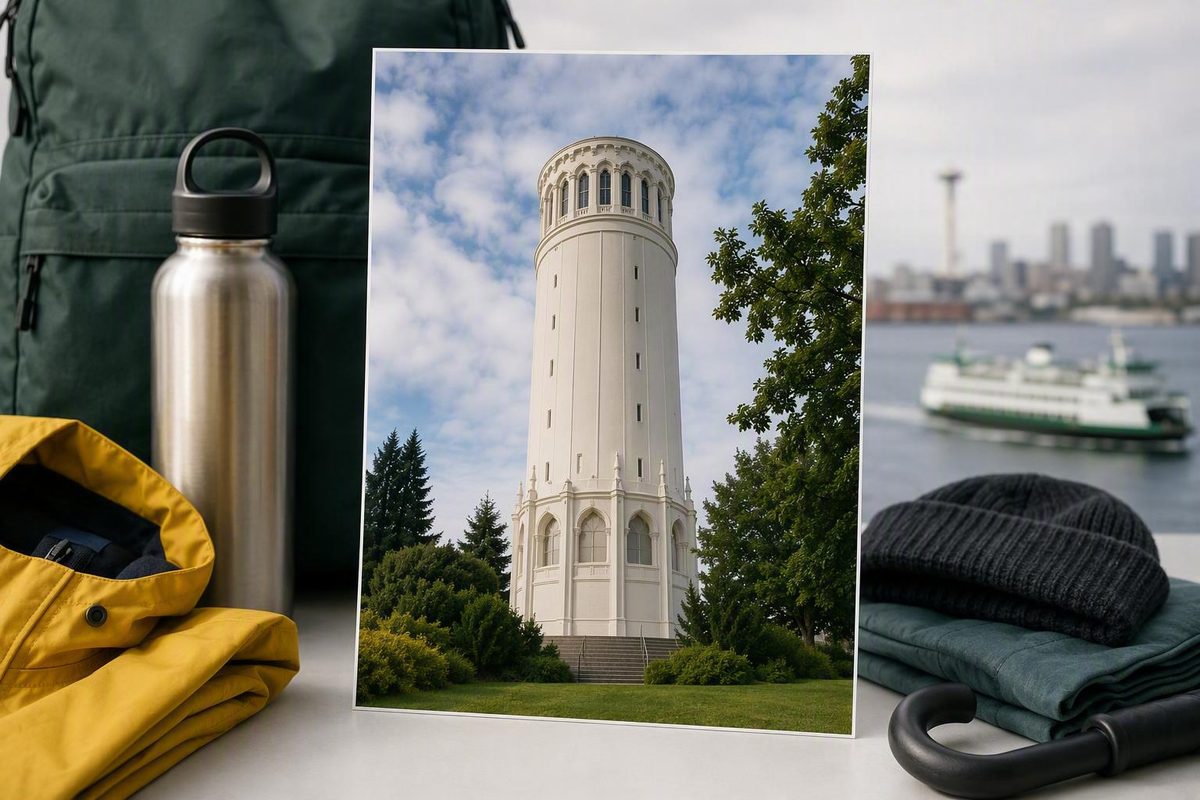
Treat the Volunteer Park Water Tower as one compact Capitol Hill anchor, not the entire outing. Verify current access before leaving, visit with enough time to complete the stair climb before dusk, and keep the park’s gardens, trails, conservatory, or museum as flexible follow-on stops. Views depend on weather, foliage, and visibility, so a distant mountain panorama is never guaranteed.
The quick plan: when to go and what to verify
Volunteer Park Water Tower planning box
- Address: 1247 15th Ave. E, Seattle, WA 98112
- Water-tower hours: 10 a.m. to dusk
- Park hours: 6 a.m. to 10 p.m.
- Access: Interior stairs to the observation deck
- Before leaving: Check the park page or ask Seattle Parks about current access at (206) 684-4075
These address, schedule, and contact details come from the official Volunteer Park page.
The tower and the surrounding park have different schedules. Do not assume that tower access continues until the park closes. Because dusk changes throughout the year, the tower does not have one fixed evening closing time.
For a late-day visit, leave enough margin to find the entrance, climb at your own pace, spend time at the observation level, and descend before the dusk closure. Seattle Parks does not define “dusk” on the supplied park page, so a calculated sunset time should not be treated as an exact closing time.
One recent visitor report describes combining the climb with the museum and gardens, but an individual experience does not establish future access.
Older visitor guides and reviews describe tower entry as free. The current municipal park page does not state a tower fee policy, however, so verify rather than building your plan around free admission.
Finding the tower inside Volunteer Park
Use 1247 15th Ave. E, Seattle, WA 98112 as the navigation destination. Once inside Volunteer Park, look near the south entrance on East Prospect Street. Visitor accounts place the cylindrical brick tower in the park’s southeast area, within the roundabout near that entrance.
A simple on-foot sequence is:
- Enter the park near East Prospect.
- Look for the large brick tower in the roundabout.
- Visit the tower first if it is open and the viewpoint is your priority.
- Continue north through the park toward the gardens, conservatory, museum, lawns, and other features.
The tower is visually distinctive and does not resemble a conventional open-air overlook. Its round brick exterior surrounds a working standpipe, while the public route rises inside the structure.
Current parking availability, restrictions, and road access are not established by the supplied evidence. Older visitor accounts should not be used to assume that parking will be plentiful or unrestricted.
What the climb is like
Two interior stairways spiral around opposite sides of the central standpipe and lead to the observation deck. Plan for approximately 106–107 steps: a municipal historical document reports 106 steps, while a visitor-oriented description reports 107 stairs. The reason for the one-step difference is not explained.
How demanding the climb feels will depend on your mobility, balance, and fitness. Take it at your own pace rather than relying on older descriptions that characterize it as easy or short.
Do not count on specific landings, designated rest areas, capacity controls, or special arrangements for strollers, children, or animals. If any of those details will determine whether you can visit, ask Seattle Parks before making a special trip.
No elevator or step-free route to the observation deck is documented. The Volunteer Park Trust describes the visitor route as two interior stairways spiraling to the top, so visitors should not assume that the upper deck can be reached without climbing stairs. Park-level attractions are the practical alternative for anyone unable to use the staircase.
Views and photography: set realistic expectations
Reported sightlines include downtown Seattle, the Space Needle, Puget Sound, and Bellevue. In suitable conditions, visitors have also reported seeing the Olympic Mountains, Cascade Mountains, and Mount Rainier. Treat those distant mountain views as possibilities rather than dependable features.
Several conditions can affect what you see:
- Clouds, rain, and haze can hide distant landmarks.
- Seasonal foliage and nearby trees can obstruct portions of the view.
- Bars and grating across the open viewing windows can interfere with photographs.
The result is a historic city lookout rather than a guaranteed unobstructed panorama. Clear weather improves the odds of distant views, but it does not remove trees or the window structures.
If photography is your priority, make the tower your first park stop when visibility looks favorable. For a late-day visit, first confirm current access and allow enough time to enter, climb, take photographs, and descend before the tower’s dusk closure. Do not assume that sunset itself marks the operator’s exact closing moment.
The observation level also offers something to examine when clouds hide the skyline or mountains. Interpretive panels explain Volunteer Park and Seattle’s Olmsted park and boulevard system, adding historical context to the climb.
Build a compact Volunteer Park outing
Keep the route flexible instead of assigning a strict duration to each stop:
- Start with the water tower after its listed 10 a.m. opening.
- Walk through the gardens or follow the park trails.
- Add the Volunteer Park Conservatory or Seattle Asian Art Museum if their separately verified schedules and admission policies fit your visit.
- Include the Black Sun sculpture or lawns as optional outdoor additions.
Seattle Parks lists gardens, trails, restrooms, and drinking fountains among Volunteer Park’s amenities. The listing does not establish how close each facility is to the tower, so leave time to orient yourself after the climb.
| Conditions | Tower strategy | Flexible follow-on plan |
|---|---|---|
| Clear with good visibility | Visit the tower first for the best chance of distant views | Gardens, Black Sun, lawns, or trails |
| Low clouds or haze | Treat the climb as a historic lookout rather than a mountain-view stop | Conservatory or museum after checking access |
| Rain | Confirm tower access and decide based on your own mobility needs | Emphasize indoor attractions |
| Near dusk | Leave a generous margin before the tower closes | Keep later stops at park level |
Check each attraction directly for its current hours, admission policy, and access conditions rather than assuming that all Volunteer Park features share one schedule.
This structure keeps the day useful if the tower is closed or visibility disappoints. The climb remains the anchor, while the other park attractions provide a weather-ready fallback without requiring a complicated itinerary.
Why this water tower doubles as a viewpoint
The tower is both a public lookout and part of Seattle’s water infrastructure. The Water Department built the park reservoir in 1901 and the standpipe in 1906. The tower subsequently became a popular observation point and was closed during wartime for security, according to the municipal archival history cited above.
Volunteer Park Trust says the standpipe holds 883,000 gallons and remains in use even though the reservoir is offline. The structure around it dates to 1906, and two stairways rise along opposite sides of the standpipe to reach the observation deck.
Its architecture gives the utility structure an unusually formal appearance. The walls taper from 27 inches thick at the base to 17 inches at the top and are built from clinker brick interrupted by granite bands. Granite also surrounds the doorways.
Above each entrance is the inscription “Aqua Pura,” meaning “Pure Water.” The wording reflects the tower’s original and continuing connection to the city water system rather than treating it solely as a sightseeing platform.
Although a possible architect has been suggested, the attribution remains uncertain. The tower should therefore not be assigned definitively to a particular designer.
For a short Seattle visit, keep the decision simple: use the tower as one Capitol Hill anchor, not a rigid itinerary. If access or visibility does not cooperate, shift the emphasis to the gardens, trails, conservatory, museum, sculpture, or lawns.
Is the Volunteer Park Water Tower open today?
The regular tower schedule is 10 a.m. to dusk, but that does not confirm today’s access. Check the Seattle Parks listing or ask about current conditions at (206) 684-4075 before making a special trip.
Is the Volunteer Park Water Tower free?
Older visitor sources describe entry as free, including a dated visitor review. The current municipal park page does not confirm a fee policy, so verify rather than assuming admission remains free.
How many stairs are in the Volunteer Park Water Tower?
Plan for approximately 106–107 steps. The municipal historical record gives the lower count, while several visitor-oriented accounts report 107 steps, including a 2016 park account.
Is there an elevator to the observation deck?
No elevator or step-free route is documented. The published visitor route uses interior spiral stairways, so do not assume the observation deck is accessible without climbing stairs. Contact Seattle Parks if step-free access will determine whether you can visit.