
How to Plan a Final-Season Visit to Fort Worden’s Artillery Museum
Status updated Aug. 9, 2026: open Wednesday through Sunday, 11 a.m. to 4 p.m., before the Sept. 7 closure. Opening that Monday remains unconfirmed.
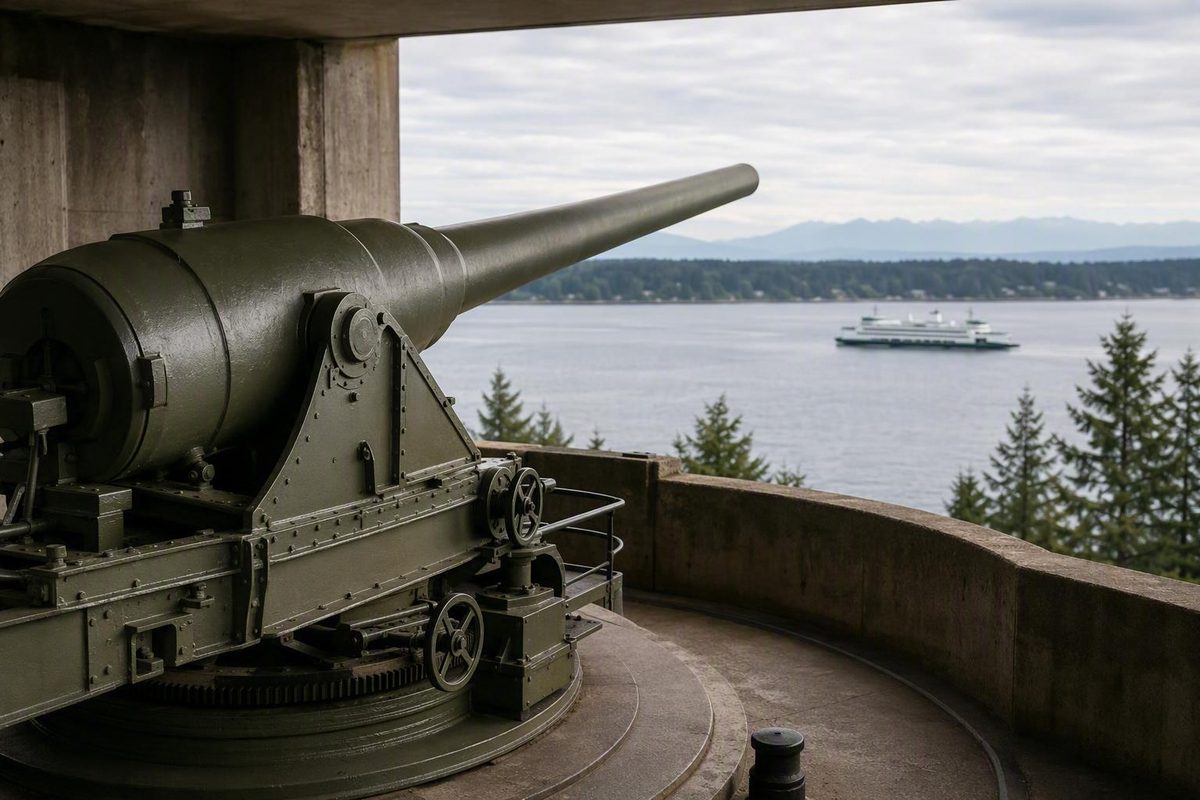
Editorial note: This guide was updated August 9, 2026, using current museum notices, Washington State Parks information, local reporting, and published historical guides. Operational details should still be confirmed directly before travel.
Final-season status: what visitors need to know first
Status updated August 9, 2026: The Puget Sound Coast Artillery Museum remains open and has announced that it will close on September 7, 2026. Its current regular schedule is Wednesday through Sunday, 11:00 a.m. to 4:00 p.m. The museum describes admission as free, with donations welcomed, and lists 360-385-0373 as its visitor-information number on the official museum website.
Current local reporting calls admission “by donation.” Although that wording differs slightly from “free, donations welcome,” neither description presents visitors with a mandatory museum ticket price.
Do not confuse museum admission with vehicle requirements inside Fort Worden State Park. The museum says a Washington State Discover Pass is required in the park, but older museum pages display conflicting prices. Check current Washington State Parks terms, exemptions, and purchase options instead of treating any price quoted on an older page as authoritative.
Because this is the museum’s final season, confirm operations shortly before leaving home. This is particularly important if you are traveling a substantial distance, coordinating with a ferry, hoping to take a tour, or visiting during the final week.
There is also an unresolved Labor Day question. The announced closing date—Monday, September 7, 2026—falls outside the museum’s posted Wednesday-through-Sunday schedule. The available information does not confirm that Building 201 will open that Monday. Local reporting says the museum will operate “through Labor Day weekend,” but that phrase does not establish special Monday hours. If September 7 is your intended date, call before traveling.
Older online directories can add confusion. Some list Thursday-through-Sunday hours and fixed adult, child, military, or family prices. Those details conflict with newer official information and current reporting. Use the museum’s dated final-season notice rather than an undated directory.
Before setting out:
- Confirm your date and hours directly with the museum.
- Ask whether a guided tour will be offered and whether arrangements are required.
- Verify September 7 operations rather than assuming the museum will open that Monday.
- Navigate to Building 201 rather than relying only on the park’s general address.
- Check state-park vehicle requirements separately from museum admission.
- Keep an outdoor Fort Worden alternative available in case museum operations change.
Where the museum is and how to find Building 201
The museum-specific address is:
Puget Sound Coast Artillery Museum 200 Battery Way, Building 201 Fort Worden State Park Port Townsend, WA 98368
The museum’s directions say to turn right at the four-way stop after entering the park. Building 201 is the third barracks building on the left, beside the State Park Office, and parking is across the street. An accessible entrance is available at the rear; drivers approaching it should continue straight at the four-way stop, take the next right onto the one-way road, and look for the third building on the right. These details come from the museum’s Building 201 directions.
Fort Worden’s general address is 202 Eisenhower Avenue, Port Townsend, WA 98368. That address will get you to the larger park, but the Battery Way address is more precise when navigating directly to the museum. The park contains numerous historic buildings, accommodations, cultural organizations, trails, beaches, museums, and military sites, so “Fort Worden” alone is not a sufficiently precise destination.
Treat the Building 201 number as the primary on-site landmark. The museum’s directions identify the building as beside the State Park Office, while the current park page reports that park and staff offices are in Building 202. Following the numbered-building directions avoids ambiguity.
The documented rear entrance does not establish that every gallery, restroom, doorway, parking route, or outdoor fortification is step-free. Visitors who need accessible parking, wheelchair clearances, seating, restroom details, or a dependable route through the exhibits should call the museum before traveling. Artillery Hill is a separate outdoor environment, and its historic structures and sloping terrain may require different planning.
Museum admission and state-park vehicle access remain separate. Before driving into the park, consult the current Fort Worden State Park page for pass rules, alerts, office locations, closures, and exemptions. This is especially useful for visitors using rental cars or arriving in multiple vehicles.
What the museum interprets and what visitors can expect to see
The Puget Sound Coast Artillery Museum focuses on the Harbor Defenses of Puget Sound from the late 1800s through the end of World War II. Its purpose is broader than displaying large weapons. The museum explains why Fort Worden existed, how its fortifications functioned, and how soldiers coordinated observation, calculation, communications, and artillery across a regional defense network.
The interpretation also follows Fort Worden beyond its gun-battery era. Exhibits address its development and military use, its period as a state diagnostic and treatment facility for young people, and its eventual conversion into a Washington state park.
Reported exhibit categories include:
- Military uniforms
- Firearms and artillery
- Telephones and other communications equipment
- Rations and everyday military equipment
- Historic photographs
- Dioramas
- A small theater
- Material about Fort Worden’s later institutional and park history
The JeffCo Beacon’s account of the museum’s final season describes weapons, uniforms, communications equipment, rations, photographs, dioramas, and audiovisual interpretation among the displays. It is an overview, not a guarantee that every previously documented object will remain in the same gallery throughout the closing season.
A 2021 TravelAwaits article also described video presentations and a three-dimensional scale model of Battery Kenzie. According to that older account, the model illustrated the battery’s design and the operation of its two disappearing guns. Because the description predates the final season by several years, visitors should not assume that the model or a particular video will be available without confirmation.
Communications and fire-control objects are especially useful for understanding how a coastal fort worked as a system. A large gun was only one part of that system. Personnel had to observe a vessel, determine its position and movement, process those reports, communicate targeting information, and direct the appropriate emplacement.
An independent Fort Worden travel account documents a museum plotting table formerly used at the Harbor Defense Command post. The table processed ship-position reports and helped direct information to gun emplacements. The same account describes visual signaling equipment, including an Aldis lamp used for communication among Fort Worden, Fort Casey, and Fort Flagler.
These objects give the outdoor batteries a clearer meaning. Without indoor interpretation, visitors may see only concrete rooms, corridors, mounts, and observation positions. After studying plotting equipment, telephones, photographs, and models, those spaces become parts of an operational chain:
- Observe the maritime approach.
- Establish the target’s position and movement.
- Plot and calculate firing information.
- Communicate instructions.
- Prepare ammunition and guns.
- Observe results and update commands.
Displays can change, particularly as an institution approaches closure and prepares for the future of its collection. If one uniform, firearm, model, plotting table, signal device, or piece of artillery is the main reason for your trip, call before visiting.
How Fort Worden fit into the defense of Puget Sound
Fort Worden was an Endicott-period seacoast fortification intended to help defend the entrance to Puget Sound, the naval base at Bremerton, and population centers farther inside the region. Its location near Admiralty Inlet placed it along the principal maritime approach.
The fort was not designed to operate as an isolated group of guns. It coordinated with Fort Casey on Whidbey Island and Fort Flagler on Marrowstone Island. Museum and tourism materials commonly describe the three installations as the “Triangle of Fire.” The phrase is useful shorthand for their geographic and operational relationship, but it should be treated as a recurring interpretive label rather than uncontested formal terminology.
In simplified form, the defense system worked like this:
- Personnel at observation or fire-control positions watched approaching vessels.
- Position reports moved through the command network.
- Plotting personnel calculated the vessel’s location, direction, and movement.
- Commands and targeting information went to selected batteries.
- Gun crews at dispersed emplacements prepared to respond.
- New observations allowed fire-control personnel to adjust their instructions.
That sequence explains why the military landscape contains more than gun emplacements. Command posts, plotting stations, observation positions, communications facilities, magazines, power structures, and roads all supported the batteries.
Fort Worden had 41 seacoast guns mounted in 12 batteries. The last seacoast guns were installed in 1911; about half were removed in 1918 for the war in Europe. The remaining guns were decommissioned in 1945 and removed in 1946. Fort Worden remained an active Army installation until 1953 and became a state park in 1972, according to the Artillery Hill historical guide.
Fort Worden’s beginning is better described as a period than reduced to one definitive founding year. Sources cite both 1897 and 1898, apparently referring to related milestones such as regional defense planning, the start of construction, or the fort’s development. A bounded timeline is more dependable:
- Work on the Puget Sound Endicott defenses began in the late 1890s.
- Fort Worden’s first guns were manned in 1902.
- The last seacoast guns were installed in 1911.
- Many guns were removed during World War I.
- The final guns were decommissioned in 1945.
- Those remaining guns were removed in 1946.
- Fort Worden remained an active Army installation until 1953.
- It became a Washington state park in 1972.
The museum’s importance lies partly in showing the people and technical processes behind that deterrent landscape.
From a veterans’ project to 50 years at Fort Worden
The museum effort grew from veterans associated with the U.S. Army Coast Artillery Corps’ 248th Regiment. They organized around preserving and interpreting why Fort Worden existed and what the soldiers staffing the Puget Sound defenses did.
A one-room museum opened in Building 200 in 1976, and the larger museum in Building 201 opened in 1985. The institution is an independent nonprofit. Its 2026 anniversary marks 50 years at Fort Worden, beginning with the original one-room museum rather than 50 years inside Building 201.
Building 201 had already served several purposes. It began as a Fort Worden barracks and later housed part of the state juvenile diagnostic and treatment operation before becoming the museum’s home. Sources disagree over whether that operation ended in 1970 or 1971, so selecting one definitive closing year would create false precision.
The building is therefore part of the interpretation. Visitors are not entering a contemporary, purpose-built museum. They are entering a reused military structure whose changing public functions reflect Fort Worden’s evolution from Army post to state institution, cultural campus, museum setting, and public park.
The museum’s volunteer legacy also extends beyond the galleries. From 2004 through 2016, volunteers cleaned, painted, and repaired gun and mortar batteries and helped restore historic sightlines on Artillery Hill. The same local reporting says the museum averaged about 12,000 visitors per year before the pandemic and recorded 9,500 visitors in 2025, including school instructional tours, in its account of the museum’s final summer.
Restoring sightlines was interpretive work as well as physical maintenance. Coast Artillery operations depended on observing maritime approaches and communicating across distance. When vegetation obscures those views, visitors lose part of the geographic logic behind observation positions and batteries.
Attendance figures provide context but do not fully describe institutional health. They show continued public use, but they do not reveal whether the nonprofit had sufficient volunteers, leadership succession, building capacity, collections-care resources, or funding to continue operating.
Why the museum plans to close and what may happen to the collection
Museum representatives and current reporting identify the aging of members and volunteers as the principal challenge behind the planned closure. Succession and staffing pressures reportedly made it difficult to continue an institution dependent on volunteer labor and specialized historical knowledge.
The age and condition of Building 201 have also been cited as challenges. A historic barracks can be an unusually appropriate museum setting, but an available source does not provide a complete facilities assessment. It would therefore be inappropriate to diagnose specific structural, accessibility, security, or environmental-control deficiencies beyond the concerns reported by museum representatives.
Attendance does not support the simplistic claim that the museum is closing because nobody visited. Thousands of people continued to come, including school groups. At the same time, attendance alone does not prove that the museum was financially or operationally sustainable. A volunteer-run institution can attract a meaningful audience while still facing leadership, staffing, facilities, or collections-care constraints.
The available evidence also does not establish that closure was inevitable, unrelated to finances, or impossible to prevent through a new operator or succession plan. Complete financial statements, governance records, recruitment history, facilities plans, and transfer negotiations are not available.
The museum reportedly intends to sell collection material to people or organizations expected to appreciate and honor Coast Artillery history. It is reported to own more than 90 percent of the objects on display, while Washington State Parks owns most of the remainder. Those ownership divisions mean the contents should not be treated as a single collection controlled by one party. The ownership and proposed-sale details are attributed to museum representatives in the JeffCo Beacon report.
Important questions remain unanswered:
- How and when will objects be offered?
- Will sales be public, private, or managed through specialist dealers?
- How will prospective buyers be evaluated?
- Will museums, archives, or other public institutions receive priority?
- Which objects belong to Washington State Parks?
- Will related groups of objects and archival material remain together?
- Will major artifacts remain in Washington?
- Will photographs, catalogs, records, or oral histories remain accessible?
- What will happen to Building 201?
No available source establishes sale dates, prices, procedures, named buyers, or a guarantee that important artifacts will remain publicly accessible in the Puget Sound region. Visitors should distinguish between the stated intention to find appreciative buyers and a confirmed preservation or public-access plan.
Build a Fort Worden visit around the museum
Treat Building 201 as the interpretive anchor for a final-season visit. Start indoors, learn how the Harbor Defenses of Puget Sound functioned, and then connect that information to Fort Worden’s surviving military landscape.
A flexible sequence is more useful than a rigid timed itinerary:
- Confirm that the museum is open.
- Visit Building 201 and focus on observation, plotting, communications, and artillery.
- Continue to publicly accessible areas of Artillery Hill.
- Finish with a trail, beach, or waterfront stop if time and weather allow.
There is no authoritative museum visit duration in the available evidence. The time needed will depend on your interest in military technology, photographs, models, uniforms, communications equipment, and Fort Worden’s later history. Do not organize ferry reservations or other fixed commitments around an estimate from a single online review.
Documented Artillery Hill points of interest include Batteries Ash, Benson, Brannan, Powell, Quarles, Randol, Tolles, and Walker. The Harbor Entrance Command Post is identified as open only by guided tour, while the cistern, radio station, and switchboard house are listed as closed to the public. Current schedules and conditions still require confirmation even when a site appears in the Artillery Hill interpretive guide.
Do not enter a structure that is locked, fenced, signed as closed, or otherwise restricted. A building’s presence on a map or online tour does not mean its interior is open. Around historic military structures, use ordinary caution: watch your footing, carry a light if entering a permitted dim space, supervise children closely, and follow all posted instructions.
Fort Worden also offers beaches, other museums and interpretive locations, 12 miles of hiking trails, and 8.3 miles of biking trails. Dogs must remain leashed. Park alerts, closures, office locations, fire restrictions, and facility conditions can change, so consult Washington State Parks shortly before your visit.
For wet or unsettled weather, prioritize Building 201 during the rainiest portion of the day and move Artillery Hill or the waterfront to the clearest forecast window. That is practical itinerary advice, not museum policy. Bring a layer and footwear appropriate for exposed coastal weather and damp outdoor surfaces.
Families can connect the museum to the batteries by looking for evidence of the system described indoors:
- From where could observers see the water?
- How might a position report have reached a plotting room?
- Where would commands have traveled next?
- Which spaces held ammunition or equipment?
- Why were guns divided among several batteries?
- Which views would have mattered before later vegetation growth?
These questions turn the outdoor landscape from a collection of concrete structures into an understandable chain of military functions.
The essential plan is simple: verify the museum’s status and hours directly, navigate to 200 Battery Way, Building 201, and handle state-park vehicle requirements separately from the donation-supported museum visit. Use the museum as the indoor key to Artillery Hill. September 7, 2026 remains an announced future closing date, while Monday operations, final-week tours, site access, and the collection’s eventual destinations remain subject to confirmation.
Frequently asked questions
Is the Puget Sound Coast Artillery Museum still open?
Yes. As of August 9, 2026, it remains open and has announced plans to close on September 7, 2026. The current regular schedule is Wednesday through Sunday, 11:00 a.m. to 4:00 p.m., according to the museum’s current notice.
Do not assume that it will open on Monday, September 7. That date falls outside the posted regular schedule, and special Monday hours have not been confirmed.
Is admission free, and do I need a Discover Pass?
The museum describes admission as free with donations welcomed; current reporting calls it admission by donation. Neither description lists a mandatory museum ticket price.
Vehicle access and parking requirements inside Fort Worden are separate from museum admission. Check Washington State Parks for current Discover Pass rules, prices, and exemptions rather than relying on prices displayed on older museum pages.
Where is the museum within Fort Worden State Park?
Use 200 Battery Way, Building 201, Port Townsend, WA 98368. After entering the park, turn right at the four-way stop. The museum says Building 201 is the third barracks building on the left, with parking across the street. An accessible entrance is available at the rear.
Fort Worden’s general park address is 202 Eisenhower Avenue, but the Building 201 address is more precise for museum navigation.
Are guided tours available, and do they require reservations?
The museum says tours are available, but the available information does not establish a regular schedule, price, capacity, or reservation policy. Call 360-385-0373 before visiting if a tour is important to your plans.
For Artillery Hill, do not assume that every structure is open or included in a tour. The Harbor Entrance Command Post is identified as guided-tour-only, while several support structures are closed to the public.
What will happen to the museum’s artifacts after it closes?
The museum reportedly plans to sell collection material to people or organizations expected to appreciate and honor Coast Artillery history. The museum owns most displayed objects, while Washington State Parks owns most of the remainder.
No confirmed information establishes sale procedures, dates, prices, buyers, priority for public institutions, or whether major artifacts will remain publicly viewable in the region. The collection has not been shown to have a single post-closure destination.