
How to Recognize a Hemlock Without Relying on One Clue
Inspect flat needles for tiny stalks and two pale bands beneath them, then look for hanging cones. Bundled needles suggest pine. Upright cones suggest true fir.
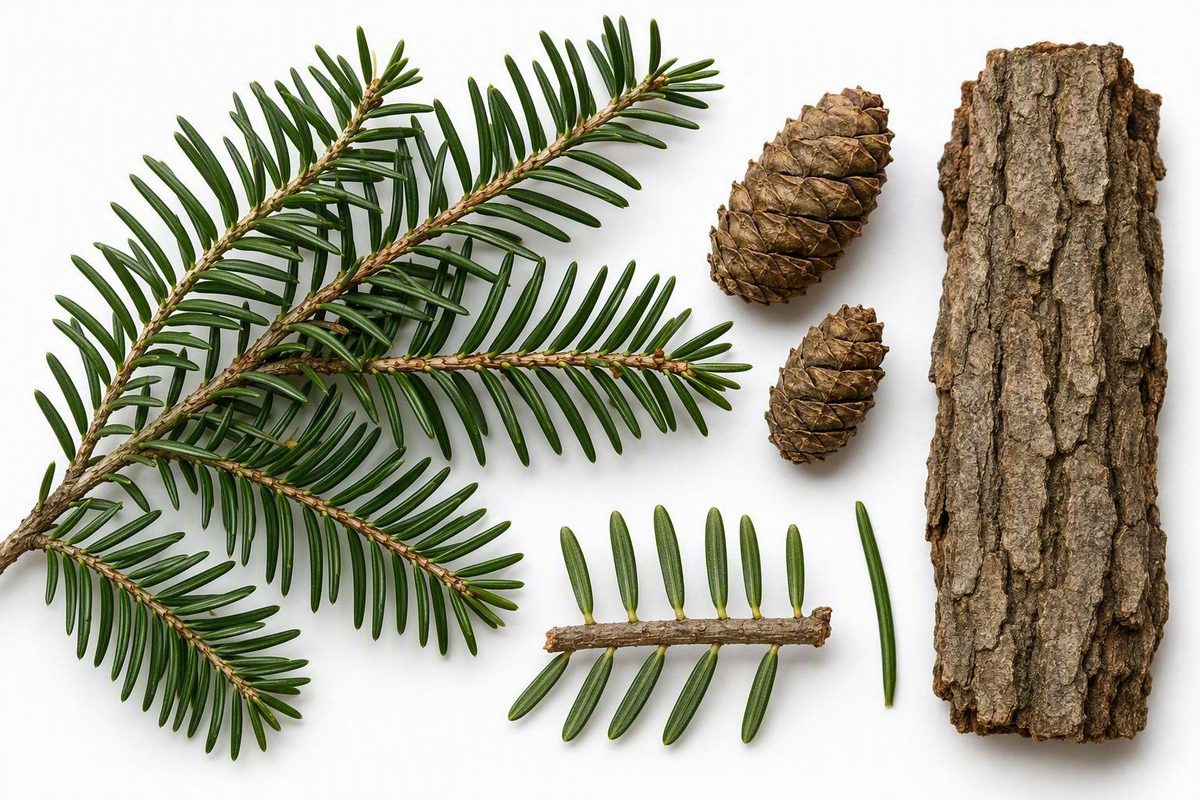
Hemlock tree identification is most dependable when several independent features agree. Start with the needles, inspect how they attach to the twig, look underneath them, and then use cones, foliage arrangement, crown shape, bark, and geography to test the result.
The usual combination is short, soft, flat needles attached one at a time by tiny stalks; two pale bands beneath each needle; relatively small hanging cones; and fine, often drooping foliage. None of these features is conclusive alone. Fir needles can also have pale bands, bark changes with age, cones may be absent, and not every hemlock has an obvious drooping top.
The Fastest Reliable Hemlock Identification Check
Begin close to the twig rather than trying to identify the tree from its height or silhouette.
- Confirm that it is an evergreen conifer. Needle-like foliage should remain present through winter.
- Check whether the needles attach individually. Bundled needles point toward pine, while dense clusters on short shoots may indicate tamarack.
- Feel and inspect the needles. Typical hemlock needles are short, soft, flat, and usually blunt or rounded rather than stiff and sharply pointed.
- Turn a healthy needle over. Look for two pale longitudinal bands. The Maine Forest Service hemlock guide notes both these bands and the important fact that fir needles may have similar markings.
- Examine the attachment point. A hemlock needle joins the twig through a tiny, narrow stalk rather than a broad, suction-cup-like base.
- Look for cones. Hemlock cones generally hang and have thin, papery scales.
- Step back. Fine branchlets, a feathery crown, drooping tips, or a bent terminal leader can support the identification.
They are a strong prompt to continue checking, but they do not prove that the tree is a hemlock.
Treat the clues in this order of importance:
- Most useful: needle shape and attachment
- Next: cone orientation and foliage arrangement
- Confirming evidence: crown, branch tips, leader, and bark
- Supporting context: habitat, apparent height, and geographic location
A practical field standard is to seek at least three independent traits. Flat stalked needles, pale underside bands, and small hanging cones make a strong combination. This is still not a guarantee, but it is much safer than relying on color, bark, habitat, or a drooping top alone.
Stop and reconsider when you encounter a major contradiction:
- Needles in bundles suggest pine.
- Stiff, sharp, four-sided needles suggest spruce.
- Flat needles with suction-cup-like bases and upright cones suggest true fir.
- Large hanging cones with conspicuous projecting bracts suggest Douglas-fir rather than hemlock.
Phone-ready field checklist
- [ ] Evergreen conifer
- [ ] Needles attached one at a time
- [ ] Needles short, soft, flat, and generally blunt
- [ ] Two pale bands beneath a healthy needle
- [ ] Tiny stalk between needle and twig
- [ ] Cones hanging rather than standing upright
- [ ] Cones thin-scaled and papery
- [ ] Fine, feathery, or drooping branchlets
- [ ] At least three independent traits agree
- [ ] No strong contradictory feature
Needles and Twigs: The Most Useful Close-Up Clues
Needles and their attachment points are usually the best place to begin. They can be examined on saplings, on reachable lower branches of mature trees, and on fresh fallen twigs whose source is reasonably certain.
Typical hemlock needles are:
- Short relative to most pine needles
- Soft and flexible
- Flat rather than square or strongly angled
- Individually attached
- Usually rounded or blunt at the tip
- Darker above and paler beneath
Exact needle length, density, and arrangement vary among species. A typical measurement should never become a pass-or-fail rule.
Turn over several healthy needles and look for the paired pale or whitish bands running lengthwise beneath them. Faded, diseased, dusty, or yellowing foliage may obscure the contrast, so compare multiple intact needles rather than deciding from one damaged specimen.
Next, inspect the point where each needle meets the twig. A hemlock needle sits on a tiny petiole—plainly, a short, narrow stalk. These attachment points can leave the twig looking slightly bumpy after needles are lost. The attachment is usually more informative than color because many unrelated conifers share similar shades of green.
Do not interpret a flattened spray too literally. Hemlock needles originate around the twig, but they can twist or bend near their bases so that the foliage appears to lie mainly in one plane. A branch that looks two-ranked from the side does not necessarily have every needle emerging in two perfectly straight rows. That distinction matters when comparing hemlock with fir, yew, or Douglas-fir.
Species also differ in how closely they fit the familiar “flat spray” description:
- Eastern hemlock: Needles are relatively uniform in length, and the foliage commonly looks flattened.
- Western hemlock: Needles vary conspicuously in length, producing an irregular, feathery spray.
- Carolina hemlock: Needles radiate more fully around the branch.
- Mountain hemlock: Foliage may look more radial or bottlebrush-like than a classic eastern-hemlock spray.
The contrast between eastern and western hemlock is especially useful. Eastern hemlock generally has a tidier, more even needle pattern. Western hemlock looks less regular because short and longer needles occur together. Portland Urban Forestry describes western hemlock needles as unequal in size and arranged around the stem in a spray, giving the foliage a fluffier appearance in its western hemlock profile.
Always compare several twigs. A shaded interior branch may look sparse, while exposed new growth may look denser. Browsing, storms, pruning, pests, drought stress, and ordinary breakage can all conceal the normal pattern. If only one damaged twig is available, keep the identification provisional.
Cones, Crown, Leader, and Bark: How to Confirm the Identification
Once the needles and attachment point suggest hemlock, use cones and whole-tree form to test the conclusion.
Hemlock seed cones are generally relatively small, hanging, thin-scaled, and papery. They may look delicate beside the heavier cones of many pines, spruces, and Douglas-firs. Exact dimensions vary by species, however. Carolina and mountain hemlock can have longer cones than a simplified eastern-hemlock description would suggest, so no universal length cutoff works for every hemlock.
Cone orientation is often more useful than a rigid measurement:
- Hemlock cones hang.
- True-fir cones stand upright.
- Spruce cones also hang, but spruce needles differ sharply in shape and texture.
- Douglas-fir cones hang but carry conspicuous projecting bracts.
The absence of cones does not rule out hemlock. A tree may be too young to produce them, cones may be hidden high in the crown, or older cones may already have fallen. Western hemlock may not begin producing cones until it is about 25 years old, according to Portland Urban Forestry’s species account cited above.
From a distance, many hemlocks have a fine, lacy, or feathery crown. Branch tips may droop, and the terminal leader—the topmost continuation of the trunk—may bend or nod. This tendency is particularly noticeable in western hemlock.
A curved leader remains supporting evidence, not a universal rule. Pruning can remove it, storms can break it, and crowding can distort the crown. Age, wind exposure, competition, and viewing angle can make a leader appear straight or hide it completely. A hemlock’s top is not a dependable compass.
Bark is similarly variable. Young bark can be relatively smooth and gray or gray-brown. As the tree matures, it may become ridged, scaly, plated, or furrowed, with brown, reddish-brown, gray, or cinnamon tones. Eastern hemlock commonly develops broad ridges or plates, while older western hemlock becomes rougher and furrowed.
Use bark to answer, “Does this fit the other evidence?” rather than, “What species has this bark?” Western hemlock bark can resemble Douglas-fir bark, and both change substantially with age.
A no-cones workflow
When cones are unavailable:
- Confirm that the needles are individually attached.
- Check that they are soft and flat rather than stiff and four-sided.
- Turn several healthy needles over and look for paired pale bands.
- Find the tiny stalk between each needle and the twig.
- Examine whether the foliage is flattened, irregularly feathery, radial, or bottlebrush-like.
- Look for fine branchlets and a curved or drooping leader.
- Check whether the bark is consistent with the tree’s apparent age.
- Use region and likely species as a final filter.
- Compare the specimen with fir, spruce, Douglas-fir, yew, pine, and tamarack before deciding.
Because hemlocks are evergreen, these needle-and-twig checks remain available in winter. Snow, distance, or poor light may conceal the crown and bark, but reachable foliage can still be examined.
Which Hemlock Is It? A Region-First Guide to Four Native Species
Geography can narrow the choices, but it cannot establish identity by itself. Eastern and Carolina hemlocks occur naturally in eastern North America, while western and mountain hemlocks occur naturally in western North America. Ornamental trees, arboretum specimens, and forestry plantings may occur well beyond their native ranges.
| Species | Native region | Needle arrangement | Needle-length pattern | Leader or crown tendency | Cone pattern |
|---|---|---|---|---|---|
| Eastern hemlock (Tsuga canadensis) | Northeastern North America and south through the Appalachians | Commonly flattened-looking | Relatively uniform | Loose, lacy crown; tips and leader may droop | Small, papery, hanging cones |
| Western hemlock (Tsuga heterophylla) | Northwestern North America | Irregular, feathery spray | Conspicuously unequal | Drooping branchlets and often a curved leader | Small, often numerous, hanging cones |
| Carolina hemlock (Tsuga caroliniana) | Eastern North America, centered in the southern Appalachians | More radial around the branch | Less useful alone | Bent leader may be present | Generally larger than eastern-hemlock cones |
| Mountain hemlock (Tsuga mertensiana) | Western North America | More radial or bottlebrush-like | Variable | Crown form varies with exposed conditions | Longer, more cylindrical cones |
Eastern hemlock — Tsuga canadensis
Look for relatively uniform short needles in a flattened-looking spray. The crown often appears loose, irregular, and lacy, with fine twigs and drooping tips. Its cones are small and pendant. Its natural range extends across northeastern North America and south through the Appalachians. A detailed eastern hemlock species account describes its flat, blunt, stalked needles, age-related bark changes, hanging cones, and regional distribution.
Western hemlock — Tsuga heterophylla
Unequal needle lengths are one of the best species-level clues. Viewed from the side or head-on, a twig has an irregular, feathery appearance rather than a neat line of equally long needles. Drooping branchlets, a curved or nodding leader, and small hanging cones strengthen the identification. The species is native to northwestern North America.
Carolina hemlock — Tsuga caroliniana
Carolina hemlock differs from eastern hemlock in its more radial foliage: needles extend around the branch instead of producing such a strongly flattened spray. Its cones are generally larger than eastern hemlock’s, although cone size should still be interpreted as a species-dependent tendency. A government-sponsored Western North Carolina identification guide contrasts the flat-plane foliage of eastern hemlock with the more radial arrangement of Carolina hemlock.
Habitat should not be used as a decisive test for Carolina hemlock. Needle arrangement, cone form, geography, and a regional botanical key are more dependable.
Mountain hemlock — Tsuga mertensiana
Mountain hemlock can depart most strongly from the generalized image of a hemlock. Its foliage may be blue-green or gray-green and more bottlebrush-like, while its cones tend to be longer and more cylindrical. Treat these as broad field tendencies rather than a complete species key. A specimen with stalked, hemlock-like needles should not be rejected merely because its foliage lacks an eastern-hemlock-style flat spray.
For a wild tree, geographic likelihood is valuable. In a garden, park, cemetery, campus, arboretum, or managed forest, it may be much less useful. If foliage and cones do not fit the expected native species, consult a regional botanical key or ask an herbarium, forestry office, extension service, or qualified arborist to review detailed photographs.
Identifying Western Hemlock in Seattle and the Pacific Northwest
For Seattle and western Washington, western hemlock—Tsuga heterophylla—is the leading native hemlock candidate. That makes it the logical species to test first, not an automatic identification.
Use this Seattle-area combination:
- Short, soft, flat needles
- Clearly unequal needle lengths on the same twig
- Pale lines beneath the needles
- An irregular, feathery spray
- Drooping branchlets
- A curved or nodding top when visible
- Numerous small, brown, papery cones when present
Unequal needles are especially helpful. Look at a twig head-on: western hemlock often appears tousled or feathery because needle lengths and orientations vary. From farther away, the finer branchlets and top may sag rather than forming the stiffer outline typical of many firs and spruces. The Fauntleroy Watershed western hemlock profile documents this combination for a Seattle-area setting.
Bark can range from gray to brown-red or brown and becomes more furrowed or plated with age. Do not separate western hemlock from Douglas-fir by bark alone. Mature specimens of both can show brown, furrowed bark, especially when viewed from a trail.
Western hemlock commonly grows in moist Pacific coastal forests, tolerates substantial shade, and may become established on nurse logs or decaying stumps. As the supporting wood decomposes, exposed roots can remain straddling the space where the log once lay. This is an interesting contextual clue, not a diagnostic requirement; a regional western hemlock guide describes both nurse-log establishment and the exposed roots that may remain afterward.
The coastal range extends from Alaska toward northern or central California, with some inland populations. Location still cannot resolve the identity of a planted tree or compensate for damaged foliage.
Visitors can perform most useful checks without breaking or transporting anything:
- View the crown from an opening in the trail.
- Compare reachable foliage without pulling it from the tree.
- Gently view attached foliage only when it can be done without bending or damaging the branch.
- Inspect naturally fallen fresh twigs and cones when their source is reasonably clear.
- Use a finger, ruler, or familiar object for scale in a photograph.
- Follow posted site rules and leave plant material in place as a low-impact practice.
A fallen twig can be especially useful after wind, but make sure it came from the tree being examined. In mixed forest, branches may fall from overlapping crowns or be moved along the ground.
Hemlock Lookalikes: Fir, Spruce, Pine, Douglas-Fir, Yew, and Tamarack
The best comparisons are structural. Fragrance varies with species, season, freshness, and the observer, so it should remain secondary.
| Tree | Needle attachment | Needle shape | Arrangement | Underside appearance | Cone orientation | Cone details | Overall form |
|---|---|---|---|---|---|---|---|
| Hemlock | Individual, on tiny stalks | Short, soft, flat, usually blunt | Often flattened-looking or feathery; species exceptions occur | Paired pale bands are typical | Hanging | Relatively small, thin-scaled, papery | Fine, lacy, often drooping |
| True fir | Individual, commonly on suction-cup-like bases | Often flat and soft | May look flattened or extend around twig | Pale bands may be present | Upright | Cones stand on branches and may break apart there | Often more regular and erect |
| Spruce | Individual, attached to small woody pegs | Stiff, sharp, angled or four-sided | Around the twig | Not a sufficient shortcut | Hanging | Generally firmer than hemlock cones | Stiffer, pricklier foliage |
| Pine | In bundles | Usually much longer and narrow | Bundled in groups | Not the main test | Usually hanging or outward | Often woody | Coarser foliage |
| Douglas-fir | Individual | Flat, usually more uniform | Spiraled around twig | Not decisive | Hanging | Larger, with prominent projecting bracts | Generally more erect than western hemlock |
| Yew | Individual | Flat, often longer | Commonly flattened-looking | Underside color alone is not a safe test | No ordinary hemlock cones | Red berry-like structures may occur | Often shrub-like or a small tree |
| Tamarack | Dense clusters on short shoots | Soft, narrow | Clustered rather than singly spaced | Not the main test | Upright or outward | Small woody cones | Deciduous; loses needles seasonally |
Hemlock versus true fir
Both can have soft, flat needles with pale bands underneath. The attachment point is the clearest close-up difference: hemlock needles sit on tiny stalks, while true-fir needles commonly meet the twig through bases resembling small suction cups. Cones provide a second strong distinction—hemlock cones hang, while true-fir cones stand upright.
Do not decide from a flat-looking spray or pale underside markings alone. Both groups can show those features.
Hemlock versus spruce
Hemlock needles are soft and flat. Spruce needles are generally stiff, sharp, and angled or four-sided. A spruce needle can often be rolled between the fingers, whereas a flat hemlock needle will not roll in the same way. Spruce needles also surround the twig and attach to persistent woody pegs, leaving a rough twig when the needles fall.
Spruce cones hang, so orientation alone does not separate spruce from hemlock. Needle cross-section, sharpness, and attachment are more useful.
Hemlock versus pine
Pine needles grow in bundles, while hemlock needles attach one at a time. Pine needles are also generally much longer than the short hemlock needles described here. If multiple needles clearly share one bundle at the base, the tree is not a hemlock.
Hemlock versus tamarack
Tamarack produces clusters of roughly 10–20 soft needles on short shoots rather than attaching each needle separately along the twig. The Adirondack Watershed Institute’s comparison uses clustered tamarack needles versus individually attached eastern-hemlock needles as a primary distinction.
Western hemlock versus Douglas-fir
This comparison is particularly useful in Seattle and the Pacific Northwest.
Western hemlock tends to have:
- Unequal needle lengths
- A more irregular, feathery twig
- Drooping branchlets and often a curved leader
- Small papery cones without conspicuous projecting bracts
Douglas-fir tends to have:
- More uniform needle lengths
- A fuller spiral of needles around the twig
- A more erect overall form
- Larger hanging cones with conspicuous bracts projecting between the scales
Bark should not lead this comparison because mature specimens can look similar.
Hemlock versus yew
Yew may have flat, individually attached needles arranged in a flattened-looking pattern. Some field guides describe yew as lacking the conspicuous paired white lines expected beneath hemlock needles, but underside color should not carry the identification by itself. Yew produces no ordinary hemlock-like cones and may bear red, berry-like structures when present.
Use the total combination of foliage, attachment, reproductive structures, and growth form. The absence of red structures at the time of observation does not by itself establish that the plant is a hemlock.
Finally, resist relying on smell. A crushed needle may have a noticeable fragrance, but odor is subjective and can change with freshness. Attachment, needle form, underside markings, and cones are more repeatable evidence.
What to Do When the Clues Conflict
Do not force an identification because several features seem close. One strong contradiction can outweigh multiple weak similarities.
Suppose the needles are flat and have pale bands, but their bases resemble small suction cups. That combination points toward fir, not hemlock. Likewise, a drooping crown cannot override bundled needles, and suitable habitat cannot override sharp, four-sided needles.
Separate the evidence into two groups.
Diagnostic or high-value clues
- Individual versus bundled or clustered needles
- Flat versus four-sided needle shape
- Tiny stalk versus suction-cup-like attachment
- Hanging versus upright cones
- Presence or absence of Douglas-fir cone bracts
- Species-specific foliage arrangement
Supporting clues
- Bark color
- Moist or shaded habitat
- Apparent tree height
- Crown density
- Regional likelihood
- A drooping or bent leader
Supporting evidence should reinforce structural evidence, never replace it.
Do not assume that a small tree is young. Eastern hemlock is highly shade tolerant and can remain suppressed beneath a forest canopy for decades. The New England Forestry Foundation’s eastern hemlock profile notes that a tree shorter than a person and scarcely thicker than a thumb may be about 50 years old. Size is therefore poor evidence of age or identity in deep shade.
For later verification, take a deliberate photo set:
- Entire tree and surrounding context
- Crown silhouette
- Terminal leader
- Side view of a twig
- Head-on view of the same twig
- Upper surface of healthy needles
- Needle undersides showing the pale bands
- Close-up of the attachment point
- Bark at a clearly indicated height
- Buds
- Cones from multiple angles, if present
Photograph reachable attached foliage only when it can be viewed gently without damage. Otherwise, use a naturally fallen fresh twig whose source is reasonably certain. Place a ruler or another clear scale beside fallen needles or cones when practical, and follow local rules governing the handling or removal of natural material.
If the identification affects tree removal, pesticide use, treatment, pest reporting, or another consequential decision, seek local review. Appropriate contacts may include a forestry agency, cooperative extension service, herbarium, certified arborist, conservation district, or invasive-species program.
A general article or photograph can narrow the possibilities, but it cannot guarantee a definitive answer for damaged trees, unusual cultivars, hybrids, or species planted outside their normal ranges.
Hemlock Woolly Adelgid and the Poison-Hemlock Name Confusion
White cottony or woolly material is not a normal botanical feature used to identify a tree as hemlock. It may instead indicate hemlock woolly adelgid, a pest question that should be considered separately from the tree’s identity.
Inspect where the white material occurs. Suspected adelgid wool is found at the bases of needles, where the needles meet the twig. Do not treat pale material elsewhere on a branch—such as webbing, sap, lichen, fungus, or debris—as confirmation.
Coverage may be sparse or extensive. Examine more than one twig and take clear photographs showing both the material and its position at the needle bases. Because lookalikes exist, white wool should be treated as a reason to request verification rather than as conclusive proof.
Do not carry, mail, or transport a branch suspected of infestation. Moving affected material can spread the pest. Save MI Hemlocks’ identification guidance recommends using photographs for professional review and specifically warns against physically transporting a potentially affected branch.
Contact the relevant local forestry, extension, arboriculture, or invasive-species program rather than applying a generic treatment plan.
The name “hemlock” also causes an unrelated confusion. Hemlock trees belong to the woody conifer genus Tsuga. Poison hemlock, Conium maculatum, is an herbaceous flowering plant, not a conifer and not a close relative. Sharing a common name does not make the plants botanically equivalent.
Frequently Asked Questions
Can you identify a hemlock tree without cones?
Yes, but use a combination rather than a single substitute clue. Check for short, soft, flat needles attached individually by tiny stalks; turn several healthy needles over for paired pale bands; examine the foliage arrangement; and then use branch droop, leader form, bark, and region as confirmation.
Cones may be absent from young trees, hidden high in the crown, or already fallen. If needle shape and attachment fit but whole-tree features are unclear, keep the identification provisional.
What is the clearest difference between hemlock and fir?
At close range, examine how the needle meets the twig. A hemlock needle sits on a tiny narrow stalk. A true-fir needle commonly has a broader base resembling a miniature suction cup.
Cones provide another strong distinction when present: hemlock cones hang, while true-fir cones stand upright. Pale underside bands do not resolve the question because both groups can have them.
Does every hemlock have a drooping top?
No. A bent or drooping leader is a useful tendency, particularly for western hemlock, but it is not universal or always visible. Species, age, pruning, storm damage, crowding, wind exposure, and viewing angle can alter or conceal the top.
A straight-looking leader should prompt a closer check, not automatically rule out hemlock. Give more weight to needle structure and attachment.
What does white cottony material at the base of hemlock needles mean?
It may indicate hemlock woolly adelgid, but appearance alone does not conclusively confirm the pest. Photograph the material closely, including its position at the needle bases, and request review from a local forestry, extension, arboriculture, or invasive-species professional.
Do not transport the branch. Keep pest diagnosis separate from tree identification: the white material is not a normal botanical characteristic of Tsuga.
Is a hemlock tree the same plant as poisonous poison hemlock?
No. Hemlock trees are woody evergreen conifers in the genus Tsuga. Poison hemlock, Conium maculatum, is an unrelated herbaceous flowering plant. The shared common name does not indicate a close botanical relationship.
In the field, remember the core sequence: inspect the needle, turn it over, check its tiny stalk, look for hanging cones and a fine or drooping form, and then test the result against regional species and likely lookalikes. Several agreeing features are more reliable than any single clue.
Around Seattle, western hemlock is the leading native candidate, but planted trees and damaged specimens can complicate identification. If white wool appears at needle bases, photograph it, leave the branch in place, and seek local professional verification.