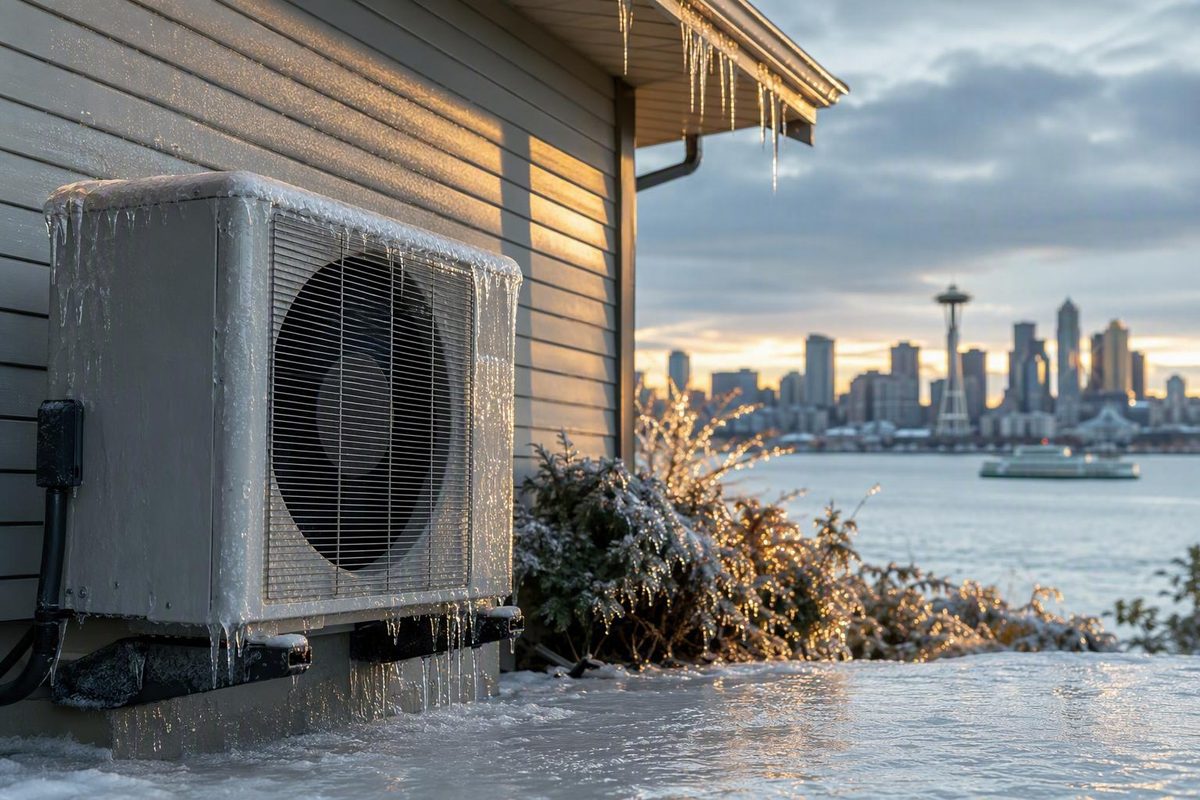
Is the Ice Normal, or Should You Stop the Outdoor Unit?
It often can keep heating if utility power is available, air can move through the outdoor unit, the fan is unobstructed, and indoor temperature holds.

The Short Answer: Leave It on Heat, Use Backup, or Call for Help?
A heat pump can generally continue heating during an ice storm while utility power is available, air can move freely through the outdoor unit, the fan is unobstructed, and the system is maintaining the indoor temperature. Cold weather, light frost, or limited surface ice does not automatically mean the equipment is failing.
Use this three-level decision guide:
| Situation | Typical signs | Immediate response |
|---|---|---|
| Monitor normal operation | Light frost or limited surface ice; occasional steam; a temporary outdoor-fan pause; no alarming noise; stable indoor temperature | Leave the thermostat on normal Heat and observe the system |
| Take cautious action | Loose snow, leaves, or storm debris are collecting around the cabinet, vents, or drainage path but can be reached safely | Gently clear only loose material from around the unit without touching the coil, fan, wiring, or internal parts |
| Use backup and seek service | Fan trapped by ice; thick glaze blocking airflow openings; grinding or rattling; repeated shutdowns; an error code; branch impact; visible damage; indoor temperature continuing to fall | Follow the manual’s shutdown or Emergency Heat procedure and contact a qualified HVAC professional |
Light coil frost is an expected part of winter operation. Heat pumps use an automatic defrost cycle to remove it, and that process may produce steam, temporarily stop the outdoor fan, or briefly change the temperature of air coming from indoor registers. Those can be normal defrost signs when the unit remains unobstructed and resumes heating afterward, according to winter heat-pump guidance from Van Bremen’s Heat & Air.
Do not select Emergency Heat merely because it is cold outside or you can see light frost. Emergency Heat is a temporary bypass for an outdoor unit that is damaged, obstructed, unavailable, or apparently unable to operate safely. It is not a deicing mode and does not make the heat pump more powerful.
Safety first: Stay indoors if the path to the equipment is dangerously icy, branches or sheets of ice are falling, a power line is down nearby, or you see exposed or damaged wiring. Middle Tennessee Electric advises treating every downed line as energized and staying at least 30 feet away from it. Do not risk a fall or electrical contact to inspect HVAC equipment. Review the utility’s winter-storm safety guidance.
This is general troubleshooting guidance, not a substitute for model-specific instructions or an on-site safety assessment. Your thermostat manual and the outdoor unit’s installation and operating instructions control shutdowns, backup heat, fault codes, deicing, and restarting after an outage. If the manual says to stop the system under the conditions you observe, follow it.
Why Freezing Rain Is Harder on a Heat Pump Than Ordinary Frost
An air-source heat pump heats a home by moving heat rather than creating all of it directly. Refrigerant circulates through a refrigeration cycle, absorbing heat at the outdoor coil and releasing it indoors. For that process to work, the outdoor fan must move air across the coil.
Low outdoor temperature and freezing rain create different challenges. Colder air can reduce the heat available to the equipment while increasing the building’s heating demand. Freezing rain adds a physical problem: liquid precipitation freezes onto cold surfaces and can form glaze on coil fins, the fan guard, cabinet vents, and other airflow openings.
Ordinary frost develops when moisture freezes on a cold outdoor coil during heating operation. Heat pumps anticipate this condition. When the controls determine that defrost is needed, the system temporarily changes operation to warm the outdoor coil and melt the frost.
Storm glaze comes from the weather rather than solely from normal coil operation. It can form a harder external coating across places a standard defrost cycle may not clear effectively. If glaze blocks the coil fins, air cannot pass through normally. If it bridges the fan guard or reaches the blades, it may interfere with fan movement. A Chatham Journal explanation of ice-storm effects describes how freezing-rain glaze, restricted airflow, repeated defrosting, and refreezing meltwater can combine even when a heat pump otherwise works normally in winter. Read the overview of heat pumps during ice storms.
Drainage is another concern. Water produced during defrost must leave the unit. When temperatures remain below freezing, that water can refreeze in the base pan, around drainage openings, or on the ground below. Continued accumulation may obstruct drainage and, depending on the equipment’s design, interfere with nearby components.
That is why an outdoor unit may appear to be running while the house still loses heat:
- Restricted outdoor airflow reduces heat transfer.
- More frequent or extended defrost activity interrupts normal heating.
- The heat pump may have less available capacity in colder conditions.
- The building loses heat faster as wind and outdoor temperature worsen.
- A dirty indoor filter or blocked register can compound the problem.
- Backup heat may be insufficient, unavailable, or configured differently than expected.
No single visible amount of ice proves a particular failure. There is also no universal outdoor temperature, ice thickness, or icing duration at which every heat pump must be stopped. Equipment design, installation, controls, drainage, backup heat, weather exposure, and the home’s heating load all matter.
The practical question is therefore not merely, “Is there ice?” It is: Can the system still move air, operate without signs of mechanical distress, and maintain the home?
Normal Defrost or Dangerous Ice? Read the Signs
Normal defrost can look dramatic. Steam may rise quickly as frost melts. The outdoor fan may pause, and refrigerant movement or a reversing valve may produce unfamiliar sounds. Indoor air may briefly feel cooler, while auxiliary heat may activate automatically to limit the temperature change. These behaviors can occur because defrost temporarily reverses normal heating operation to warm the outdoor coil. The Chatham Journal overview explains these normal defrost effects.
Evaluate the signs together rather than treating any one observation as proof of failure.
| What you observe | What it may mean | What to do |
|---|---|---|
| Thin, even frost on part of the outdoor coil | Routine frost during heating operation | Continue normal Heat and monitor |
| Frost clears during automatic defrost | Defrost is doing its job | No intervention is normally needed |
| Steam rises from the outdoor unit | Defrost is melting frost or ice | Observe from a safe location; do not assume it is smoke |
| Outdoor fan temporarily pauses during defrost | May be normal model-specific operation | Wait to see whether normal heating resumes |
| Brief cooler airflow indoors | Temporary effect of defrost | Monitor indoor temperature; auxiliary heat may engage automatically |
| Changing refrigerant-flow or valve sounds | May be normal during cycle reversal | Compare with the manual and listen for grinding or impact noises |
| Indoor temperature remains stable | The system is keeping up with demand | Leave Emergency Heat off and continue monitoring |
| Loose snow or leaves surround the cabinet | Airflow or drainage could become restricted | Clear only loose material if access and footing are safe |
| Thick glaze encases vents, coil surfaces, or the fan guard | Storm ice may be restricting airflow | Follow the manual; consider temporary backup and arrange service |
| Fan appears unable to move freely | Ice or debris may be creating a mechanical obstruction | Keep hands and tools outside the guard; follow the shutdown or backup procedure |
| Grinding, scraping, or heavy rattling | Possible fan contact, ice interference, or physical damage | Use the approved backup mode if available and call for service |
| Repeated starts, stops, or lockouts | Controls may be responding to a fault | Record the pattern or code and contact a technician |
| Thermostat displays an error code | The system has detected a condition requiring attention | Photograph or record the code and consult the manual |
| Indoor temperature steadily falls | Available heat is not meeting the home’s load | Check safe, accessible items; use backup as directed and seek service |
| Ice clears but repeatedly returns | Possible airflow, drainage, defrost-control, or mechanical problem | Arrange professional diagnosis |
| Branch, roof ice, or debris strikes the unit | Possible hidden or visible damage | Keep away from damaged parts and call for service |
Persistent glaze that blocks the fan, encases airflow openings, triggers repeated shutdowns, causes unusual noise, or prevents the home from warming is different from routine frost. CARE Services recommends professional attention when storm ice does not clear, blocks airflow, interferes with heating, or accompanies mechanical warning signs. See its guidance on problematic outdoor-unit icing.
There is no evidence-backed rule stating that every defrost must last a particular number of minutes or that a particular number of inches of ice is always safe or unsafe. Controls differ by model, and exposure varies sharply among installations.
Persistent ice can have several possible causes:
- Outdoor airflow is blocked.
- Defrost water cannot drain.
- Roof runoff is freezing on the unit.
- A sensor or defrost control is not operating correctly.
- The fan or another mechanical part is damaged.
- The refrigeration system is not performing correctly.
Appearance alone cannot determine which cause applies.
Do not repeatedly switch off a system that appears to be completing ordinary defrost cycles merely because light frost returns. Interrupting normal operation may prevent the defrost process from clearing that frost. The opposite limit is equally important: do not keep forcing the outdoor unit to operate if the fan is immobilized, equipment has been struck, wiring is exposed, or grinding suggests mechanical contact.
Emergency Heat vs. Auxiliary Heat: What Each Setting Actually Does
The terms Auxiliary Heat and Emergency Heat are often confused, but they generally describe different control decisions.
Auxiliary heat is backup heat that the system activates automatically. It may come on when:
- The heat pump cannot meet current heating demand by itself.
- The equipment enters certain defrost cycles.
- The thermostat setting is increased substantially.
- Outdoor conditions or system controls call for additional capacity.
Emergency Heat is usually selected manually at the thermostat. On many systems, it bypasses the outdoor heat pump and relies on the installed backup source. Craighead Electric Cooperative distinguishes automatic auxiliary operation from manually selected Emergency Heat and recommends reserving the manual mode for a malfunction or equipment-threatening icing rather than routine cold weather or ordinary frost. See the cooperative’s Emergency Heat guidance.
The backup source depends on the home. It may be:
- Electric resistance elements in an air handler
- A gas furnace in a dual-fuel system
- An oil furnace
- Another system-specific heat source
Emergency Heat is not a stronger version of normal Heat. It does not direct extra heat to the outdoor unit, melt exterior glaze, repair a fan, or increase compressor capability. It changes which available heating equipment the controls use.
Generally leave Emergency Heat off when:
- The home remains at or near the thermostat setting.
- The outdoor fan is unobstructed.
- The unit has no alarming mechanical sound.
- Light frost clears during defrost.
- The only concern is cold weather or a small amount of visible ice.
Temporary Emergency Heat may be appropriate, subject to the manual, when:
- A branch or falling debris has damaged the outdoor unit.
- The fan is trapped by ice or debris.
- The unit grinds, scrapes, or rattles in a way that suggests unsafe operation.
- Thick glaze blocks airflow openings.
- The outdoor unit repeatedly shuts down.
- The outdoor unit is unavailable after a fault or outage.
- The indoor temperature continues falling despite normal Heat.
Selecting Emergency Heat solely because any ice is visible can unnecessarily bypass a functioning heat pump. If the backup is electric resistance, it generally costs more to operate than ordinary heat-pump mode. The actual difference depends on weather, equipment, utility rates, building heat loss, and the type of backup; no fixed cost or electricity multiplier applies to every home.
System design also changes what the thermostat setting means:
| System type | Typical backup behavior | Ice-storm implication |
|---|---|---|
| Ducted heat pump with electric backup | Auxiliary resistance heat may activate automatically; Emergency Heat generally bypasses the outdoor unit | Temporary Emergency Heat may maintain indoor heat when the outdoor unit is unsafe or unavailable, but electric use may rise |
| Dual-fuel heat pump | A gas or oil furnace may provide backup according to the controls | Emergency mode may transfer heating to the furnace, although controls and blowers commonly still require electricity |
| Conventional furnace without a heat pump | No outdoor heat-pump compressor is involved | A heat-pump Emergency Heat setting generally does not apply |
| Ductless mini-split | Some systems have no conventional Auxiliary or Emergency Heat setting | Follow the mini-split manual and use a separately planned safe backup source if needed |
Avoid making a large thermostat increase to test whether the system can catch up. A sudden setpoint jump may trigger automatic auxiliary resistance heat without identifying the icing problem. Instead, note the current setpoint and actual room temperature, keep the setting steady, and determine whether the difference is stable or growing.
If you select Emergency Heat, treat it as a bridge while an unsafe or unavailable outdoor unit is assessed—not as a cure. Air Today Heating & Cooling similarly describes Emergency Heat as a temporary bypass when the primary heat-pump stage is frozen, damaged, unavailable, or unable to maintain the home. Review its explanation of Emergency Heat during an ice storm.
A Safe Inspection Checklist During and After the Storm
Start with a go-or-no-go decision. Do not go outside if:
- The walking surface is dangerously glazed or unstable.
- Ice or branches are falling.
- A tree is leaning toward the equipment.
- Electrical damage or exposed wiring is visible.
- A utility line is down nearby.
- Darkness or blowing precipitation prevents a safe inspection.
If conditions are safe, inspect only from outside the cabinet. Do not remove service panels.
1. Look at the top, sides, and visible vents
Check for loose snow, drifting snow, leaves, or storm debris that may block airflow. Observe whether glaze has sealed openings or bridged the space around the fan guard.
2. Observe the fan without touching it
Look through the guard from a safe position. Do not put a hand, stick, brush, or tool through the guard, and do not try to spin the fan manually. If it appears trapped by ice or debris, use the shutdown or backup procedure specified for the system and arrange service.
3. Look and listen for damage
Watch for:
- Thick, persistent glaze
- A bent guard or cabinet
- Bent or visibly damaged fan blades
- Branch or roof-ice impact
- Exposed wiring
- Grinding, scraping, or severe rattling
- Repeated attempts to start
- A thermostat fault message or error code
Keep away from exposed wiring and damaged components. Photos taken from a safe distance, together with notes about sounds, fault codes, and shutdown timing, can help a technician.
4. Check conditions inside the home
Write down:
- Thermostat setpoint
- Actual indoor temperature
- Whether the temperature is stable or falling
- Whether air is moving from the registers
- Whether airflow is normal, reduced, or absent
- Whether the thermostat displays Auxiliary Heat, Emergency Heat, or an error
A steady room temperature is reassuring even if the outdoor unit looks frosty. A widening difference between setpoint and room temperature is a more useful warning sign than ice alone.
5. Inspect the accessible filter
If the filter is dirty, replace it with the size and type recommended by the manufacturer. A heavily restricted indoor filter can reduce airflow and compound a system already struggling with outdoor icing. Do not substitute a denser filter unless the equipment is designed for it.
6. Check the drainage area visually
Look for a visible path by which defrost water can leave the unit. Note whether ice is building beneath the cabinet or around its base. Do not crawl underneath, chip at the base pan, or open the unit to reach drainage components.
7. Clear only loose material
When footing and overhead conditions are safe, gently remove loose snow and debris from around the cabinet. Work away from the unit rather than striking or brushing the coil. Preserve clearance on all sides and above the equipment.
General winter guidance commonly recommends about 18 to 24 inches of surrounding clearance, but the manufacturer’s and installer’s requirements control for a particular unit. Van Bremen’s Heat & Air gives the 18-to-24-inch range while also advising that the top, sides, and vents remain clear. See its snow-clearance recommendations.
Finish with one of three decisions:
- Continue monitoring: Light frost, normal defrost behavior, unobstructed airflow, no visible damage, and stable indoor temperature.
- Use temporary backup according to the manual: The outdoor unit is obstructed, damaged, unavailable, or failing to maintain heat, but the installed backup is safe and operational.
- Contact an HVAC professional: Ice persists or returns, the fan is trapped, the unit makes alarming sounds, a fault recurs, or indoor heating continues to decline.
If you see exposed wiring, a branch on electrical equipment, or other electrical damage, keep away. Contact the utility when its equipment or lines may be involved, and use appropriately qualified electrical and HVAC professionals for the affected systems.
How Not to Remove Ice From the Outdoor Unit
Homeowner work should generally stop at clearing loose snow and debris around the heat pump. Bonded ice on the coil, fins, fan, guard, or internal components is different. Forceful removal can damage equipment or injure the person attempting it.
Do not use:
- Screwdrivers, knives, picks, or sharp scrapers
- Hammers or mallets
- Shovels against the cabinet
- Impacts against the fan guard
- Open flame or forced high heat
- Boiling water
- Force that bends coil fins
- Hands or tools through the fan guard
Boiling water is not a generally approved deicing method and may leave more water to refreeze on the equipment, drainage area, or walking surface. News guidance on ice-storm heat-pump operation likewise warns against chipping ice or pouring hot water on the outdoor unit. See the Asheville Citizen Times explanation.
Published contractor advice conflicts on water-based deicing. Some sources permit limited warm-water or hose use, while others discourage pouring water on the equipment or recommend leaving bonded ice to a professional. Generic advice cannot account for every electrical layout, shutdown method, drainage arrangement, or manufacturer restriction.
Use water only if the specific equipment manufacturer expressly permits it and provides an applicable shutdown and deicing procedure. Depending on the installation, generic water-based advice may fail to address:
- Electrical components and wiring
- Immediate refreezing
- Blocked drainage
- Ice forming beneath the unit
- Slippery footing
- Model-specific restrictions
Do not open service panels or attempt to diagnose refrigerant performance, defrost sensors, circuit boards, contactors, fan motors, or wiring. Those tasks involve model-specific procedures and hazards that cannot be resolved by looking at exterior ice.
Do not wrap an operating heat pump in a tarp, plastic sheet, or improvised enclosure. The equipment needs open airflow through the coil and space to discharge air. A cover that traps or redirects air may create the restriction you are trying to prevent.
A manufacturer-approved snow hood or purpose-designed accessory is different from an improvised cover. It must be approved for the relevant equipment or installation, preserve the required airflow and service access, and be installed according to its instructions. It is a planned installation measure—not permission to place a temporary shelter over a running unit during a storm.
Stop and request service when:
- Bonded ice traps the fan.
- Ice encases the coil or airflow openings.
- Ice repeatedly returns after apparent defrost.
- The unit makes grinding, scraping, or impact noises.
- Removing loose surrounding snow does not restore open airflow.
- The equipment repeatedly shuts down or cannot maintain heat.
The goal is not to make the cabinet look completely ice-free. The goal is to protect airflow, drainage, fan movement, and the integrity of the equipment.
Power Outages and Ice-Storm Safety Are Separate Problems
A thermostat setting cannot replace utility power. A standard heat pump needs electricity for its compressor, outdoor and indoor fans, controls, and defrost operation. When utility power fails, selecting Emergency Heat does not create an independent energy supply.
Electric resistance backup also requires electricity. Gas- or oil-fired backup may use another fuel, but its ignition controls, safety controls, thermostat, and circulating blower commonly still need electrical power. Consequently, Emergency Heat generally is not an outage solution.
Keep two decisions separate:
- Thermostat-mode decision: Should the powered system use the outdoor heat pump or bypass it in favor of installed backup?
- Household outage decision: How will occupants remain safe if the heating system has no usable power?
Before a storm, plan for:
- A safe, approved backup-heating option
- Flashlights and replacement batteries
- Charged phones and communication equipment
- Necessary medications
- Food and water
- Warm clothing and blankets
- A strategy for protecting vulnerable plumbing
- A safe place to relocate if indoor conditions become unsafe
Treat every downed line as energized and remain at least 30 feet away. Generators must not be operated indoors or in enclosed spaces, and connection to a home’s main electrical panel should be performed by a qualified, licensed electrician, according to Middle Tennessee Electric’s severe-cold guidance.
Do not assume a portable generator or battery can run a heat pump—or its high-demand resistance backup—without verifying:
- Compressor starting requirements
- Continuous electrical load
- Backup-heater load
- Voltage and phase
- Transfer and connection equipment
- Grounding requirements
- Compatibility with controls and power electronics
- Manufacturer requirements
Verification must be specific to both the HVAC equipment and the backup-power system.
If a condensing furnace supplies backup heat, keep its outdoor combustion-air intake and exhaust terminations clear of snow and ice. Blockage can shut down the furnace and may contribute to carbon-monoxide accumulation. Trane’s winter preparation guidance specifically warns that blocked furnace venting can cause shutdown and possible carbon-monoxide buildup. Review the manufacturer’s winter-storm guidance.
After power returns, do not apply a universal breaker-cycling or compressor-restart sequence. Systems may use protective delays or model-specific post-outage procedures. Follow the thermostat and equipment manuals. If the unit reports a fault, makes an abnormal sound, or was physically damaged during the outage, leave it in the manufacturer-recommended safe state and seek service.
Recovery, Service Calls, and Preventing the Next Icing Problem
If you temporarily selected Emergency Heat, do not switch back to normal Heat merely because precipitation has stopped. First complete a safe visual check.
Return to normal Heat only when:
- Weather and footing allow a safe inspection.
- Falling branches and ice are no longer a threat.
- The outdoor unit is clear of loose obstructions.
- The fan and visible airflow openings are unobstructed.
- The cabinet and guard appear undamaged.
- No exposed wiring is visible.
- Any abnormal sound heard before bypassing the unit has been resolved or assessed.
- The thermostat shows no unresolved error code.
- You have checked the model-specific restart instructions.
After returning to normal Heat, monitor closely. Listen for abnormal sounds once the outdoor unit resumes operation, record the indoor temperature, and watch whether it stabilizes. Observe whether the unit completes operating and defrost cycles without recurring glaze, alarming noise, or lockouts.
Arrange professional service for:
- Persistent or recurring ice
- Defrost that appears ineffective
- A fan obstructed by bonded ice or debris
- Grinding, scraping, or severe rattling
- Thermostat error codes
- Repeated shutdowns or start attempts
- Failure to maintain indoor temperature
- Branch or debris impact
- Bent or broken components
- Exposed wiring
- Suspected physical or electrical damage
Visible ice cannot establish whether the underlying cause is drainage, airflow, a sensor, defrost controls, fan operation, refrigerant performance, or another fault. A qualified technician can evaluate operating temperatures, electrical components, control signals, and mechanical clearances rather than diagnosing from appearance alone.
Longer-term prevention begins with routine maintenance:
- Replace dirty filters with the recommended type.
- Keep leaves, vegetation, and debris away from the outdoor coil.
- Maintain required airflow clearance.
- Keep the drainage area open.
- Arrange inspections at the intervals recommended by the manufacturer and service provider.
- Test auxiliary or emergency backup operation before storm season according to the thermostat and equipment instructions.
Installation can also affect resilience. Where appropriate for the model and site, the outdoor unit may benefit from adequate elevation above expected snow and refreezing meltwater. Drainage should carry water away without creating ice beneath the cabinet. Roof edges, gutters, and drip lines should not direct freezing runoff onto the equipment.
If repeated storms create the same problem, ask a qualified contractor whether the installation needs improved drainage, elevation, relocation, or a manufacturer-approved snow hood. Do not build an improvised roof or enclosure without accounting for airflow, service access, and the equipment manufacturer’s installation requirements.
Routine filter care, debris removal, clear drainage, and professional maintenance can reduce avoidable winter problems, although they cannot prevent every weather-related icing event. Mountain Heating & Cooling identifies restricted filters, blocked outdoor airflow, persistent ice, and failed defrost as conditions that warrant attention. See its winter heat-pump maintenance guidance.
Above all, do not measure success by the absence of every trace of frost. Light frost is part of normal winter heat-pump operation. The important outcomes are open airflow, reliable drainage, free and quiet fan movement, safe equipment condition, and an indoor temperature the system can maintain.
Can a heat pump keep running during freezing rain?
Yes, it often can—provided it has electrical power, the outdoor fan and airflow openings remain unobstructed, the equipment shows no sign of damage, and the system maintains the indoor temperature.
Monitor light frost and normal defrost behavior. If freezing-rain glaze traps the fan, blocks the coil or vents, causes alarming noises or repeated shutdowns, or the house continues cooling, follow the manual’s backup or shutdown procedure and contact a qualified technician.
Is steam coming from an iced heat pump normal?
It can be. During defrost, the system warms the outdoor coil, and meltwater may produce a visible cloud of water vapor. A temporary outdoor-fan pause, changing refrigerant sounds, and briefly cooler indoor airflow may occur at the same time.
Steam is more reassuring when frost clears, normal heating resumes, the fan remains unobstructed, and the indoor temperature stays stable. Persistent glaze, grinding, error codes, or continued loss of indoor heat requires a different response.
Should I turn on Emergency Heat as soon as I see ice?
No. Light frost or limited surface ice alone is not a sufficient reason to select Emergency Heat. If the heat pump is operating normally and maintaining the home, leave the thermostat on normal Heat and monitor it.
Emergency Heat is generally reserved for an outdoor unit that is damaged, obstructed, unavailable, making unsafe sounds, repeatedly shutting down, or failing to maintain the indoor temperature. It bypasses the outdoor heat pump; it does not thaw or repair it.
Can I pour warm water or use a hose to remove ice from a heat pump?
Do not assume that is safe for your equipment. Published advice differs: some contractors permit limited warm-water use, while others discourage water-based deicing. The manufacturer’s instructions must control.
Water may refreeze in the base or drainage path, form hazardous ice underfoot, or conflict with model-specific electrical and shutdown precautions. Unless the manufacturer expressly permits water-based deicing and provides an applicable procedure, limit your work to clearing loose surrounding snow and call for service when bonded ice traps the fan or encases the coil.
Will Emergency Heat work during a power outage?
Generally, no. A heat pump needs electricity for its compressor, fans, and controls. Electric resistance backup also needs power, while gas- or oil-fired backup commonly requires electricity for controls and the indoor blower.
Emergency Heat is a thermostat mode, not an independent outage power source. Use a separate household outage plan, and never assume a generator or battery can operate the system without equipment-specific load, connection, and compatibility verification.
The overall hierarchy is simple: monitor light frost and normal defrost while the home remains warm; safely clear only loose surrounding snow or debris; use Emergency Heat temporarily only when the outdoor unit is damaged, obstructed, unavailable, or failing to maintain heat and the system instructions support that response; and call a qualified professional for persistent ice, a trapped fan, alarming sounds, repeated shutdowns, or suspected damage. The owner’s manuals control deicing, shutdown, thermostat modes, and post-outage restarting—and personal safety always takes priority over inspecting equipment during an active ice storm.