
A Seattle-to-Vancouver Day Trip Works Best by Bus—If the Schedule Leaves Five Useful Hours
Compare train, bus and driving for a Seattle-to-Vancouver day trip, including border documents, realistic timing and a compact city plan.
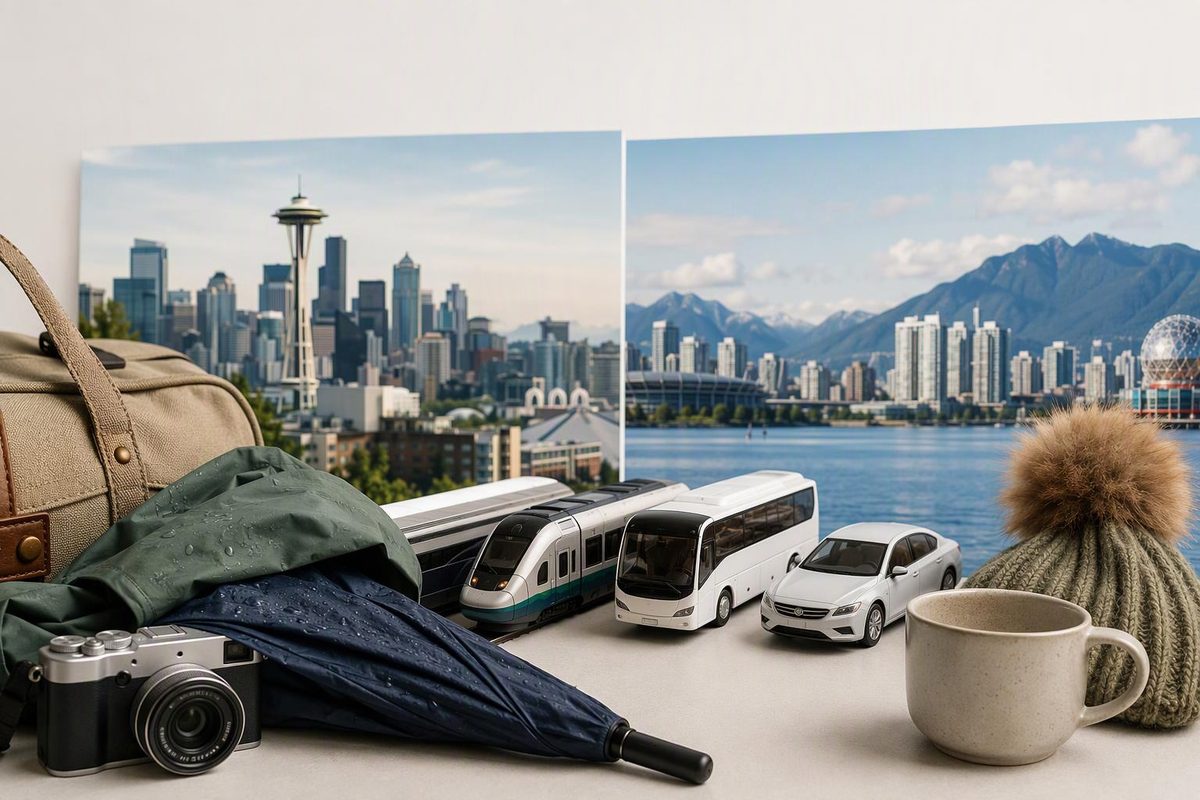
A day trip from Seattle to Vancouver, British Columbia, is possible, but it is a long international travel day—not a casual side trip. The best version uses an early intercity bus north and a late bus south. Driving can work if you accept uncertain border waits. The train is comfortable, but its current timing leaves little room for sightseeing.
Before booking, work backward from the return departure. Aim for at least five usable hours in central Vancouver after accounting for border procedures, station transfers and the carrier’s required check-in time. If the schedule cannot provide that, stay overnight or choose a closer car-free day trip from Seattle.
Train, bus or car?
| Option | Best for | Main drawback |
|---|---|---|
| Intercity bus | Maximizing time without driving | Traffic and border processing can extend the ride |
| Amtrak Cascades | Scenery and a comfortable journey | The same-day train window is very short |
| Car | Plans beyond central Vancouver | Border queues, traffic and parking |
Amtrak: better for an overnight trip
As of September 22, 2026, Amtrak Cascades has two daily trains in each direction between Seattle and Vancouver. The morning northbound train is scheduled to leave Seattle at 8:30 a.m. and arrive at 12:30 p.m. The latest southbound train leaves Vancouver at 4:55 p.m. and reaches Seattle at 9:10 p.m. The current timetable took effect June 8, 2026.
There are four hours and 25 minutes between scheduled arrival and departure. However, the same timetable instructs passengers traveling to or from Vancouver to arrive one hour before departure. That means returning to Pacific Central Station by about 3:55 p.m., leaving at most three hours and 25 minutes before allowing for arrival formalities, delays or travel from the station.
That is enough for lunch and one compact area, not a satisfying first visit. Choose the train if the journey itself is part of the appeal or if you can stay overnight.
Bus: usually the best car-free option
Intercity buses generally offer more departure choices than the train, making an earlier arrival and later return possible. FlixBus sells trips on the Seattle–Vancouver corridor, but departure times, journey lengths, prices and stops vary by date. Check the exact trip and stop details for your travel day.
For a worthwhile same-day visit, look for a booking that:
- leaves Seattle around 6 a.m. or earlier;
- arrives at a central Vancouver stop by late morning;
- departs Vancouver after 7 p.m.; and
- provides at least five hours in the city after check-in requirements.
Buy the return with the outbound rather than assuming a late seat will remain available. Confirm the stop printed on each ticket; different departures may not use the same Seattle or Vancouver location.
Treat the advertised journey time as a schedule, not a guarantee. I-5 congestion and processing at the U.S.–Canada border can make the ride longer. Avoid a nonrefundable attraction reservation soon after your expected arrival.
Driving: flexible, but not predictably faster
A car allows a before-dawn departure and a late return, and it makes Stanley Park, Richmond or other places outside the downtown core easier to reach. It also introduces the most variables.
Before leaving, check:
- border waits in both directions;
- whether your rental agreement permits travel into Canada;
- whether your insurance applies in Canada;
- parking cost and garage hours at your destination; and
- rules for bringing purchases, food and alcohol back into the United States.
For a downtown-only visit, the bus is often simpler because nobody has to drive or park. If you do drive, do not schedule a timed attraction immediately after your projected border crossing.
Check border documents before buying tickets
This is an international trip, and an ordinary driver’s license alone should not be treated as sufficient documentation.
For a U.S. citizen, a valid passport book is the simplest option for entering Canada and returning to the United States. Other documents may be accepted in some circumstances at land crossings, but the rules depend on citizenship, immigration status and mode of travel. Use Canada’s official visa and eTA checker and U.S. Customs and Border Protection’s guidance for returning travelers for your situation.
Do not assume that authorization to enter the United States also permits entry to Canada. Some travelers need a Canadian visitor visa. Visa-exempt travelers arriving by bus, train or car generally do not need an electronic travel authorization, which is primarily an air-travel requirement; Canada explains the eTA categories and exceptions.
Keep documents with you, not in checked baggage. Families, permanent residents and dual citizens should check the rules that apply to every traveler before purchasing nonrefundable tickets.
A compact Vancouver itinerary
Keep the day in central Vancouver and choose one anchor. Do not try to combine Stanley Park, Granville Island and multiple museums in a short visit.
Clear-weather plan
- Canada Place and the waterfront: Start with harbor views close to downtown.
- Gastown: Walk east, look around and have lunch.
- Choose one anchor: Continue to a short section of Stanley Park or visit Granville Island, allowing for the trip there and back.
- Protect the return: Begin moving toward the departure point 60 to 90 minutes earlier than you would for a domestic trip, then follow the carrier’s check-in instruction.
Rainy-day plan
Keep the waterfront portion brief, have lunch in Gastown or downtown, and choose one indoor anchor such as the Vancouver Art Gallery. Drop Stanley Park or Granville Island rather than squeezing it into worsening weather.
The same principle used for a Seattle rainy-day itinerary works here: preserve one worthwhile stop and remove optional walking first.
The practical verdict
Choose the bus for the best chance of a worthwhile same-day visit, the train when you can stay overnight, and a car when reaching places beyond downtown matters more than predictable timing.
If your booked schedule leaves fewer than five usable hours in Vancouver—or anyone’s border documents remain uncertain—make Vancouver a one-night trip instead.