
What the Bite of Seattle voicemail adds to the timeline
A dated evidence ledger separates the July 26 briefing requests from September records releases and October voicemail reporting, with source links and clear limits.
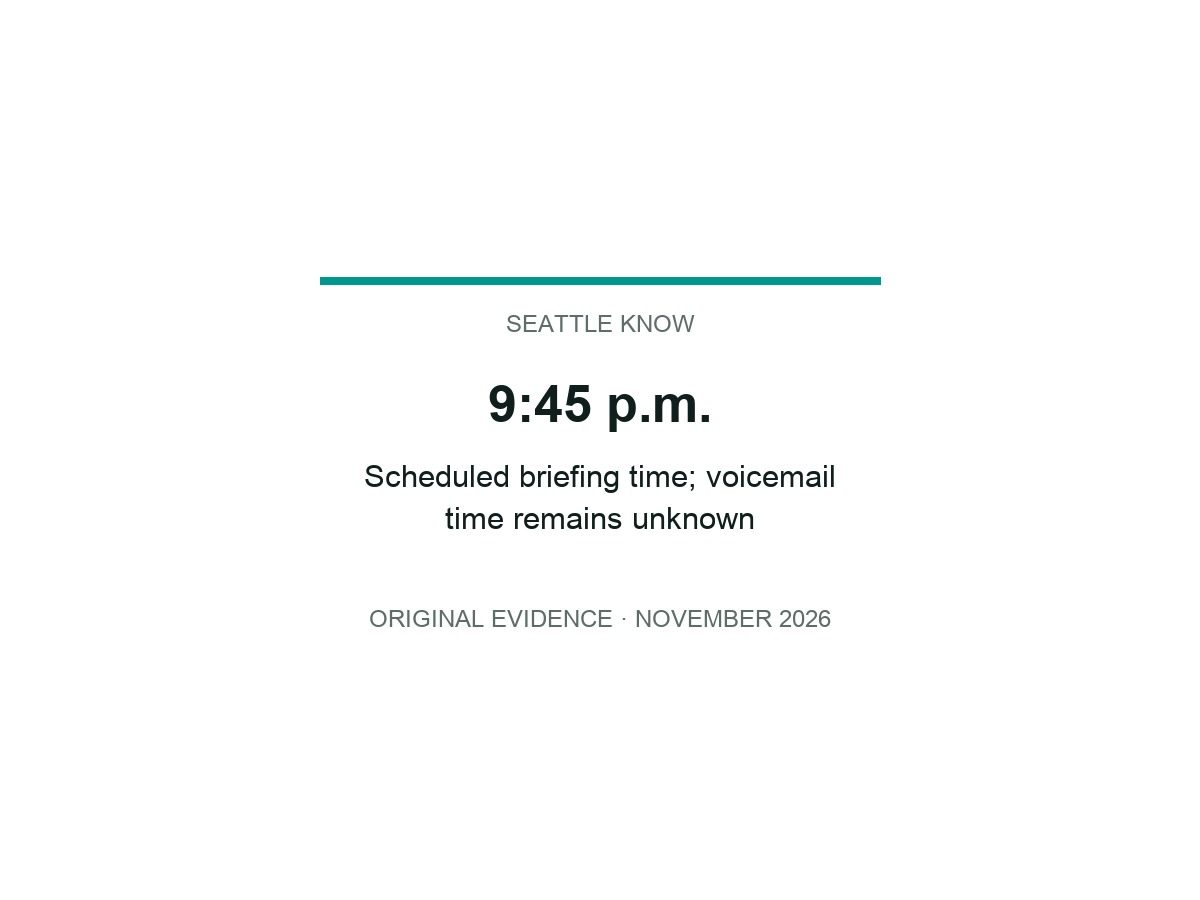
A voicemail reported on October 26 adds evidence that Seattle Mayor Katie Wilson’s public safety director asked police to postpone a briefing after the July 26 Bite of Seattle shooting. It does not establish when the message was received, whether it was acted on, or who caused every part of the evening’s delay.
In KIRO’s published transcription, Alison Holcomb asks police spokesperson Brian Pritchard to “hold on the 9:45 availability” until the mayor can join. KIRO Newsradio says it obtained the recording through a public disclosure request. 9:45 is the scheduled briefing time mentioned in the message—not a verified voicemail timestamp.
That distinction matters when tracing accountability. A request, its receipt, a decision to comply, and the resulting delay are separate events. The available transcription establishes what was reportedly requested; it cannot fill in the other steps by itself.
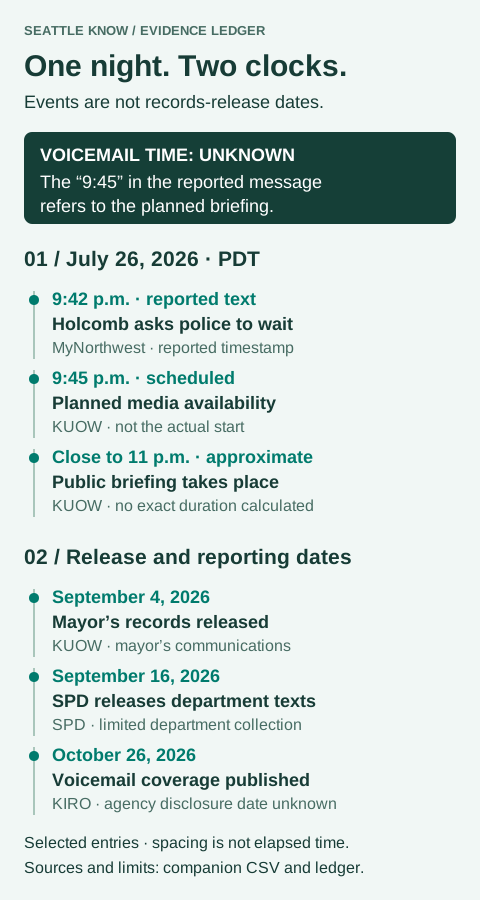
Explore the source-linked evidence ledger · Download the 17-row CSV
What was already in the record
The shooting killed three people and injured four, according to FOX 13’s September reporting. The argument over communications concerns information after that emergency; it should not obscure the people harmed.
The October story was not the first evidence of a request to wait. MyNorthwest’s voicemail report also identifies a July 26 text at 9:42 p.m. in which Holcomb asked police to wait for Wilson. It distinguishes that message from an earlier 9:36 p.m. inquiry about a media appearance.
KUOW’s September 4 account described the mayor’s release of texts and other communications that day. It placed the eventual briefing close to 11 p.m. It also recorded an online mayoral statement at 8:46 p.m. that needed correction. The delay in holding a briefing therefore should not be described as an evening with no public communication at all.
The other clock: when records became public
Seattle Police released a department text-message collection on September 16. Its notice expressly limits the collection to named department employees, excludes elected officials and outside agencies, and says former Chief Shon Barnes’ records were still being prepared. Those are limits of that release—not proof that excluded people did or did not communicate.
A September 17 joint statement from Wilson and Interim Chief Andre Sayles acknowledged the need for faster coordination. October 26 is the publication date of the voicemail coverage cited here. We have not established the agency’s exact disclosure date for that recording. Those dates belong in different columns from the July events.
What remains disputed
Assistant Chief Tyrone Davis has alleged Deputy Mayor Brian Surratt instructed police to wait. Wilson denied that account. In its November 2 follow-up, MyNorthwest reported that the mayor’s office’s latest response pointed to acknowledged missteps and its September communication framework. Holcomb’s reported message is evidence about Holcomb’s request; it does not independently resolve the separate Davis–Surratt dispute.
Other officials’ accounts need the same attribution. In a statement reported by MyNorthwest, U.S. Rep. Pramila Jayapal said she learned at 10:10 p.m. that an evening news conference would happen and arrived around 10:40. She disputed attributing hours of delay to waiting for her and Gov. Bob Ferguson. These are her reported times, not independently verified arrival logs.
FOX 13 reported Wilson had accepted responsibility for late-night delays. Accepting that responsibility does not settle the timing or causes of earlier decisions.
What to watch for next
The city’s independent-review announcement assigns the Office of Inspector General the task of examining the public-information timeline and causes of delays. The page anticipates completion by mid-December; that is an expectation, not a finding.
For future incidents, the September 2 framework sets an expectation of information to media within an hour when safe and possible, without holding earlier alerts or social updates. Readers can distinguish that promised practice from evidence showing whether it happens.
The ledger keeps unknown times blank, labels approximate and speaker-reported times, and links each entry to its source. Seattle Know has not obtained or independently listened to the original voicemail, and has not independently verified its metadata. This is an attributed synthesis of published reporting and official announcements, not an exclusive recording, a full call log, or a conclusion about causation.