
First Identify Your Snow-Named Shrub, Then Give It the Right Care
Before planting, pruning, fertilizing, or deciding whether the shrub can remain outdoors in winter, check its label for a scientific name.
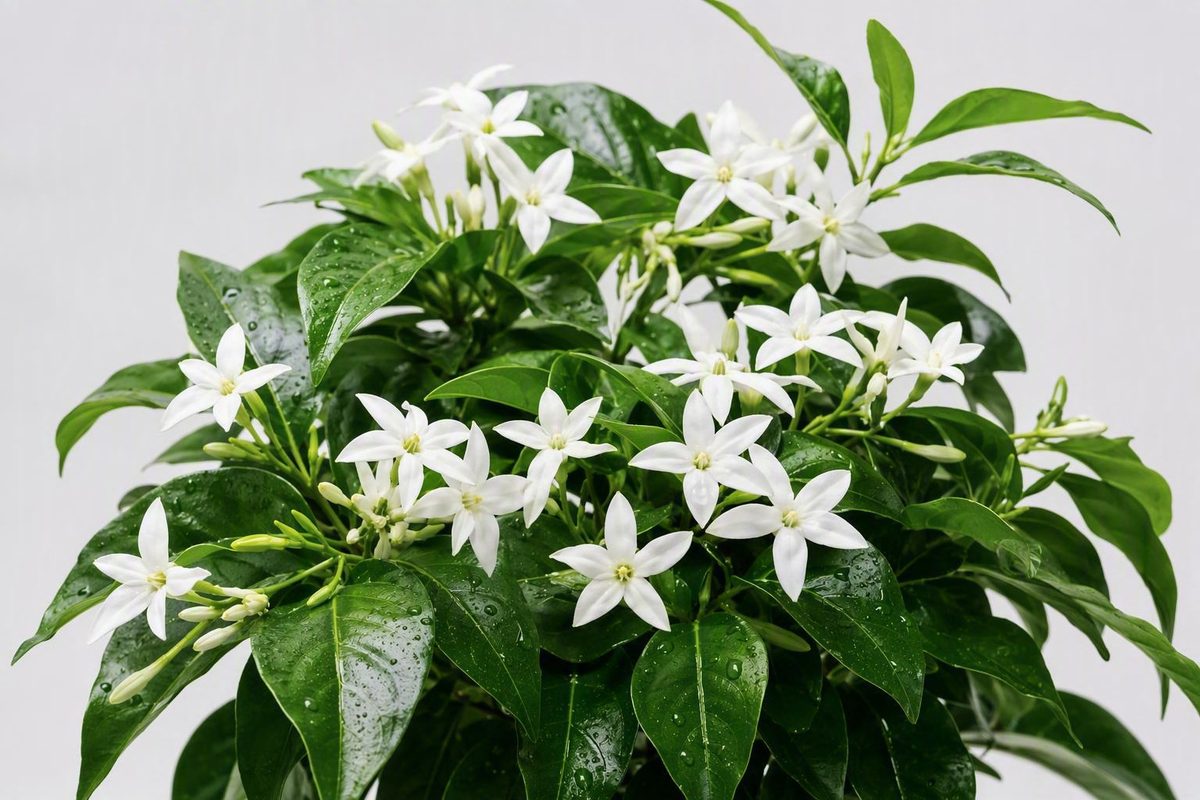
“Arctic Snow Bush” most often refers, in the reviewed plant listings, to Wrightia antidysenterica: a tropical, white-flowering shrub in the dogbane family, Apocynaceae. Similar names—particularly “snowbush” and “Snow-on-the-Mountain”—are also applied to Breynia disticha, a different tropical shrub grown for variegated foliage.
That distinction affects almost every care decision. Before planting, pruning, fertilizing, or deciding whether the shrub can remain outdoors in winter, check its label for a scientific name.
The available evidence consists largely of commercial plant listings and regional gardening guides. These sources are useful for comparing nursery names and reported growing experience, but they do not establish precise temperature thresholds, universal flowering behavior, or definitive toxicity. Where their claims conflict, this guide keeps the uncertainty visible rather than selecting an unsupported answer.
What plant is sold as Arctic Snow Bush?
In the reviewed listings using the exact name Arctic Snow, the plant is generally Wrightia antidysenterica. It is described as a compact or bushy shrub with glossy green foliage and clusters of white flowers. Listings place it in the Apocynaceae family and use alternative names including Asian Snow, Snowflake, Milky Way, and Winter Cherry Tree in addition to Arctic Snow.
Retail names are not standardized. A seller may use Arctic Snow, Asian Snow, Snowflake, Milky Way Plant, Winter Cherry Tree, or another trade name for Wrightia. “Snowbush” and “Snow-on-the-Mountain,” meanwhile, commonly refer to Breynia disticha, a member of the Phyllanthaceae family.
These are not two cultivars of the same species:
- Wrightia antidysenterica is grown primarily for conspicuous white flowers against plain green foliage.
- Breynia disticha is grown primarily for foliage mottled with pink, white, cream, gray-green, and green.
- They belong to different botanical families and have different reported origins and ornamental features.
- Both are described as tropical or subtropical plants, so neither should be presumed tolerant of freezing weather.
The most reliable first step is to inspect the nursery tag, receipt, online order record, or botanical label. Look for a two-part scientific name in the form “Genus species.” If the label says only Arctic Snow Bush, ask the seller to confirm which species was supplied.
If the label is missing, use the flowers and foliage for a preliminary identification. Do not combine advice from multiple websites merely because every page contains “snow” in the common name. Guidance intended to maintain Breynia foliage variegation does not necessarily help Wrightia flower, and a cold-response observation about one species should not automatically be transferred to the other.
Until the identity is clear, take a conservative approach: keep the plant warm, avoid saturated soil, postpone aggressive pruning or soil amendments, and do not install it permanently in a site exposed to recurring freezes.
Wrightia or Breynia? Use flowers and foliage to identify it
The quickest visual test is to ask what creates the snowy effect.
With Wrightia antidysenterica, the effect comes from clusters of conspicuous white flowers. The leaves are generally solid green, glossy, and arranged opposite one another. The flowers are commonly described as five-petaled or star-like and approximately one inch across in a Southwest Florida gardening account.
With Breynia disticha, the effect comes primarily from pale variegation. Its leaves may combine pink, white, gray-green, and green, with new growth showing stronger pink tones. Its flowers are comparatively inconspicuous and do not form the prominent display of white stars associated with Wrightia. A regional gardening guide also identifies Snow Bush and Snow-on-the-Mountain as names for this foliage plant and illustrates its mottled coloration.
| Identification feature | Wrightia antidysenterica | Breynia disticha |
|---|---|---|
| Common names encountered | Arctic Snow, Asian Snow, Snowflake, Milky Way, Winter Cherry Tree | Snowbush, Snow Bush, Snow-on-the-Mountain |
| Family | Apocynaceae | Phyllanthaceae |
| Main ornamental feature | Clusters of showy white flowers | Strongly variegated foliage |
| Foliage | Usually plain, glossy green | Mottled pink, white, cream, gray-green, and green |
| Flowers | Conspicuous, white, usually five-petaled or star-like | Small and not the principal display |
| Reported origin | Sri Lanka | New Caledonia and Vanuatu |
| Broad reported size | Commercial reports collectively span approximately 2–10 feet | One care guide gives a typical mature range of approximately 4–6 feet |
| Cold response | Tropical or subtropical; frost protection is prudent | Tropical and cold-sensitive |
| Quick identification rule | White stars with plain green leaves | Pink-white-green variegated leaves |
The table’s origin and size details come from commercial or secondary sources rather than a primary botanical treatment. A commercial plant encyclopedia reports Sri Lanka as the origin of Wrightia and gives a broad height span of approximately 2–10 feet, while a secondary botanical summary places Breynia disticha in Phyllanthaceae and reports New Caledonia and Vanuatu as its native range for the latter species.
Do not use fragrance as the deciding test. Descriptions of Wrightia range from unscented to fragrant or strongly fragrant. The supplied sources do not resolve whether this reflects differences among plants, growing conditions, flower age, time of observation, or subjective perception. If scent matters to a purchase, inspect the actual plant while it is flowering.
A more dependable rule is:
Prominent white, star-like flowers with plain glossy green leaves point to Wrightia. Strongly variegated pink-white-green leaves point to Breynia.
If the plant fits neither description, obtain a local identification before using the remainder of this guide, which focuses on confirmed Wrightia antidysenterica.
Light, water and soil care for Wrightia antidysenterica
Once the scientific name is confirmed, treat Wrightia as a warm-climate flowering shrub rather than a cold-hardy plant.
Light: Provide sun to partial shade. Brighter suitable conditions generally support more flowering, while lower light is associated with fewer blooms. The evidence does not establish one optimum number of direct-sun hours for every climate, season, or indoor setting.
In a mild or humid outdoor climate, a sunny site may work well. Indoors, use the brightest suitable position available, but acclimate a sheltered plant gradually rather than moving it abruptly into intense outdoor sun.
Water: Aim for moderate, reasonably consistent moisture combined with free drainage. Water thoroughly when the root zone needs it, then allow excess water to escape. Do not keep the medium constantly saturated. One regional gardening account recommends moderate water, associates lower light with fewer flowers, and warns against waterlogged roots while reporting tolerance of slightly acidic to slightly alkaline soil.
Assess the upper soil before watering. If it remains distinctly wet, wait and check again later. If the surface has begun to dry and the root ball is no longer saturated, watering may be appropriate.
A fixed schedule cannot account for those variables. An established in-ground shrub may need less frequent attention if its soil drains freely.
When watering a container, moisten the root ball and let the excess drain. Empty any outer pot or saucer that retains collected water. “Consistent moisture” does not mean leaving the growing pot submerged.
Soil: The clearest point of agreement is drainage. Wrightia should not remain in compacted, persistently waterlogged soil. The available sources disagree about pH: one nursery listing recommends rich acidic soil and reports chlorosis under alkaline conditions, while a regional gardening account reports tolerance from slightly acidic to slightly alkaline.
Because the evidence does not establish a strict universal pH requirement, do not acidify the soil automatically. If leaves yellow, first inspect moisture, drainage, root condition, recent cold, and changes in care. If alkaline-soil chlorosis remains a possibility, test the soil or potting medium before applying iron products or acidifiers.
Fertilizer: Keep feeding modest. The supplied gardening evidence supports occasional light fertilizer, not a universal product, dose, or schedule. Container plants may eventually exhaust available nutrients, but extra fertilizer cannot compensate for inadequate light, cold stress, or poor drainage.
Use a product labeled for the growing situation and follow its directions. Account for any fertilizer already incorporated into the potting medium.
Hardiness, frost protection and winter decisions
Commercial sources commonly place Wrightia antidysenterica in USDA zones 10a–11, although one listing marks that range as uncertain while identifying the plant as a tropical shrub. Treat such zone designations as nursery guidance, not as a guarantee that an individual plant will survive a particular temperature, duration of cold, wind pattern, or microclimate.
The word “Arctic” refers to the appearance of the white flowers. It does not imply tolerance of snow, frozen soil, or recurring freezes.
Your winter plan should reflect one of three settings.
1. Reliably frost-free landscape
In a genuinely frost-free setting, Wrightia may be planted in the ground if the location provides suitable light, free drainage, and adequate space.
Even warm regions can experience unusual cold events. Monitor forecasts and be prepared to protect the shrub if local conditions occasionally approach frost.
2. Marginal climate with occasional cold events
Where frost is possible but infrequent, use the warmest practical site and reduce exposure to cold wind. A protected location may moderate conditions, but it cannot make a tropical shrub fully freeze-hardy.
When frost is forecast, move a container under cover or provide temporary protection appropriate to the plant and site. These are general precautionary measures rather than a species-specific guarantee. The supplied evidence does not establish exactly how cold Wrightia can become or how long it can withstand a given temperature.
Cool conditions or mild frost may cause temporary foliage loss. Leaf drop by itself does not prove that the roots and stems are dead. Keep the shrub protected from additional cold and allow time for its condition to become clear before removing uncertain growth.
3. Climate with regular freezes
A movable container is generally the most practical option. Relocate the shrub to a bright, protected place before freezing conditions arrive rather than waiting for visible cold damage.
Possible winter quarters include a bright interior room, enclosed porch, sunroom, greenhouse, or another protected space used for tropical container plants. The evidence does not establish a universal minimum indoor temperature, so the defensible objective is to avoid freezing exposure and monitor the plant’s response.
A zone label alone cannot determine whether a particular shrub should remain outdoors.
Growing Arctic Snow Bush in a container or protected indoor space
Commercial listings recommend Wrightia for patios, limited-space gardens, containers, and houseplant culture. A movable pot is particularly useful where winter conditions are unreliable because the plant can spend warm periods outdoors and cold periods under protection.
Choose a container with unobstructed drainage holes. Decorative outer pots are suitable only if retained water can be removed after irrigation. Never assume that a pot is draining merely because its surface appears dry.
A container-grown shrub often requires closer moisture monitoring than an in-ground plant because its roots occupy a limited volume and the pot may heat or dry quickly. Yet a large container in a dim, cool room can stay wet for a long time. Check the medium instead of assuming that all potted plants need frequent watering.
Use a medium that retains some moisture while allowing excess water to drain. The supplied evidence does not establish one ideal recipe for every climate, container, or watering style. Evaluate how the medium functions:
- Does water enter the root ball rather than immediately escaping through a gap at the pot’s edge?
- Does excess water leave through the drainage holes?
- Does the medium begin to dry gradually rather than remaining saturated?
- Has the plant become unstable or crowded with roots?
- Has the medium collapsed into a dense mass?
Place the shrub in the brightest suitable protected location available.
Acclimate the plant when moving it between markedly different light environments. A specimen that has spent months indoors should not immediately receive the harshest outdoor exposure. Introduce brighter conditions gradually and watch the foliage for stress. Before bringing the plant inside, inspect its leaves, stems, and container.
Do not repot according to a predetermined calendar. Monitor drainage, root space, stability, growth, and watering behavior. Repot when the available root volume or deteriorated medium makes normal care difficult, and avoid moving a small root system into an unnecessarily large volume of wet medium.
Continue checking the upper medium, but do not preserve a summer watering routine out of habit. Increase watering or resume light feeding only when conditions and active growth justify doing so.
Size, flowering, foliage and pruning expectations
Reported mature sizes for Wrightia antidysenterica vary considerably. One commercial directory lists approximately 3–6 feet tall, another nursery listing gives about 7 feet, and a commercial encyclopedia spans approximately 2–10 feet.
A shrub growing in a frost-free landscape may develop differently from one confined to a pot and overwintered indoors.
The ornamental form is generally described as compact, upright, or bushy. Glossy green leaves provide a dark background for clusters of white, five-petaled or star-like flowers.
Prolonged or nearly year-round flowering is reported in warm climates, but it should be treated as potential rather than a promise. A shrub in bright, frost-free conditions may bloom over a long period, while one in a cool climate, dark room, or stressed root zone may flower intermittently. Low light is one of the first conditions to assess when flowering declines.
Foliage descriptions also vary. Some listings call Wrightia evergreen, while others describe it as semi-deciduous or report leaf loss during cool weather. These accounts can be reconciled conditionally: the plant may retain foliage in consistently warm conditions but temporarily shed leaves after cold stress or mild frost.
Fragrance remains unresolved. Some sellers call the flowers fragrant or strongly fragrant, while one regional account describes them as unscented. Do not buy the plant specifically for fragrance unless you have smelled the actual specimen or batch in bloom.
Routine heavy pruning is not clearly necessary. A naturally compact shrub may need only dead, damaged, or poorly placed growth removed. Light pruning can nevertheless:
- Control growth near a path or wall
- Improve symmetry
- Encourage a denser outline
- Remove clearly cold-damaged material
- Keep a container specimen manageable
Late winter, after the greatest danger of extreme cold has passed, is the most clearly supported general pruning window in the supplied nursery guidance which also reports a mature size of about 7 feet by 5 feet. Adjust timing to local conditions, and do not assume pruning will guarantee heavier flowering.
If cold damage is uncertain, wait until the risk of additional severe weather has passed or growth begins to reveal which stems remain viable. Then remove clearly dead portions with clean tools.
Troubleshooting sparse flowers, yellow leaves and leaf drop
Symptoms rarely identify one cause by themselves. Use this table as a sequence of checks, not as a remote diagnosis.
| Symptom | What to check first | What to do next |
|---|---|---|
| Sparse or absent flowers | Available light | If the shrub is in deep shade or a dim room, move it gradually toward brighter suitable conditions. Then review recent cold, root stress, relocation, and seasonal expectations. |
| Yellow foliage | Soil moisture and drainage | Check for saturated soil, blocked drainage, standing water, or a dense medium before assuming nutrient deficiency. |
| Yellow leaves with greener veins | Drainage and actual soil pH | Alkaline-soil chlorosis appears in one nursery listing, but another account reports broader pH tolerance. Confirm conditions before using iron or acidifiers. |
| Sudden leaf drop after cold weather | Recent temperature exposure | Protect the plant from further cold and watch for recovery; temporary defoliation has been reported after cool conditions or mild frost. |
| Container stays wet for many days | Drainage holes, saucer, medium structure, pot size, and watering frequency | Remove retained water, clear obstructions, and delay watering until the root zone begins using moisture normally. |
| Wilting despite wet soil | Root-zone condition | Do not assume the plant needs more water. Investigate persistent saturation and drainage. |
| Shrub outgrows its space | Available room and pruning history | Use measured pruning after major cold risk has passed rather than repeated severe shearing. |
| Leaves drop indoors | Light, moisture, drafts, and recent relocation | Compare the old and new environments and change one care factor at a time where practical. |
| Plant remains weak | Species identity and root condition | Recheck the scientific name and inspect the root zone; seek local diagnostic help if decline continues. |
For sparse flowering, light is the logical first check because lower light is specifically associated with fewer flowers. If exposure appears suitable, consider whether the plant recently experienced cold, remained waterlogged, dried excessively, was repotted, or was brought indoors. Fertilizer should not be the automatic first response.
For yellow foliage, inspect below the surface. Check the drainage holes and the bottom of the pot. Adding fertilizer to an already stressed, saturated root zone is unlikely to correct the underlying moisture problem.
The soil-pH evidence is contradictory. One nursery source reports sensitivity to alkaline soil, while a regional account reports tolerance from slightly acidic to slightly alkaline. Confirm actual conditions and rule out poor drainage before attempting to change pH.
The supplied evidence is insufficient to create a dependable Wrightia-specific pest and disease catalog. It would therefore be misleading to call the species pest-free, universally disease-resistant, or immune to common container problems. Inspect leaves, stems, and roots when symptoms persist, but do not assign a pest or disease name without supporting signs.
Seek assistance from a local horticultural or diagnostic service when decline continues after basic corrections or when the plant cannot be identified confidently. Useful identification material includes the original label, a photograph of the whole plant, close-ups of both leaf surfaces and flowers, and a record of recent temperatures and watering.
Landscape uses, pollinators and claims to treat cautiously
In a suitable warm setting, Wrightia antidysenterica can be used as:
- A flowering container specimen
- A patio or terrace plant
- An accent shrub
- A small hedge or informal screen
- A mass planting
- A limited-space garden shrub
- A protected houseplant or seasonal indoor specimen
For planning, allow for a shrub in the approximate 4–7-foot range while recognizing that commercial reports collectively extend from about 2 to 10 feet. Avoid placing it where ordinary growth would require constant severe trimming. In a container, preserve access for watering, drainage checks, and seasonal relocation.
The white flowers and glossy foliage can provide a strong contrast in a warm-climate planting.
Butterfly attraction is reported repeatedly in horticultural listings, so the plant may be described as one that can draw butterflies. That is not a guaranteed ecological result: visitation depends on local species, habitat, season, pesticide use, and whether the shrub is flowering. Bee and hummingbird attraction appears less consistently in the supplied evidence and should not be treated as an established general trait.
Fragrance claims are similarly contradictory. Descriptions range from unscented to strongly fragrant. If scent is an important buying criterion, evaluate the actual plant in flower.
Claims that Wrightia is deer-resistant, universally pest-resistant, or likely to live for a particular number of years are not adequately established by the supplied material. Performance and longevity can vary with climate and cultivation, while isolated nursery claims do not demonstrate a universal trait.
Traditional medicinal use is mentioned in some commercial descriptions, but those descriptions do not establish clinical efficacy, an appropriate dose, or safety. One commercial plant encyclopedia itself frames its medicinal material as ethnomedical information rather than medical treatment while stating that such claims have not been evaluated as disease therapies. Nursery and gardening descriptions should not be treated as evidence for ingesting the plant or using it for self-treatment.
Toxicity is also unresolved in the supplied evidence. A nursery listing labels Wrightia toxic but does not identify a plant part, compound, exposure route, dose, or severity. That unsupported label is not enough to classify the species as either definitively toxic or definitively safe.
Do not transfer statements about Breynia fruit to Wrightia. They are different species, and a safety claim concerning one does not establish anything about the other.
Is Arctic Snow Bush the same as snowbush or Snow-on-the-Mountain?
Not necessarily. Arctic Snow Bush generally identifies Wrightia antidysenterica in the reviewed listings: the green-leaved shrub with conspicuous white flowers. Snowbush and Snow-on-the-Mountain commonly identify Breynia disticha, which has mottled pink, white, and green foliage.
Check the scientific name rather than assuming equivalence. Without a label, prominent white flowers and plain green leaves suggest Wrightia; strongly variegated foliage suggests Breynia.
Can Arctic Snow Bush survive frost or freezing weather?
Do not assume that it can. Commercial listings commonly place Wrightia antidysenterica in USDA zones 10a–11, but those designations are broad nursery guidance rather than precise cold-survival thresholds.
Cool weather or mild frost may cause temporary leaf loss. In an occasionally frosty area, use a protected site and temporary protection. Where freezes recur, grow the shrub in a movable container and relocate it before freezing conditions.
How big does Wrightia antidysenterica get?
Commercial reports collectively span approximately 2–10 feet, with roughly 4–7 feet serving as a practical cultivated planning range. Final dimensions depend on climate, root space, light, moisture, and pruning.
A container-grown or regularly shaped specimen may remain smaller than an in-ground plant enjoying a long, warm growing season. Provide enough room rather than relying on one seller’s exact mature dimensions.
Will Arctic Snow Bush flower all year?
It may flower for a prolonged period in warm, bright conditions, and commercial or regional descriptions sometimes report bloom through most or all of the year. That does not mean every specimen will flower continuously.
Cool weather, insufficient light, indoor overwintering, and root stress can reduce or interrupt bloom. When flowers become sparse, assess light first, followed by recent temperatures, moisture, drainage, and root condition.
Is Arctic Snow Bush toxic to people or pets?
The supplied evidence does not establish that Wrightia antidysenterica is definitively safe or definitively toxic. The available nursery toxicity claim lacks the details needed to evaluate it.
Do not infer safety from the absence of a detailed warning, but do not transfer toxicity statements about Breynia disticha to Wrightia. This evidence base cannot support a more specific exposure or medical-safety conclusion.
The final decision has three steps: verify the scientific name, identify the plant by its flowers and foliage, and match care to the confirmed species and local winter conditions. For Wrightia antidysenterica, prioritize bright conditions, moderate moisture, reliable drainage, realistic expectations about flowering and leaf retention, and protection from frost. The snow-themed name describes appearance rather than cold hardiness, while fragrance, toxicity, and medicinal claims remain too uncertain to present as settled facts.