
How a Coffee Cherry Becomes the Green Bean Behind Your Brew
Natural describes a whole-cherry drying workflow, while anaerobic describes a fermentation environment applied within the broader process.
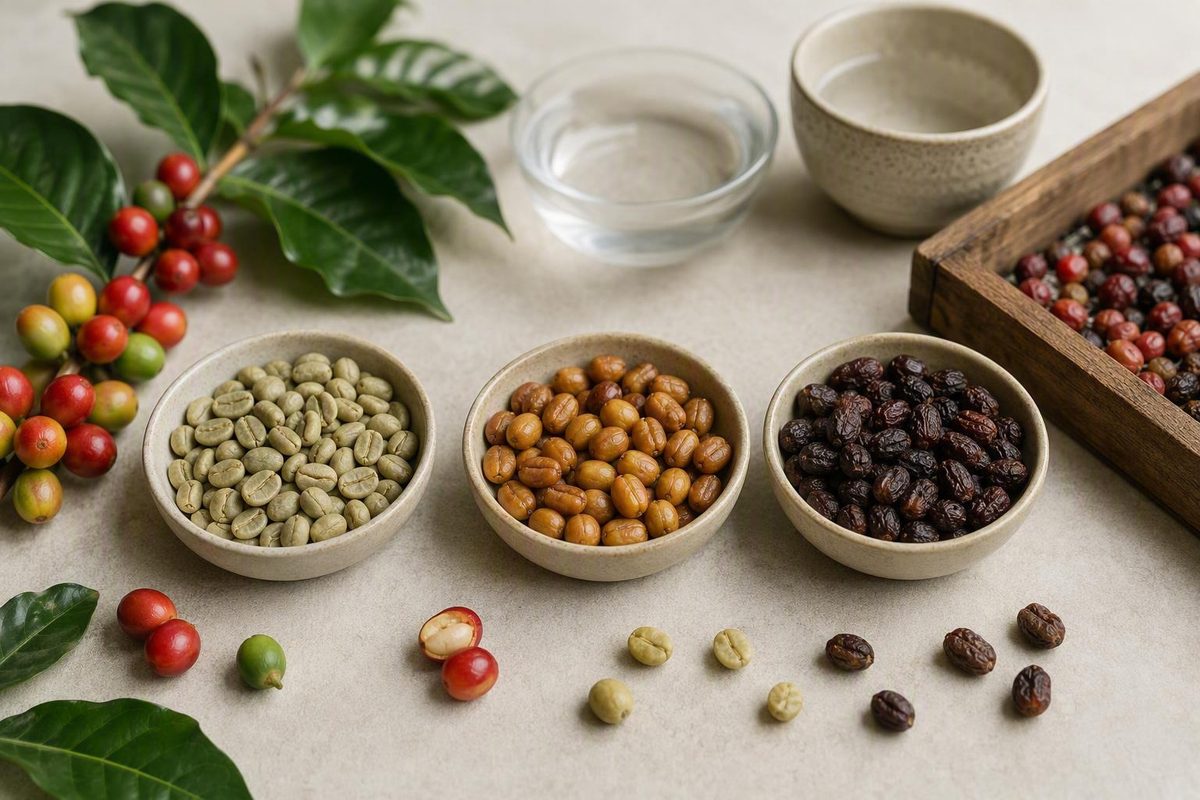
The words washed, natural, and honey on a coffee bag describe decisions made long before the coffee reached a roasting machine. They refer to post-harvest work: removing or retaining parts of the fruit, managing fermentation, and drying the seeds inside the coffee cherry.
The simplest distinction is what surrounds the seed while it dries:
- Washed coffee dries after most fruit and mucilage have been removed.
- Natural coffee dries inside the whole cherry.
- Honey coffee is depulped but dries with some sticky mucilage still attached.
These differences can influence flavor. Washed coffees are often described as clear and bright, naturals as intensely fruity and full-bodied, and honeys as sweet or intermediate in character. Those are useful tendencies, not promises. A process label is best treated as a starting hypothesis about a coffee—not a guarantee of flavor or quality.
What the specialty coffee process means
In this context, coffee processing means the post-harvest work that separates the coffee seed from the fruit surrounding it and dries that seed into green coffee suitable for milling, storage, export preparation, and roasting. What drinkers call a coffee “bean” is actually the seed of a harvested coffee cherry, not a roast-ready bean that grows by itself on a tree. The National Coffee Association’s processing overview likewise describes processing as removing seeds from harvested cherries and preparing them for roasting.
Post-harvest processing is distinct from:
- Roasting, which applies heat to green coffee and develops the characteristics associated with roasted beans
- Grinding, which changes the roasted coffee’s particle size
- Brewing, which extracts soluble material from those grounds with water
All of these stages can affect what you experience in the cup. However, a label such as washed process or natural process normally refers to work performed at origin rather than to later choices made by the roaster or brewer.
The phrase specialty coffee process does not identify one special recipe. In ordinary coffee language, it generally refers to the post-harvest methods discussed in specialty-coffee buying and labeling. The term should not be mistaken for a complete definition of specialty grade or for evidence that a coffee has met a particular grading or cupping requirement.
Washed, natural, and honey are broad processing families rather than rigid global standards. Two producers can both describe a coffee as washed while using different sorting methods, fermentation vessels, water practices, drying surfaces, or schedules. Honey terminology varies even more. The label outlines the workflow but rarely communicates every operational detail.
Process choice is practical as well as sensory. Climate, available water, equipment, labor, local tradition, drying space, risk, and the profile sought by a buyer can all influence the producer’s decision. No single workflow suits every farm, mill, harvest, or market.
From ripe cherry to green coffee: anatomy and the basic timeline
Understanding the coffee cherry makes processing language easier to follow. From the outside inward, the relevant layers can be described as:
- Skin: The cherry’s outer covering
- Pulp: The fleshy fruit beneath the skin
- Mucilage: A sticky layer surrounding the inner structure
- Parchment: A papery protective layer around the seed
- Silverskin: A thin layer closely attached to the seed
- Green coffee seed: The unroasted material eventually sent to a roaster
Not every source groups the fruit’s anatomy in precisely the same way, but this six-part model is a useful working map. It also explains why “removing the fruit” can involve several operations rather than one simple peeling step. A detailed coffee-processing guide uses the same sequence of skin, pulp, mucilage, parchment, silverskin, and green seed.
A simplified post-harvest timeline looks like this:
- Harvest the cherries.
- Sort the crop to remove unwanted fruit and debris.
- Remove or retain the fruit according to the chosen process.
- Manage fermentation or remove mucilage by another method.
- Dry the coffee.
- Rest or store it as appropriate to the producer’s workflow.
- Hull away dried fruit or parchment.
- Sort and grade the green coffee for sale or export preparation.
The sequence changes by method. Natural coffee is dried before the fruit is removed. Washed coffee is depulped and cleaned of mucilage before drying. Honey coffee is depulped but dried with mucilage attached.
Harvesting and sorting
Cherries on the same tree or branch do not necessarily ripen simultaneously. Selective harvesting aims to collect ripe fruit while leaving immature cherries for later. Sorting after harvest may further separate underripe, overripe, damaged, dried, or otherwise unsuitable fruit.
Reducing mixtures of different maturity levels can provide a more consistent starting material for later processing. Sorting does not guarantee quality, but it can reduce variation before fermentation and drying. The Institute of Food Technologists’ production overview distinguishes selective picking from strip picking and describes later separation, hulling, and grading.
Sorting practices vary by producer. They may include hand inspection, screens, mechanical equipment, winnowing, or flotation in water. No one method is universal.
Depulping is not the same as hulling
These terms describe different operations:
- Depulping happens relatively early. A depulper removes the skin and much of the fleshy fruit from fresh cherries.
- Hulling generally happens after drying. Depending on the process, it removes dried fruit from natural coffee or parchment from dried parchment coffee.
A depulped seed can therefore still require later milling. In washed and honey processing, removing the fresh outer fruit does not ordinarily remove every protective layer around the seed.
Why drying matters
Freshly processed coffee contains too much moisture for stable storage. Drying reduces biological activity and helps limit mold, rot, spoilage, and other defects. An overview of washed, natural, and honey processing identifies proper drying and monitoring as important controls against mold, spoilage, and uneven drying.
Coffee may be dried on patios, raised beds, or other surfaces, in direct sunlight, under shade or cover, or in mechanical dryers. Producers may use one approach or combine several according to weather, volume, infrastructure, and production goals.
A final moisture level of approximately 10–12% is commonly cited for dried green coffee, but this is an approximate range rather than a universal operating or storage-safety specification. The 10–12% range is reported in this processing overview.
Washed coffee: fruit removed before drying
Washed processing is defined most clearly by what is absent during drying: most fruit and mucilage have already been removed. The parchment normally remains around the seed until later milling.
A general washed workflow is:
- Sort the harvested cherries.
- Depulp them to remove the skin and much of the fruit.
- Remove the remaining mucilage.
- Wash or clean the parchment coffee as required.
- Dry the parchment-covered seeds.
- Hull the dry parchment during later milling.
- Sort the resulting green coffee.
Mucilage removal can involve fermentation, washing, agitation, mechanical action, or a combination of methods. In many workflows, fermentation helps break down the sticky material so it can be removed more easily. Fermentation may take place with added water or with little or no added water, and producers can use tanks or other vessels. A coffee importer’s processing glossary describes both water-based and low-water fermentation variations within the washed family.
“Washed” therefore does not mean every producer immerses coffee in an identical tank for an identical period. The label does not specify the vessel, temperature, water source, microbial conditions, or mechanical setup.
Published examples place washed fermentation at approximately 12–72 hours, while other workflows may extend from several hours to several days depending on technique and conditions. These figures describe examples, not a transferable recipe. A commercial processing overview reports the 12–72-hour range and its dependence on conditions.
After mucilage removal, the parchment coffee still needs careful drying. It may be spread on patios or raised beds, dried in sunlight or shade, or placed in a mechanical dryer. Layer depth, airflow, turning, and protection from rain remain important even though the outer fruit is no longer present.
Poor control during fermentation or drying can contribute to spoilage, incomplete or uneven mucilage removal, and inconsistent results. Fermentation is especially sensitive to differences in time, temperature, and other operating conditions, as described in this overview of coffee-processing methods.
What washed coffee may taste like
Washed coffees are commonly associated with:
- Clear or well-defined flavors
- Bright acidity
- Floral, citrus, or tea-like characteristics
- A structured cup
- Lighter body than many natural coffees
These are tendencies rather than properties guaranteed by the word washed. A washed coffee can be relatively full-bodied, low in perceived acidity, deeply roasted, or otherwise unlike the familiar stereotype.
The process label also says nothing conclusive about quality. Removing fruit before drying may make certain characteristics easier to perceive, but the final result still reflects harvesting, fermentation, drying, storage, roasting, and brewing.
Equipment, water, and environmental tradeoffs
Washed processing generally requires suitable depulping and mucilage-removal equipment. Many washed systems also use water, although the amount and purpose vary.
The word washed cannot establish a coffee’s total water footprint or environmental performance. A fuller assessment would need to consider:
- Where processing water comes from
- Whether water is reused
- How wastewater is treated
- Whether mucilage is removed mechanically or by washing
- How much energy drying requires
- How fruit and other organic byproducts are handled
The label describes how the coffee was handled more reliably than it describes the overall environmental performance of the facility.
Natural coffee: the whole cherry dries around the seed
Natural processing—also called dry processing—moves drying to the beginning of the fruit-removal sequence. Instead of depulping fresh cherries, the producer dries them intact and removes the dried fruit afterward.
A general natural workflow is:
- Harvest and sort the cherries.
- Spread the intact fruit on patios, raised beds, or another drying surface.
- Manage layer depth, airflow, and exposure.
- Turn or rake the cherries regularly.
- Protect them from rain and excess moisture.
- Continue drying until the intended endpoint is reached.
- Hull away the dried skin, pulp, mucilage, and parchment.
- Sort the green coffee.
The essential structural difference from washed processing is that drying begins before the fruit is removed. This does not mean biological activity has been eliminated; fermentation can occur while the whole cherry dries.
The National Coffee Association describes intact cherries being dried in the sun, regularly turned, and protected during rain or at night before the dry husk is removed. It gives about 11% moisture as an example endpoint and notes that drying may take several weeks, depending on weather—not as universal instructions for every producer or lot. See the association’s natural-process description.
Why natural drying requires close management
A fresh coffee cherry is moist fruit surrounding one or more seeds. If cherries are piled too deeply, left still for too long, exposed to rain, or dried with inadequate airflow, the lot can dry unevenly.
Important variables include:
- Cherry ripeness and condition
- Weather and humidity
- Drying-surface design
- Layer thickness
- Air movement
- Frequency of turning
- Day-and-night temperature changes
- Protection from rain or ground moisture
- Overall drying progression
Inadequate control can contribute to mold, rot, excessive fermentation, uneven moisture, or inconsistent flavor. Regular turning helps reduce these risks, but sorting, airflow, weather protection, and appropriate layer depth also matter. Natural processing therefore uses little or no water for fruit removal but still demands drying space, monitoring, labor, and suitable conditions. These handling needs and mold or over-fermentation risks are summarized in the Nordic Approach processing guide.
What natural coffee may taste like
Natural coffees are often associated with:
- Pronounced fruit character
- Berry or tropical-fruit notes
- Greater perceived sweetness
- Fuller or rounder body
- Wine-like or fermented characteristics
Some drinkers seek naturals for those qualities. Others prefer less fruit intensity or fewer fermentation-associated notes.
A natural label cannot tell you that a coffee will taste like blueberry, that it will be “funky,” or that it will be high quality. Cherry ripeness, coffee variety, climate, drying control, storage, roast, and brewing all shape the result. A carefully executed natural can taste clear and structured rather than overtly fermented.
Natural processing also should not be declared the most sustainable method simply because little or no water is used to remove the fruit. A wider comparison would need to consider drying space, labor, weather exposure, rejected-lot risk, energy use where dryers are involved, organic-waste handling, and local conditions. As Counter Culture Coffee’s processing guide emphasizes, natural and washed describe processes rather than rankings of which coffee is inherently better.
Honey coffee: mucilage retained during drying
Despite the name, honey processing does not ordinarily involve adding honey. The name refers to the sticky, honey-like mucilage left around the parchment after depulping.
A general honey workflow is:
- Sort the cherries.
- Remove the skin and much of the pulp.
- Leave some mucilage attached to the parchment.
- Dry the coffee with that mucilage present.
- Turn and monitor it during drying.
- Remove the parchment during later milling.
- Sort the green coffee.
Honey processing can be understood as a midpoint between washed and natural processing, provided that comparison is not taken too literally:
- The fruit is removed earlier than in natural processing.
- More mucilage remains during drying than in a typical washed process.
- The seed is not dried inside the entire intact cherry.
Honey processing is also called pulped natural in some contexts, although naming practices vary.
What honey coffee may taste like
Honey coffees are commonly associated with:
- Pronounced sweetness
- A syrupy or rounded texture
- Moderate or balanced acidity
- More fruit or body than a typical washed profile
- More clarity than a strongly fruit-driven natural profile
The “middle” description is only a useful generalization. A honey coffee may resemble a washed coffee, a natural coffee, or neither. Mucilage retention is one variable among many.
Yellow, red, black, and white honey
Some labels add a color such as yellow, red, black, or white honey. These colors should not be interpreted as a universal scale with fixed percentages or guaranteed flavors.
Depending on the producer or region, a honey color may reflect some combination of:
- How much mucilage was retained
- Color development during drying
- Drying speed
- Exposure to sun or shade
- Layer depth and turning practices
- A producer-specific protocol
There is no single formula in the supplied evidence that makes every black honey or yellow honey directly equivalent. The color becomes more informative when a producer or roaster explains what it means for that particular lot.
Drying risks
Retained mucilage is moist and sticky, so honey coffee requires regular turning and monitoring. Poor airflow, inappropriate layer depth, inadequate weather protection, or inconsistent turning can contribute to uneven drying, mold, spoilage, or uncontrolled fermentation. Frequent monitoring and turning are identified as important controls in a comparison of washed, natural, and honey processing.
Those risks are not unique to honey coffee, and the process should not automatically be described as more difficult or more spoilage-prone than every alternative. Actual risk depends on the coffee, facility, environment, batch, and producer’s control.
Washed vs. natural vs. honey: a practical comparison
The three core labels are easiest to compare by asking one question: What surrounds the seed while it dries?
| Method | Fruit present during drying | General workflow | Water and infrastructure considerations | Drying demands | Principal process risks | Typical sensory tendencies |
|---|---|---|---|---|---|---|
| Washed | Most fruit and mucilage removed; parchment remains | Sort, depulp, remove mucilage, clean, dry parchment coffee, hull | Usually requires depulping and mucilage-removal equipment; water use and treatment vary | Even parchment drying using patios, beds, shade, sun, mechanical dryers, or a combination | Poorly controlled fermentation, incomplete mucilage removal, water-management problems, uneven drying | Clarity, brightness, structured acidity, floral or citrus notes, lighter body |
| Natural | Whole cherry remains intact | Sort, dry whole cherries, turn and protect them, hull dried fruit | Little or no water is used for fruit removal; suitable drying space and weather management are important | Extended management of intact fruit; airflow, layer depth, turning, and rain protection matter | Mold, rot, excessive fermentation, uneven drying, inconsistent flavor | Fruit intensity, sweetness, berry or wine-like notes, fuller body |
| Honey | Skin and much of the pulp removed; some mucilage remains | Sort, depulp, retain mucilage, dry, hull parchment | Requires depulping equipment; water use varies | Sticky mucilage requires turning, airflow, weather protection, and monitoring | Uneven drying, mold, spoilage, uncontrolled fermentation | Sweetness, syrupy texture, moderate acidity, a balance of clarity and fruit |
These are common patterns rather than mandatory operating procedures. Producer-specific workflows may change the order, equipment, fermentation environment, or drying method.
What the comparison can—and cannot—tell you
A process label can help establish expectations:
- Washed suggests that the coffee dried after most fruit and mucilage had been removed.
- Natural means that the whole cherry dried around the seed.
- Honey means that the cherry was depulped but some mucilage remained during drying.
The label can also support a cautious sensory guess. Someone seeking a clear, bright cup might begin with washed coffees. Someone seeking pronounced fruit and fuller body might explore naturals. A drinker who enjoys sweetness with a profile between those familiar poles might try honey coffee.
None of those choices guarantees the expected result. Process is only one influence among:
- Coffee variety
- Geography and growing environment
- Altitude and climate
- Cherry ripeness
- Harvest and sorting decisions
- Fermentation conditions
- Drying execution
- Green-coffee storage
- Roast level and roasting approach
- Grind size
- Brewing water
- Brewer and recipe
A UC Davis Engineering overview describes the combined influence of geography, harvesting, processing, roasting, grinding, water, filtration, and brewing. That is why two coffees carrying the same process label can taste substantially different.
No method is inherently best. A workflow that fits one producer’s climate, infrastructure, labor, and market may not suit another. For drinkers, the best choice is the coffee they enjoy, whether or not it matches a familiar process stereotype.
Wet hulling and experimental fermentation terms
Not every bag stops at washed, natural, or honey. You may also encounter terms such as wet hulled, anaerobic, carbonic maceration, yeast inoculated, or additive fermentation.
The clearest way to interpret these descriptions is to separate two dimensions:
- Fruit-removal and drying workflow: Washed, natural, honey, or wet hulled
- Fermentation environment or treatment: Open, low oxygen, carbon-dioxide-rich, inoculated, or otherwise modified
These dimensions can overlap. An anaerobic coffee is not necessarily an alternative to natural or washed processing.
Wet hulling
Wet hulling, often called giling basah, is a workflow in which parchment is removed while the coffee still retains relatively high moisture. The exposed coffee then undergoes additional drying. This differs from the more familiar sequence in which parchment coffee is dried further before hulling.
Some sources associate the method with heavier body and savory, earthy, nutty, or chocolate-like characteristics. Those are broad sensory associations, not outcomes guaranteed by the method. A coffee-processing comparison describes the sequence and its Indonesian association.
Anaerobic fermentation
Anaerobic fermentation generally means fermentation in a sealed environment designed to be low in oxygen or deprived of oxygen. The term does not identify one standardized recipe.
Producers can vary:
- Whether they ferment whole cherries or depulped coffee
- The type and size of vessel
- Whether water is added
- How much oxygen remains
- Fermentation duration
- Temperature
- The microorganisms present
- What happens after fermentation
- The final drying method
That is why anaerobic natural is a useful label. Natural describes the whole-cherry drying workflow, while anaerobic describes a fermentation environment applied within the broader process.
Carbonic maceration
Carbonic maceration is more specific. In coffee terminology, it generally refers to intact cherries placed in an airtight vessel containing or purged with carbon dioxide.
It is related to anaerobic processing because it uses a sealed, oxygen-limited environment, but the terms are not exact synonyms. Carbonic maceration communicates more about the condition of the fruit and the gas environment; anaerobic can cover a wider range of sealed fermentation practices. A detailed processing terminology guide distinguishes low-oxygen fermentation from carbon-dioxide-purged vessels holding whole cherries.
A label might therefore say anaerobic natural or carbonic-macerated natural. Experimental language can supplement the base process rather than replace it.
Inoculation and additives
Some producers introduce selected yeast cultures during fermentation. Other nonstandard approaches may introduce non-coffee ingredients during fermentation or drying.
These practices do not form one standardized category. A shopper who wants to know whether selected microbes or non-coffee ingredients were introduced should check the producer’s description or ask the seller directly.
Experimental names can cover substantial variation in vessels, oxygen levels, microbes, fruit condition, duration, temperature, and drying. A clear account of what was actually done is therefore more informative than a dramatic name by itself.
How to read a process label and choose coffee
A process label becomes more useful when read alongside the rest of the bag or menu. Look for:
- Origin: Country, region, or local growing area
- Producer or washing station: Who grew or processed the lot
- Variety: The type of coffee plant
- Base process: Washed, natural, honey, wet hulled, or another workflow
- Fermentation treatment: Anaerobic, carbonic maceration, inoculated, or otherwise modified
- Drying information: Patio, raised bed, shade, mechanical dryer, or a combination
- Roast level: A major influence on how origin and processing characteristics appear
- Tasting notes: The seller’s intended sensory description
- Brewing guidance: The preparation style for which the coffee is recommended
For a simple preference guide:
- Start with washed coffee if you often enjoy clarity, bright acidity, and floral or citrus-like profiles.
- Explore natural coffee if you prefer pronounced fruit, sweetness, and fuller body.
- Try honey coffee if you want sweetness and an often intermediate balance of clarity, fruit, and texture.
- Consider wet-hulled coffee if you are curious about coffees sometimes associated with heavier body and savory or earthy characteristics.
- Approach experimental fermentations with curiosity while remembering that the terminology covers many different practices.
Two coffees with the same label may still taste unrelated. A lightly roasted washed coffee of one variety can differ sharply from a darker-roasted washed coffee grown elsewhere. Two naturals may diverge because of variety, ripeness, climate, drying surface, weather, storage, roast, or brewing.
Useful questions for a detailed label or knowledgeable seller include:
- What is the base process?
- Was a special fermentation environment used?
- Were whole cherries or depulped seeds fermented?
- How was the coffee dried?
- Were selected yeasts used?
- Were any non-coffee ingredients introduced?
- Is the producer, mill, or individual lot identified?
- Does the honey color have a producer-specific meaning?
More detail can improve transparency, but a detailed story is not by itself independent verification of what occurred. Evaluate the specificity of the information, who supplied it, and whether the description identifies the producer and lot.
The most useful rule is compact: use the process label to form a hypothesis, then judge the individual coffee by tasting it.
Frequently asked questions
Does honey-processed coffee contain actual honey?
Ordinarily, no. Honey processing is named for the sticky, honey-like mucilage left around the parchment after depulping. The coffee dries with some of that mucilage attached; honey is not normally added.
That answer applies to standard honey-process terminology. If a coffee is described as co-fermented, infused, or processed with additives, check the label or ask the seller whether non-coffee ingredients were introduced.
Is washed, natural, or honey coffee the best?
No method is universally best. Washed, natural, and honey processing involve different workflows, resource needs, operating risks, and common sensory tendencies.
The most suitable process for a producer depends on climate, infrastructure, labor, water, drying conditions, experience, and market goals. The best choice for a drinker depends on taste. Washed coffee may be a useful starting point for clarity and brightness, natural for fruit intensity and body, and honey for sweetness and an intermediate profile—but individual coffees often depart from those patterns.
What moisture level should coffee reach after drying?
Approximately 10–12% moisture is a commonly cited range for dried green coffee, but it should not be treated as a universal safety or operating specification. The intended endpoint can depend on the process, measurement method, lot uniformity, storage conditions, and subsequent handling. The approximate range is documented in this green-coffee processing overview.
A single reading also cannot establish that the coffee dried evenly or will remain stable in every storage environment. Moisture measurements need to be interpreted in context.
Is anaerobic coffee a fourth main processing method?
It is more precise to treat anaerobic fermentation as a second dimension rather than as a direct replacement for washed, natural, or honey processing.
Washed, natural, and honey primarily describe when fruit is removed and what remains during drying. Anaerobic describes fermentation in a sealed, low-oxygen environment. A coffee can therefore be labeled anaerobic natural or anaerobic washed, combining its fermentation treatment with its base process.
Some simplified guides list anaerobic as a separate method, but the two-axis framework explains detailed labels more clearly.
Why can two coffees with the same process label taste different?
A process label identifies a broad family, not a standardized formula. Two washed coffees can involve different varieties, growing environments, cherry maturity, fermentation vessels, temperatures, durations, mucilage-removal methods, drying conditions, and storage histories.
Roasting and brewing add further variation. Roast development, grind size, water composition, extraction method, temperature, and recipe can all change how a coffee tastes.
The process label narrows the possibilities, but it does not isolate cause and effect.
The simplest rule to remember
Washed coffee dries after most fruit and mucilage have been removed. Natural coffee dries inside the whole cherry. Honey coffee is depulped but dries with some mucilage retained.
Wet hulling changes when parchment is removed. Anaerobic, carbonic, inoculated, and additive language describes additional fermentation choices that may be layered onto a base process. Every label still covers producer-specific decisions.
Process information can help you shop more deliberately, but it cannot promise flavor, quality, ethics, or sustainability. Use it as an informed starting point—not as the final verdict in the cup.